Outlines or Not – That is the Question

Day 15: #atozchallenge

I don’t know about you but I’ve read so many articles on outlining versus pansing, my head is spinning. For the most part, I am one of those who write by the seat of their pants. I let the muse and my characters take me where the story needs to go.

Since I’ve been working on my first novel (for a while now), I decided to look at outlining and novel mapping as a way to help me get the book finished and ensure I had all the necessary bits and pieces.

I use Scrivener and it has proven to be an invaluable tool in outlining what I’ve written to date. It is particularly helpful utilizing the custom meta data.

In additional, I started an Excel worksheet that maps out my novel. Columns include Character, scene number, timeline, setting, goal, conflict, action, reaction, stakes raised, and plot advancement. Each row is a scene. While Scrivener’s outline is similar, I like having something tangible to look at and make notes on while I’m writing.

Before you begin the outline, there are three things you need:

  1. The premise of your story – what is the basic idea?
  2. Your Characters – make a list of essential characters. Understand the events that have placed the character is this situation and what things influence his/her reactions.
  3. Establish settings.
  4. Sketch out scene ideas.

Complete your outline, scene by scene. You can elaborate or use a single sentence.

Outlines come in a number of formats: the linear, skeletal, summary, snowflake, contextual, visual map, or software. Choose the one you’re most comfortable with or none at all. Not every writer uses outlines and that is perfectly okay. After all, it’s your story, write it the way you want to.

Want to see examples, check out 8 Ways to Outline a Novel by Robbie Blair. You can find out more about outlining scenes at C.S Lakin’s,  Live, Write, Thrive and K.M. Weiland’s, Outlining your Novel.

I’d love to hear your comments. Talk to me. Tell me your story and look for me on Facebook at SheilaMGood,  PinterestBloglovinTwitter@sheilamgood, and Contently.

Naming Your Characters

Day 14: #atozchallenge

When William Shakespeare’s Juliet discovered Romeo bore the name of her enemy, she asked:

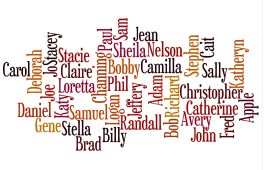
NameWordle“What’s in a name?
That which we call a rose
By any other name would smell as sweet.”

 I  respectfully disagree with Juliet. To me, a rose is a rose, is a rose, and I venture to say others feel the same. To call a rose by any another name would be nonsense.

We all have certain mindsets when it comes to names. For example, Billy Bob denotes an image far different than the name Randolph. Naming a child, Elizabeth Marie Kennedy Thornton (fictitious) makes us think privileged.

Names conjure memories both good and bad. Ever time I hear the name Gene I am once again in the 5th grade. Our brothers, sisters, or distance cousins all provide us a mental picture of a person. It’s from life experiences and the individuals that cross our paths in which we draw inspiration for naming the characters in our stories.

Important Points to Remember:

  • Match the name to the character’s personality. Channing is not likely to make readers think of a shy introvert.
  • Don’t get stuck on a letter. Sure it might be easier, but Carol, Cait, and Cami will make the readers head spin trying to tell the characters apart.
  • Assigning cute or unusual names is tricky. When done, the character’s personality must fit the name like a glove. The name, Apple, however, popular in Hollywood, is never going to make me think of anything other than a red delicious.
  • Tread carefully when naming a character based on someone you know. Get too close to the real thing and you might just have a family member on your back.

Helpful Resources for Naming Characters:

It isn’t always easy to come up with the right name, or one we think fits the character, but there are resources.

Naming characters can be fun or frustrating but don’t let it get in the way of telling your story. You can change names anytime, just write the story.

How do you choose the names of your characters?

I’d love to hear your comments. Talk to me. Tell me your story and look for me on Facebook at SheilaMGood,  PinterestBloglovinTwitter@sheilagood, and Contently.

Manuscript – Agent and Editors List

Day 13:  

Are you ready to find the perfect agent for your manuscript? Then you’ll want to check out the Manuscript Wishlist (MSWL).

With an impressive array of agents and editors, this site is all about helping you get your manuscript into the right hands. It couldn’t be any simpler.

MSWL is your go-to place for up to date:

1. Agent lists
2. Editor lists
3. Genre – name filters (parametric search)
4. Keyword Search
Is your manuscript ready for prime time? Looking for an editor or agent, check out MSWL.

I’d love to hear your comments. Talk to me. Tell me your story and look for me on Facebook at SheilaMGood,  PinterestBloglovinTwitter@sheilagood, and Contently.

Loglines – What DoThey Do for You?

Day 12:   

What in the world is a logline?  A one or two sentence description of what your story is about. Think of it like a five-second sales pitch.

What Does it Do for You? A well-written logline enables you to answer without any hesitation the question, What is your story about?

In addition, it helps you, the author, stay on track and spot problems within the story structure.

Essential elements of a logline:WritingLoglines

  1. The protagonist
  2. The end goal
  3. The stakes

These elements are critical to include, but be concise and use phrasing that creates interest and hooks the reader.

Here’s an  example from my current work in progress: (Be kind, I’m still toying with it)

When Bostonian Claire Nelson (protagonist) is called home after sixteen years to care for her estranged mother (goal), the secrets of her past reveal a darker betrayal (stakes) and she forced make a choice (goal).

Have you written your logline? To learn more check out: How and Why to Write a Logline for Your Story by Becca Puglisi

I’d love to hear your comments. Talk to me. Tell me your story and look for me on Facebook at SheilaMGood,  PinterestBloglovinTwitter@sheilagood, and Contently.