Dialogue Stories Worth Sharing

Time to ShareAnother from the files.

In keeping with the theme of dialogue (if you read my last post,  today’s  stories to share are the winners of the Annual Dialogue Story Contest offered by Bartleby Snopes. 

Unfortunately, Bartleby Snopes closed their doors (so to speak) in 2016. But, you can still find the winning stories and many others in their online edition, available here. Without further ado:  Here are the Winners of the Annual Dialogue Story Contest.

  1. The Boogeyman by Rebecca McDowell –  7th Year Winner
  2. Slurpie Safari by Sorrell Westbrook-Wilson – 6th Year Winner.
  3. Night Orderly by Ronald Freidman – 5th Year Winner.
  4. Open Me by Lee Snoops – 4th Year Winner.

Can you write an all dialogue story? Give it a try and share it, here in the Cow Pasture.

I’d love to hear your thoughts on the subject. Join the conversation. Talk to me or tell me your story. I’m all ears.

Tips for Writing Dialogue and Getting it Right

Courtesy of Script Magazine & Google

From the Cow Pasture Archieves: Enjoy

Writing dialogue is one of the most challenging skills for writers to learn. Conversations dominate our lives on a day-to-day basis, but we rarely, if ever, focus on the tone, rhythm, or body language when engaged.

I like to people watch. The mall or similar venues are great places to hone this skill. Observing other’s interactions offers a treasure trove of different gestures, tones,  words, body language, and action, to use in your stories.

Writing dialogue isn’t as easy as watching a conversation. In real life, we don’t have to worry about commas, speech tags, unclear antecedents, tone, or rhythm, or who is speaking. But, when writing, we must convey all of those aspects and more.

One of the stories in my upcoming short story collection is almost entirely dialogue. I have revisited that story a million times to ensure the conversation between the two men flow, sound natural, and is believable. That’s a rabbit hole best left for another discussion. Ultimately, readers will determine if I did my job well or not. For those of you who struggle, as I do, following are a few tips I’ve learned along the way and trust me, I’m not the expert.

 Writing Dialogue:

  1. Short sentences are best.
  2. Use contractions unless your story dictates a more formal language or it is a characteristic of one of your characters.
  3. Make it clear who is speaking.
  4. Don’t overuse the characters names.
  5. Keep dialogue tags simple as in: said, asked, replied, and answered. Using verbs like whispered, shouted, or stammered are permissible, but don’t over do it.
  6. Don’t forget body language which often speaks louder than words.
  7. Stay away from dialects unless you’re an expert in the dialect.
  8. Characters shouldn’t sound like duplicates of each other. We all have our own distinctive manner of speaking; characters should too.
  9. In real life, we often say, um, ah, or trail off in the middle of a sentence, but use sparingly, unless it’s reflective of a particular characters speech pattern.
  10. Make sure the conversation has a purpose. In real life, we talk about topics that would never keep a reader’s interest. For example using coffee grounds to fertilize the soil of house plants. Unless discussing coffee grounds is significant to the story – like say,  burying a murder instrument underneath the coffee grounds – I’d leave that conversation out of the story.

Speaking of observation, here is a look at one of my all time favorite scenes. Whoever wrote this dialogue, rich in words, body language, gestures, and action. It was magnificent. Enjoy.

Want more information on dialogue? Check out these resources:

I’d love to hear your thoughts on the subject. Join the conversation. Talk to me or tell me your story. I’m all ears.

For Every Action

newton-s-cradle-balls-sphere-action-60582.jpgIf you remember much from your school days (which is getting harder by the year for this fence jumper) you’re familiar with Newton’s Third Law of MotionFor every action, there is an equal and opposite reaction (a force when an object interacts with another interaction).

For example, if I throw a rubber ball against the wall in anger, the wall is gonna push back and one of several things will happen: 1) I’ll catch it; 2) I will miss it and it will crash into my antique lamp; or 3) it will fly back and sock me in the nose (the most likely scenario). That’s a silly example, but you get the drift. Now, think about writing and how this law relates to your characters and their dialogue.

Dwight V. Swain, author of Techniques of the Selling Writer discusses how to identify “the code of efficient prose, Motion-Reaction Units (MRU); and, in her post, Motivation-Reaction Units: Cracking the Code of Good Writing, K.M. Weiland breaks it down even further by providing excellent examples.

Simply put, something motivates your character to react. An action, deed, event, conversation, impulsiveness, or fear, to name a few. The possibilities of what that motivation is depends on your character, and your story. The list of motivations can be long, winding, and provide depth to your story. Whatever it is that motivates a  character to action, the reactions will help propel the story forward, introduce complications, the ante, and used to reveal.

A Few Things to Keep in Mind When Using MSU’s:

  1. Motivations, the actions and reactions must run in a logical manner.  They have to make sense to your reader. Introducing a  reaction before the cause or motivation sows confusion.
  2.  According to K.M. Weiland, MRU’s typically are divided into three parts: feelings/thoughts, action, and speech.
  3. Not all three of these elements are always necessary; well-written dialogue can reveal a lot about the characters reaction.
  4. Reaction doesn’t always mean a  physical reaction; sometimes, it’s mental or emotional. It should, however, be clear to the reader.

Using MRU’s is a tool which we can use to bring our scenes, characters, and dialogue to life, making them feel real and authentic to the reader. Check out K.M. Weiland’s post, Motivation-Reaction Units: Cracking the Code of Good Writing and tell me what you think. Do you use this technique or something different? Share it with the Fence Jumpers, we’d love to hear all about it.

I’d love to hear your comments. Talk to me. Tell me your story. I’m all ears and look for me on Facebook at SheilaMGood,  PinterestBloglovinTwitter@sheilamgood, Contently, and Instagram. You can follow my reviews on Amazon and Goodreads.

SaveSave

Want to Know How to Write Realistic Internal Dialogue?

images-29

Clipart

As a writer, we want our characters to come across as credible and believable. Internal thoughts are part of bringing our characters to life. So, what is the correct way to write  what characters are thinking?

Reasons to Use Internal Dialogue:

  1. To make  characters real to our readers.
  2. Show vulnerability – to help connect readers to the character.
  3. For dramatic effect – when you want to emphasize something important. Readers tend to remember emphasized moments.
  4. To show the character’s motivation.
images-33

Courtesy of Quick & Dirty Tips

Ways to Show Internal Dialogue

  1. Using the tag, “He thought.”   I wish Stephen would leave well enough alone, she thought.
  2. Italics:  Why can’t Stephen leave well enough alone?  Italics are  my favored method to show internal dialogue.
  3. Intermingling thoughts with narrative.  Claire stared out the window. Why couldn’t Stephen be happy with the status quo? She didn’t have a clue what answer she’d give him this weekend.
  4. Using quotations – for the most part,  is not recommended, even single quotations. Because quotations denote dialogue, it can confuse to the reader.

Do you find one method preferable over another? Why?

I’d love to hear your comments. Talk to me. Tell me your story. And as always, you can follow me on Facebook at SheilaMGood, Pinterest, Bloglovin,  Contently, and  Twitter @cofcmom.

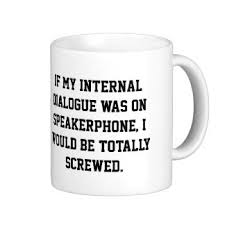
Coutresy of zazzle.com

Courtesy of zazzle.com

Want more on Formatting Internal Dialogue? Check out Grammar Girl’s, Quick and dirty Tips.com