Do You Have a Weak Plot?


Photo courtesy of Google & writeonsisters.com

Photo courtesy of Google & writeonsisters.com

I’m in the midst of trying to complete a rough draft of my novel, Hello Hell. Some 40,000 words in, I decided to change the timeline, which also requires additional changes to some of the characters and the setting. Don’t you just love the hairbrain ideas that come to us in the middle of the night? It is a daunting task already, but I’m also trying as I go, to examine the structure of my story.  David Villalva over at Story & Craft has a wonderful post out today discussing plot and high stakes. “A weak plot propels them to check out,” he says and offers an excellent and simple Stakes formula: If protagonist does not achieve the story goal, negative outcomes will occur.

Want more information and a free download of his Storytelling blueprint, check out David’s site.

Make Memories With a Safe and Happy July 4th

crossfitfairfax.com

crossfitfairfax.com

My500 Word challenge.

I’m taking a break this weekend, unplugging my computer and spending the next couple of days with my family and friends.

Holidays were meant for relaxation and making memories. So, to all of you, I send you wishes of a safe and happy 4th!. Close the laptops, remember all who fought and served to give us the freedom we celebrate.

See you back on Monday!


“Freedom has its life in the hearts,

The actions, the spirit of men-

And so, it must be daily earned and refreshed

Else, like a flower cut from its life-giving roots,

It will wither and die.”

     Dwight D Eisenhower

How to be an Effective Critique Partner

Critique_005I’ve been bogged down this weekend with family and community events. So, I’m sharing an oldie but goodie, with a few tweaks and additional information. Enjoy.

Critiques are a part of every writer’s life. Whether it’s a one on one partner, or a group providing feedback. Having another set of eyes on your stories, essays, or novels is essential for growth and success.

Accomplished writers already understand the value of a good critique partner. For newer writers or those who have yet to take part in a group, I’d like to share my critique cheat sheet. I hope you’ll find the information provided here helpful.

A Few Things to Remember:

  • The format and function may differ from group to group.
  • Know the rules before joining to ensure the commitment is one you are willing to make.
  • If you don’t know the group’s process, ask before your first meeting.
  • Don’t  rubber stamp each submission presented with, “I loved it,” without providing further constructive feedback. Doing so is unfair to the author. Those who submitted work want and deserve a genuine response and critique.
  • Critique groups are not about safeguarding a writer’s feelings. It’s about providing quality feedback.
  • If this is your first group, familiarize yourself with the terminology groups use. (genreprotagonist, antagonist, point of view (POV), voice, conflict, backstory, info dump, pacing, opening and resolution).

 My Cheat Sheet for the Short Story Critique and Things to Consider:

  1. Did you enjoy the story?  If not, why.
  2. Could you identify the story’s setting? Or, did you get lost in too much backstory?
  3. Did the story engage you and draw you in? Did you want to keep reading?
  4. What about the opening sentence or paragraph? Did they make you want to read further. If not, why? What made you hesitate?
  5. Was the protagonist clear to you? Did you understand the goals? Did you have enough information about the main character? Did you like the character or care about his/her situation (goals versus conflict).
  6. Were the stakes facing the protagonist, high enough to make you care?
  7. Did you find the dialog believable? Too much internal dialogue?
  8. Were you able to identify the genre?
  9. Did the story progress in a natural flow, or were there places that left you confused? Explain.
  10. Was there a resolution? Did the ending make you happy or, leave too many unanswered questions?
  11. Could you identify the theme?
  12. Explain the things that gave you pause. Make notes in the margins of the submitted piece indicating pertinent information. It could be a wrong word choice, sentence length, credibility, pacing, or something else.

Articulating your impressions provides the author with specific feedback. They can then decide to use or not use the information to strengthen their story. Sometimes, we’re too close to our work to see the flaws. Another set of eyes helps point out the weaknesses or holes in our story.

Good critique partners are an invaluable resource and asset to writers of all levels and I encourage you to find one in your area or online.

Want more information on critique partners and groups? Ryan Lantz gives excellent pointers, in his post, Critique Partners 101: Everything You Need to Know Before Pairing Up.

Interested in starting a group? Janice Hardy, from Fiction University, provides the lowdown on how to start a group, Are You Looking for a Critique Group or Partner?

Here’s to wonderful critique partners.

I’d love to hear your comments. Talk to me. Tell me your story. And as always, you can follow me on Facebook at SheilaMGood, PinterestBloglovin, Twitter @cofcmom, and Contently.

How to Be Your Own Health Care Advocate

images-3I know I missed day 8 was a bit under the weather; my bad.

Day 9

Day 9

Here is Day 9 of the My 500 Words Challenge! Our words carry weight. They can inspire and motivate others. Or they can teach us a thing or two. Today, use your words to educate others.

In my previous life I was a nurse. I can tell you the view from  the other side of that profession is a daunting and sometimes frustrating experience. Particularly with all the changes in the health care system. When I began my nursing career, a patient care decisions were between the patient and the doctor.

Visits lasted longer than ten minutes. The physician genuinely seemed concerned and was eager to answer questions. Wake up sick, an appointment was usually available. Now, you’re lucky if you can get in to see your family physician within  two months. Acutely, ill? The standard response is, “Go to the emergency room or your nearest urgent care center.” And, if you’re ill enough for hospital admission, it won’t be your physician who comes to see you or follow your care – nope it will be a Hospitalist!

Hospitalist may be very qualified, however, they are NOT,  my physician. They don’t know my history. Of course, they can pull my records up in the new electronic medical record system, but they don’t know me. I am more than the computerized template of information and checklist. Talk about loss of continuity of care!

I have an autoimmune disease with chronic complications. There was a time I could call one of my physicians and discuss my health. He/she respected my opinion and when I disagreed with the treatment plan, was willing to talk. That has become a thing of the past.

In order to maintain control over my own care, I developed a system. After all, this is the only body I’m gonna have and I deserve not only to be heard, but to make sure my physicians are up to date.

In addition, every frigging time I go for a follow-up, labs, or other outpatient procedure, I’m required to answer the same damn questions and fill out the same stupid forms.

List all physicians seen since your last visit.

List all medications and allergies

List history of surgeries

When was the last time you had a mammogram, colonoscopy, blah, blah, blah. 

I can’t remember what I did yesterday much less what I did last year, or longer. If you want to be informed and an active member of your healthcare team, I have a few recommendations.

  1. Always take another person with you, especially if you’re facing tests results, potential bad news, or have a chronic or complicated history.
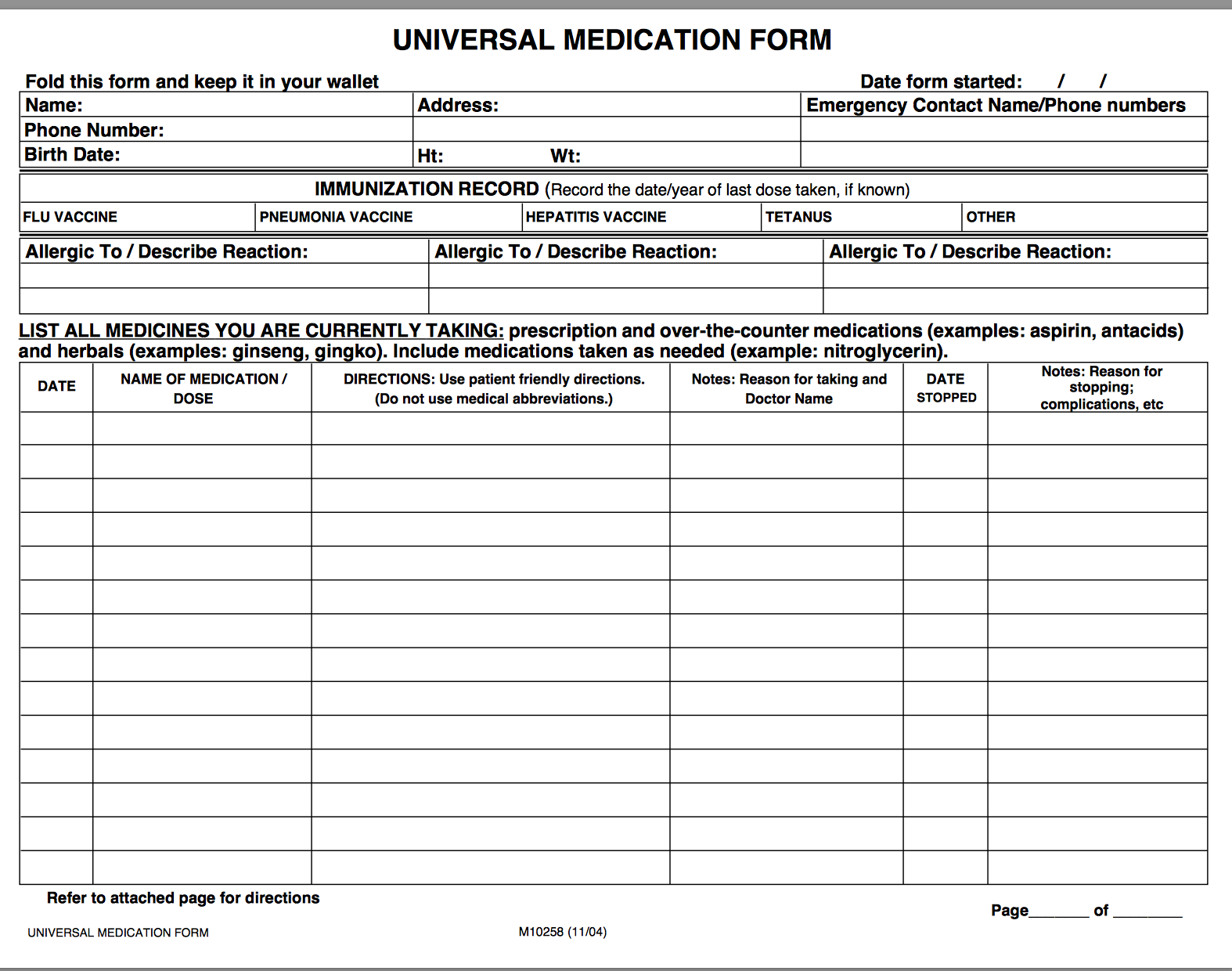
  2. Maintain a universal medication sheet with  immunizations, and allergies and carry a copy of it with you.
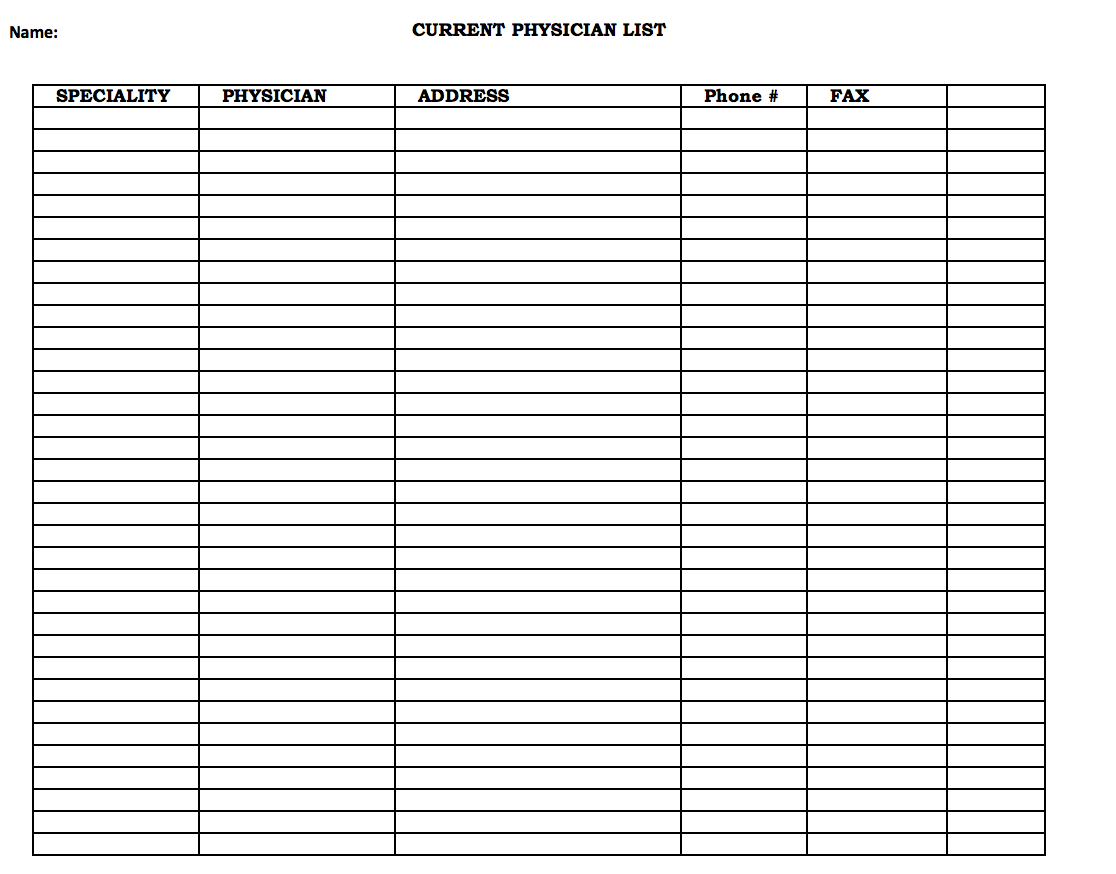
  3. Make a list of all physicians, include the practice name, address, phone number, and fax number.

    Screen Shot 2015-06-26 at 11.36.38 PM

    Universal Medication Form

  4. Keep a list of previous surgeries, hospital admissions, and the year.
  5. Keep a list of  significant outpatient procedures: mammogram, bone density, colonoscopy, and other preventive procedures.
  6. Request and keep a copy every test ordered for you; labs, x-rays, cat scan, MRI’s, etc. These are not routinely offered, but all you have to do is request a copy. I’ve provided easy to use forms, feel free to download. Here’s to health.
    Screen Shot 2015-06-26 at 11.26.49 PM

    CLICK TO DOWNLOAD

    Screen Shot 2015-06-26 at 11.19.54 PM

    CLICK TO DOWNLOAD

    I’d love to hear from you. Talk to me, tell me your story. And, as always, you can follow me on Facebook at SheilaMGood and  Twitter @cofcmom.