Are You a Free-Thinker? Maybe, Maybe Not

Day 11 of the My 500 Words Challenge! Write a letter or appeal, something that persuades your reader to join the cause, take sides with your movement, or simply try something new.”  
Phot courtesy of www.michellehenry.fr & Google

Photo courtesy of http://www.michellehenry.fr & Google

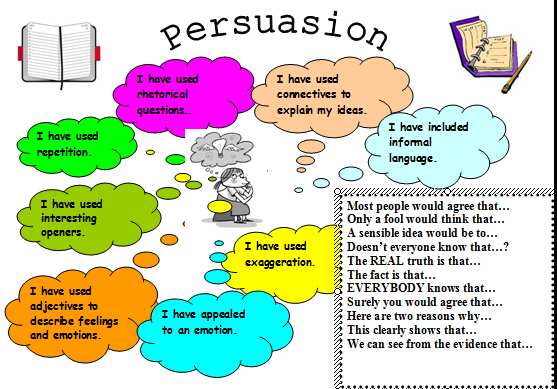
“Persuasion is human communication designed to influence the autonomous judgments and actions of others.

I hesitated to do this prompt because of the climate of disagreement prevalent in our society these days. I won’t go into the issues, we all know what they are, but to say there is division between opposing groups is an understatement. The biggest reason for that division is spin, influence, manipulation, or more accurately the art of persuasion.The media tell us there’s a consensus regarding these issues, but is that true?

So, for this challenge, I’m not going to try and persuade anyone about anything. In this red-hot societal climate, I’d be rowing upstream without a paddle. Instead, let’s talk about how we are persuaded.

Think you’re an independent thinker? Think again; with the massive presence of social media, we’re anything but free thinkers. Not yet persuaded? Consider the following studies. Not all persuasion is wrong, but being able to tell the difference between gentle persuasion and manipulation is important.

In his bookInfluence: The Psychology of Persuasion,Dr. Robert Cialdini’s Regents’ Professor Emeritus of Psychology and Marketing at Arizona State University, shares six basic psychological principles used for persuasion. I’m sure when you think about it, you’ll recognize these behaviors of influence.

1. Reciprocation – Trespond to (a gesture or action) by making a corresponding one. Example: Your co-workers surprise you with a gift for your birthday. When you receive a request to contribute a donation to buy a gift for another co-worker’s birthday, you reciprocate, even if you don’t care for the person. After all, she contributed to yours. You reciprocated with a donation, but you were persuaded  by a sense of obligation. I imagine you can think of other examples where this plays out day-to-day. We’ve all been invited to a friend’s Tupperware, jewelry, or a cookware party where everyone in attendance bought something. Were you the lone individual who didn’t buy an item? Doubtful. 

2. Scarcity – The state of being scarce or in short supply. You’ve heard the old saying, We always want what we can’t have. How many times have we read in the paper or an on-line news account of a store closing or product being discontinued? What happens next? The sales skyrocket because the product or service has become scarce.

3. Authority – The power or right to give orders, make decisions, and enforce obedience. A person with extensive or specialized knowledge about a subject; an expert.  The power to influence others, especially because of one’s commanding manner or one’s recognized knowledge about something. We routinely accept the word of a person or organization, we rarely question experts; think doctor.  We don’t go to see a dentist for a heart problem. Likewise, we seek out an attorney specializing in the particular type of law, we require; think divorce or criminal. Jurors listen, believe, and trust the testimony of “experts” when rendering their verdict. The media knows this and makes use of it on a daily basis. Think political campaigns. Information disseminated by the media, in most cases, is perceived as accurate, even when it proves otherwise.

4. Consistency – Conformity in the application of something, typically that which is necessary for the sake of logic, accuracy, or fairness. We hear, all the time, in discussions of parenting or pet training for that matter, consistency is the key. By nature, we humans like things which are consistent. For example, once we take a stand about something, we strive to maintain the same position when faced with similar situations or actions. It’s called the “Rule of consistency.”  In 1960’s, two psychologists,  Jonathan Freedman and Scott Fraser conducted a study on the “foot in the door technique.”  What the study found is people prefer to do things the same way every time. Simply put, being consistent makes life easier. If you donate to March  of Dimes, once; you will donate again.

5. Liking – A feeling of regard or fondness.  We like people who give us compliments,  are similar to us and are cooperative. To those individuals, we respect their opinions and tend to listen. Think co-workers, best friend, parents or a supportive spouse.

6. Consensus – General agreement. People look to others to determine how they should behave. The best examples to date include our latest societal issues, which I don’t intend to discuss in this post, perhaps another day.  When you understand the principles most often used in persuasion, know which buttons to push, which angles to play, and  appreciate the power of words, persuasion is easy. Everyone uses these principles whether it’s a conscious decision as with journalist or unconscious because we want what we want. The difference lies in our knowledge base, value and our aim.

The use of persuasion is not all bad; sometimes it’s helpful, but make no mistake, it’s also manipulative. So, the next time you espouse being a free-thinker, take a second look. Pay attention to who’s doing the persuading, what principles they’re are using and their end game. When you get the feeling, ” I’m being manipulated,” chances are, you’re correct.

I’d love to hear your comments. Talk to me. Tell me your story. And as always, you can follow me on Facebook at SheilaMGood and  Twitter @cofcmom.

Day 11

Day 11

Why Do You Write?

Day 10

Day 10

Day 10 of the My 500 Words Challenge! Write about writing. What do you love about the craft? What do you hate? What are you struggling with, when it comes to this challenge?

If you read my post from Day 5, Cow Pasture Chronicles, My Oasis, you already know when I began putting pen to paper. As a young it was more about finding my voice in a crowed and loud home. When you’re surrounded by so many others, a listening  and understanding ear is hard to find. Writing became an escape and gave me the satisfaction that someone was listening, even if they were the four-legged kind.

When I began college, an English Professor, Nancy Moore thought my writing was exceptional and encouraged me to major in English. Of course with her high praise, she became a favorite of mine. I’m amazed I remember her name. An English major lasted a year before I changed it to Nursing, but my love of writing and words continued to grow. My mother planted that seed a long time ago with her love of books; reading was a family affair.

Which brings me to why I love the craft. It’s the stories, plain and simple. To me there is nothing so intriguing and exciting as a story which transports you to the page. Or, as I did the other day at the gym, exclaim out loud, “OMG.” In case you’re curious,  I’m reading  Stephen King’s, A Good Marriage. It’s the stories of our lives, the people, places, things, and events we experience along the way that give us our stories.  Writing, like no other craft, sets the imagination free with no boundaries. Okay, maybe a few.

Which brings me to what I hate about the craft. Rules and competition top my list. The rules of grammar are stifling sometimes. I know, many of you will throw your hands to your chest in shock, “You must follow the rules. By the way, watch out for weak words and passive sentences. Show, don’t tell. Make your opening sentence, paragraph dynamite. Check pacing and sentence length, and without conflict and rising stakes, and without the proper structure, it won’t work.

Now, before y’all (southern slang) started scolding me in print, let me say, “I understand the need for rules, some of them, but when your focus becomes micromanaging every sentence, you lose the ability to let the story flow. Instead, it can feel like labor, a long,  arduous labor.

I’ve always believed competition  a good thing; regardless of the enterprise or the craft. But, with a zillion people on the internet and probably as many blogs, being heard becomes a game of chance as much as skill. A chance that a blog post will go viral, the right person with the right connections likes what she read and passes you on to others. Contests are a whole other type of competition. With thousands of entries, getting your story to stand out, becomes like a needle in a haystack. Yeah, yeah, I hear you – “If the story is good enough, it’ll stand out. Maybe, hopefully, or perhaps, the screening reader doesn’t like your genre, or plot line. Not that it wasn’t well written, but that kind of story ain’t her cup of tea.” Submitting work is challenging,  time-consuming, and the rewards, few and far between.

What am I struggling with, related to this challenge? Time, plain and simple. I’m somewhat of a perfectionist and I didn’t like missing Day 8, but the one thing I’ve learned  since I began writing (and it’s difficult), is to recognize when I need a break, to stop pushing, and take time to relax, and let my mind wander the fields of words and imagination.

Thanks Jeff, for the challenge and todays prompt.

Tell me what you think. Tell me your story. I’d love to hear from you. And as always, you can follow me on Facebook at SheilaMGood and  Twitter @cofcmom.

How to Be Your Own Health Care Advocate

images-3I know I missed day 8 was a bit under the weather; my bad.

Day 9

Day 9

Here is Day 9 of the My 500 Words Challenge! Our words carry weight. They can inspire and motivate others. Or they can teach us a thing or two. Today, use your words to educate others.

In my previous life I was a nurse. I can tell you the view from  the other side of that profession is a daunting and sometimes frustrating experience. Particularly with all the changes in the health care system. When I began my nursing career, a patient care decisions were between the patient and the doctor.

Visits lasted longer than ten minutes. The physician genuinely seemed concerned and was eager to answer questions. Wake up sick, an appointment was usually available. Now, you’re lucky if you can get in to see your family physician within  two months. Acutely, ill? The standard response is, “Go to the emergency room or your nearest urgent care center.” And, if you’re ill enough for hospital admission, it won’t be your physician who comes to see you or follow your care – nope it will be a Hospitalist!

Hospitalist may be very qualified, however, they are NOT,  my physician. They don’t know my history. Of course, they can pull my records up in the new electronic medical record system, but they don’t know me. I am more than the computerized template of information and checklist. Talk about loss of continuity of care!

I have an autoimmune disease with chronic complications. There was a time I could call one of my physicians and discuss my health. He/she respected my opinion and when I disagreed with the treatment plan, was willing to talk. That has become a thing of the past.

In order to maintain control over my own care, I developed a system. After all, this is the only body I’m gonna have and I deserve not only to be heard, but to make sure my physicians are up to date.

In addition, every frigging time I go for a follow-up, labs, or other outpatient procedure, I’m required to answer the same damn questions and fill out the same stupid forms.

List all physicians seen since your last visit.

List all medications and allergies

List history of surgeries

When was the last time you had a mammogram, colonoscopy, blah, blah, blah. 

I can’t remember what I did yesterday much less what I did last year, or longer. If you want to be informed and an active member of your healthcare team, I have a few recommendations.

  1. Always take another person with you, especially if you’re facing tests results, potential bad news, or have a chronic or complicated history.
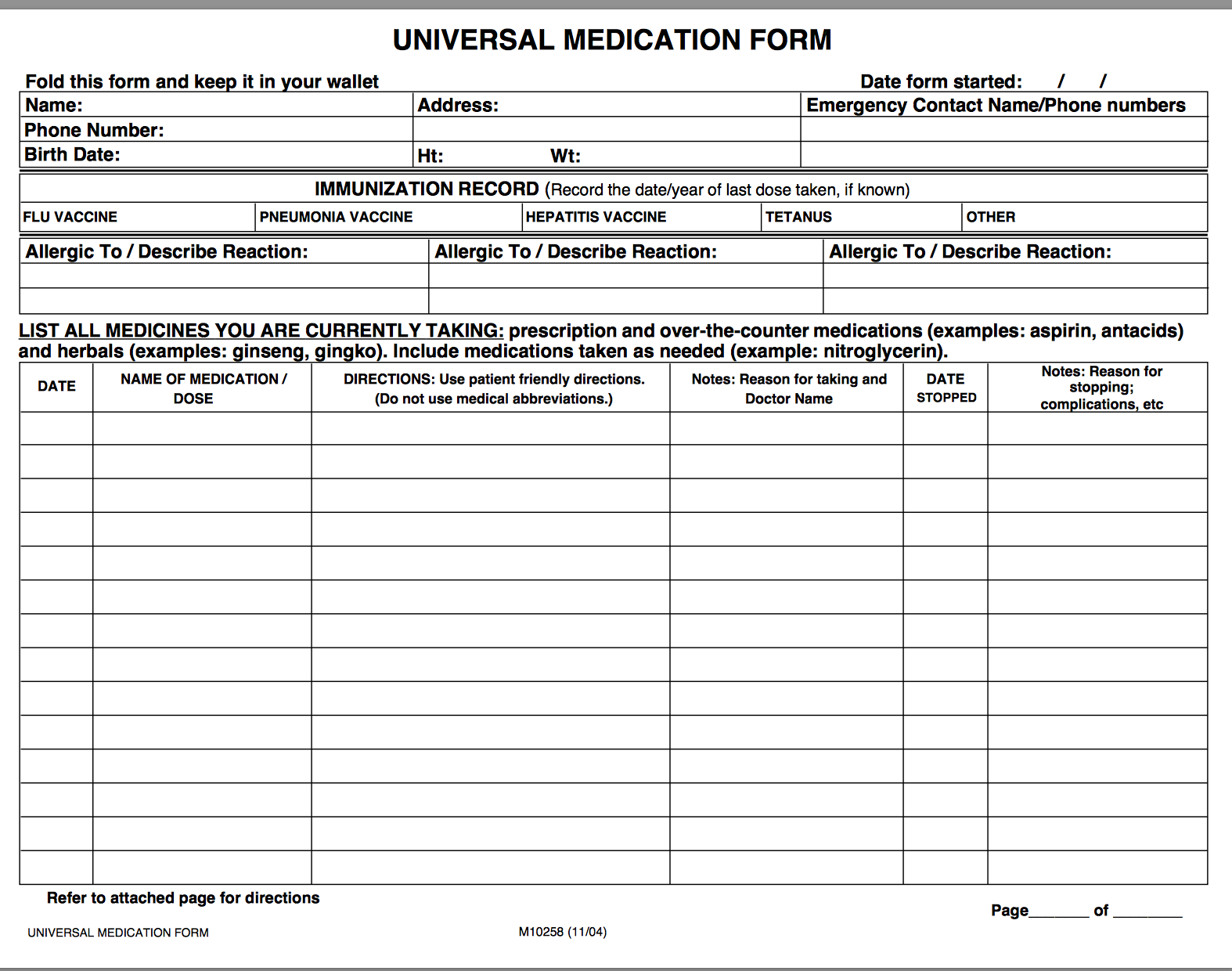
  2. Maintain a universal medication sheet with  immunizations, and allergies and carry a copy of it with you.
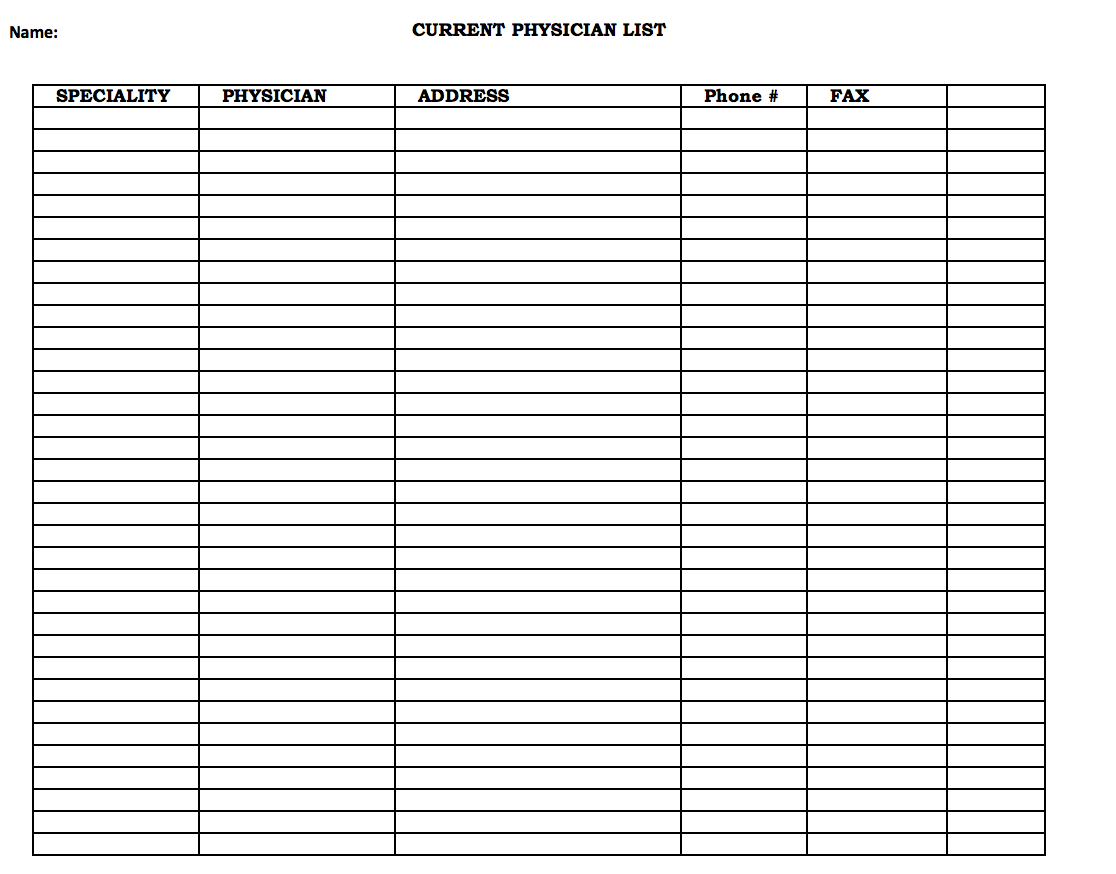
  3. Make a list of all physicians, include the practice name, address, phone number, and fax number.

    Screen Shot 2015-06-26 at 11.36.38 PM

    Universal Medication Form

  4. Keep a list of previous surgeries, hospital admissions, and the year.
  5. Keep a list of  significant outpatient procedures: mammogram, bone density, colonoscopy, and other preventive procedures.
  6. Request and keep a copy every test ordered for you; labs, x-rays, cat scan, MRI’s, etc. These are not routinely offered, but all you have to do is request a copy. I’ve provided easy to use forms, feel free to download. Here’s to health.
    Screen Shot 2015-06-26 at 11.26.49 PM

    CLICK TO DOWNLOAD

    Screen Shot 2015-06-26 at 11.19.54 PM

    CLICK TO DOWNLOAD

    I’d love to hear from you. Talk to me, tell me your story. And, as always, you can follow me on Facebook at SheilaMGood and  Twitter @cofcmom.

Tsunami of Silence – Aftershocks

Five Sentence Fiction – Waves

“It’s always the squeaky wheel that gets noticed.”

“Jesus, be quiet. Someone might overhear us.”

“So? I have the right to voice an opinion, just like the next person.”

“Not anymore; I don’t like it either, but I ain’t gonna make waves.”

“Yeah, I can see that; I just hope you can swim.”