Top 5 Resources for Contests and Submissions

CUSTOM STATIONARY-2

In my last post, I mentioned how important submitting  work on a regular basis is to writers. So, it’s only fair I share with you some of my favorite resources for the most up-to-date lists..

 My top 5 sites:

1) Duotrope: No longer free, this service now requires a paid membership. A 30-day free trial is available; after that, the cost is $5/month.

  1. The database lists thousands of markets tailored to your work and/or genre; including, fiction, non-fiction, or poetry.
  2. They offer a plethora of data on every site regarding, acceptance rates, turn around time, payment, unknown to extremely challenging markets, and other statistics.
  3. Provide a calendar of upcoming themed contests.
  4. And, track of all your submissions.

2) Every Writer’s Resource:

  1. On the home page, you will find listings for all types of literary magazines.
  2. Magazine profiles include the year founded, preferred genre,  guidelines, response time, paid or non-paying market, and names of editors.
  3. For quick reference, check out the current and updated list in the sidebar.
  4. You can search by name, category, theme, call for submissions, or print.

3) Flash Fiction Chronicles:

  1. Markets are listed according to word count restrictions;  from as little as 50-100 words  to 1500.
  2. Provides a brief summary of the magazine with links to view current issues, site guidelines and read editor interviews; one of the most informative aspects offered.
  3. Under the Resources tab, you can find additional contests list.

4) New Pages

  1. Your guide to news, literary magazines, agents, and contests.
  2. Call for submissions include, fiction, non-fiction, essay, poetry, and art.
  3. Additional resources for writers is also available.

5)  Funds for Writers

  1. Holly Clark provides a list of contests and freelance markets in every mewsletter.
  2. Information includes deadlines, the cost to enter, paid or non-paid markets, and a synopsis of the competition.
  3.  All contests listed have been researched for credibility.

images-12

Photo courtesy of google and http://www.southwestwriters.com

I hope you will explore these sites, make a list and begin submitting. I’d love to hear what you think, and about your successes. So, drop me a line.

Happy writing and good luck on your submissions.

Submit or Not to Submit

Photo courtesy of google & groggrog.blogspot.com

In the last several days, three friends have recommended writing contests to me. Intrigued I began the process of reviewing  each site,  contests details, and the guidelines. Hour’s later after reading back issues and making a list of deadlines, I’m exhausted. Submitting is hard and time-consuming work.

But life has taught me, the best things come with hard work and perseverance.

Even if your story or essay isn’t accepted, submitting on a regular basis, provides advantages.

What’s in it for you?

  1. Themed contests are like prompts, spurring imagination and the desire to write.
  2. Deadlines help you prioritize time.
  3.  Reading the works of others, introduce you to other writers and genres.
  4.  Many magazines offer feedback and/or a written critique from the judges (a favorite perk of mine.) Who wouldn’t want to receive information which will improve your skill as a writer and likewise, increase your chance of acceptance?
  5.  Practice makes perfect. You gain experience and knowledge with every submission and in the end, you might achieve your goal.
  6.  Provides a venue for others to discover your work.

As you well know, if you follow Duotrope, statistics on acceptance rates for many are dismal. However, when you receive that acceptance letter or email, it’s magic and well worth the time and effort.

A note of Caution When Submitting:

  1. Read and follow the guidelines. A lack of compliance is a frequent complaint from many editors.
  2. Check and double-check spelling and grammar. Read aloud, listen to it on your Kindle, or ask a respected friend for feedback.
  3. Stay within the designated word count. Sounds easy enough, however, sometimes the title counts, sometimes it doesn’t. Knowing which will determine whether your story lands in the consideration or rejection pile.
  4.  Know the basics of the contest. Is there a theme, particular genre, or is the contest open?
  5.  Know whether it’s a blind submission or requires author identification.
  6.  Format according to submission guidelines. The guidelines differ for each magazine or contest.
images-2

Photo courtesy of google & http://www.smartfitbykatemartin.com

So, take the leap. Review the Call for Submissions in the sidebar; check out Duotrope,  Every Writer’s Resource, and The Write Life for their list of current contests.

Remember, no risk, no gain.

Happy writing, submitting, and best of luck!

Ten Things to Make Your Critique Group a Success

I apologize for being absent lately. Sometimes we have to make choices and prioritize to address more pressing matters.  Thank you for being patient.
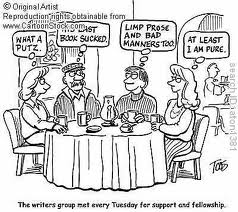
Two articles came to my attention this week on writing and critique groups. Guide to Literary Agents, Chuck Sambuchino, in his article, discusses The Top Ten Worst Types of Critique Partners.  Included among the attendees one might encounter were: The Snob, The Time Hog, The Retro, The Distractor, The Harsh Critic/The NiceyPiecey, The Debater, The Picker, The Sulker, The Boss, and The Sporadic.
images-8
Elmowrites describes in Critique and Critics, the attendees to her first group with slightly different names. The Fan, The Ogre, The Stuck Record, The Feeler, The Mechanic, and The Holy Grail. You get the gist.

Having belonged to a critique group for the last couple of years, the titles intrigued me. The “type casting” of members, however, left me wrinkling my brow. I won’t rehash the definitions here; you can read them for yourself. Whether it was one of the above personalities or group dynamics, the experience left a less than stellar impression on the authors. Still, in the end, both acknowledged the importance of feedback and encouraged writers to keep looking for a writing or critique group. Reading these articles made me wonder, was this the group experience of most people? It hasn’t been my mine.

I belong to a wonderful writer’s group, the South Carolina Writer’s Workshop (SCWW). We’re diverse in our experience, opinions, and genres. I imagine there are things in areas other than writing we might not see eye-to-eye on; I wouldn’t know and I don’t ask. We discuss writing. We focus on genuine critiques, helping each other improve, and get published. We promote each other’s blogs, author pages, websites, and publications.   We’re writers supporting writers.

So, here’s what I say: You can have a good group experience, but you have to participate. You can’t just be an observer. Here are my ten suggestions for a successful group experience.

  1. Find a group, or start one of your own. Growth comes faster with feedback.
  2. The group should have a designated leader who can moderate a meeting.
  3. Make the focus on writing, not people.
  4. Be prepared. Members are less disruptive if they’re prepared and know what to expect before the meeting. We find sending work in prior to the meeting an effective method.
  5. Don’t confuse social activities with the group meeting. The focus gets lost in the gossip.
  6. When difficult members do surface, let the leader or group moderator handle the situation one-on-one. 
  7. Don’t take it personally.  
  8. Be respectful of each other’s, work, time, and the group.
  9. Take time to familiarize yourself with group etiquette. If your group has guidelines, honor them.
  10. Know your own voice. It’s your story.

Ultimately, you are responsible for your writing and any experience you may or may not have. All critique groups are not the same, don’t give up the first time. It takes time to get to know people and the dynamics of a group. Instead, stick around, learn to listen, and speak up. You might just find yourself a group.

 Leave me a comment. Let me know about your group experience.

 Related articles