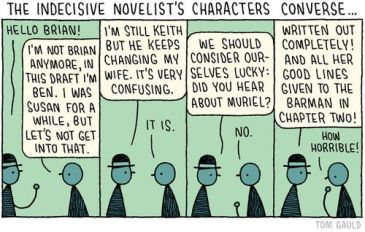
Who’s on First? Confusing POV

Day 3

Day 3

Have you ever read a book where you lost who was telling the story? Ever had to flip backwards to determine the speaker? If you have, chances are the author was using more than one point of view (POV).

One of the most important aspects of planning is determining the point of view. Who do you want to tell the story and from what viewpoint. There are three basic viewpoints: First person, second person and third person. They’re variations within each; however, I’m only going to touch on the basic POVs.

First person or the “I” view brings the reader close to the action, making them  experience the story along with the character. The following Examples are adapted from one of my stories, Fair is Fair.

“I  took my time setting the tray of coffee on the table in the living room. Let him wait. He, along with every reporter in the country had vied for this interview for years. He would wait in the cold for as long as it took, of that I was certain.”

The downside is it’s easy to slip into a mode of “telling versus “showing,” or being too wordy or passive.

Second person POV is told through the voice of a narrator using “you, yours, and you’re.” Although, frequently used in self-help books, second person POV is not often used in fiction writing. Example:

“You don’t the truth. You want me to tell the story the way you think it should be told. You want me to sugar coat the facts so that it doesn’t offend your precious audience’s sensibilities. You get the story my way or not at all.”

The downside is it’s hard to write in second person and do it well without sounding like a self-help book, or sitting in a lecture hall.

Third person POV is told through the narrator’s voice using, “he,” “she,” or “it.”  It is the most common POV used in fiction.

“She grew up in a Christian home, believing in forgiveness and the  goodness of man. She didn’t believe in capital punishment. Judgment was reserved for God, but that was before. Now, all she could think about was how fast the executioner’s hand would fall.”

The downside of using third person POV is the narrator telling things of which they couldn’t possibly know. Unless it is third person omniscient, the narrator can only see what happens from a single character’s view.

Determining the POV in which to tell your story is important because, as in life, each POV offers a different perspective. Nothing is more frustrating or confusing to a reader than a sudden switch between POV. It jars the reader from the story and creates distance to the main character. If the reader can’t follow, he won’t care about your main character and when they stop caring, they stop reading.

A few times, I’ve found myself turning the pages backward in a book to figure out which character viewpoint I’m reading. It’s frustrating, confusing and reminds me of the famous skit, Who’s on First by  Abbott and Costello.

For a detailed description of POV, check out Janice Hardy’s Fiction University. Her post, Through My Eyes. Or Your Eyes. OR Somebody Eyes. POV Basics, defines each type, and discusses in detail the advantages and disadvantages of each. Also, Marg Gilks at Writers World, has an excellent post, Establishing the Right POV,  using her own early work as an example.

Writing in different POVs is acceptable; however, the key is to have a clear delineation between the changing POVs. This can be accomplished via white space, a new scene, or chapter to indicate the change. Whatever method you use, be consistent and you’ll never end up with the reader asking, Who’s on first?

What about you? Which POV do you use and why? Talk to me. Tell me your story. I’d love to read your comments. You can follow me on Facebook at SheilaMGood and  Twitter @cofcmom.

Put Discipline into Your Daily Writing Schedule

As many of you know, if you read my post, Are Squirrels Interfering With Your Writing Routine?  It is difficult for me to stick to a daily writing schedule. I won’t rehash the reasons (you can see some of them in the post). Suffice it to say, some days I’m disciplined, other days I’m like a thirteen year old girl with her mind on everything but her homework. And don’t get me started on how a retired husband fits into the equation.

So, in an attempt to become more disciplined and inspired by my sister, Jean Cogdell @jeans writing, I’ve decided to participate in Jeff Goins 500 Words 31Day Challenge. The challenge started yesterday and I wrote a  story, Maggie’s New Beginning (Check it out) the (terribleminds)  Flash Fiction Challenge (Chuck Wendig).

Day 2

I’m announcing so you and the other participants can help keep me honest and on track. Feel free to give me a nudge. The fun part of this challenge is there’s no theme. The purpose is to help you become disciplined to write at least 500 words a day. Some days, I will share writing tips and resources. Other days, I’ll share excerpts from my work in progress or a flash fiction piece.

For those interested in participating, here are the rules:

  • Write 500 words per day, every day for 31 days.
  • You can write more if you want, but 500 words is the minimum.
  • Don’t edit. Just write.
  • If you miss a day, pick up where you left off. Don’t make up for lost days.
  • Encourage, don’t criticize (unless explicitly invited to do so).
  • Blogging counts, but email does not.
  • All of this is completely free.

I gotta say, the “don’t edit” rule kinda makes me nervous. So expect to see an errant comma or two (I’m a bit of a comma whore) or a few passive sentences.  I’m also a was whore as I tend to write as I talk; although, those who know me would never call me passive (ask them). Whatever I share I hope you will  be kind in your comments and please do comment. I love feedback, even when it hurts.

How to be Successful in keeping a Daily Schedule

1. Set your alarm and get up an hour earlier. If you’re like me, you won’t need an alarm clock. I’m up every day before 6 am.

2. Set aside uninterrupted time to write. For me, that’s those early morning hours. Once my husband’s feet hit the floor, all bets are off. Which brings me to the next suggestion.

3. Tell your family (retired husbands included) the time frame you are not to be disturbed. If a large chunk of time is too difficult, set aside increments of time. For some, you may need to place a do not disturb sign on your door, send your kids to Grandmas or locking them out of the house (make sure they have plenty of water, it’s hot as Hades). As for the husband, can’t help you too much, keeping mine occupied is all I can handle.

4. Plan for the next day.

5. Spend at least a portion of your time brainstorming for topics.

I’ll leave you with this quote of inspiration:

“If you only write when inspired, you may be a fairly decent poet, but you’ll never be a novelist.” Neil Gaiman

Do you have a daily writing schedule? How do you do it? I’d love to hear from you. You can follow me on Facebook at SheilaMGood and  Twitter @cofcmom

images-10

Maggie’s New Beginning

FLASH FICTION CHALLENGE: THE DEAD BODY (Dead bodies: they do a story good.)

Maggie’s New Beginning

“I’ll be God damned.” Maggie’s head fell against the pillow; her chest burned from the effort of pounding her fists on the sweaty mass pinning her in place. “Dammit, dammit, dammit.” She’d heard of dead weight, but this was ridiculous. What the hell was she thinking bedding his fat ass? Thanks to him, her dream of wallowing in a bed full of money had disappeared with a grunt and a snort. She squirmed underneath the weight of his bulk and struggled to breathe as the cold stones dug into her neck.

His arm fell off the side of the bed giving her a glance of the room and a teasing chance to breathe. She maneuvered a leg free, dug her heel into the side of the mattress, and pulled. The muscles in her calf screamed as she tucked her head under his flaccid arm, clawing for the edge of the bed until her whole body shook. The pungent odor of his armpit struck her across the face like a brick and she fell back gasping for air. “Jesus Fred, ever heard of deodorant? “

*

He handed the maid a wad of bills when they arrived and told her to take the rest of the week off with her family. Juanita would be in for a hell of a surprise come Monday. Everybody would gawk and whisper. Anger turned to horror as Maggie realized she’d be the subject of jeers, rumors, and half-truths. How the hell did she end up here?

*

Fred came into the jewelry store, where she worked, looking for an anniversary gift for his wife. Maggie noticed the Armani suit and Rolex watch and nudged her co-worker out of the way, “I’ll take this one, “she said, giving him her most winning smile. Round and soft, he looked like just the ticket to offer her a way out, way up and a new beginning. An hour later, he walked out of the store with a $10,000 diamond necklace for his wife and a hankering for her.

At the time, Maggie didn’t worry about the wife or what Armani was hiding. All she saw were dollar signs and a new future. She played hard reeling him in like a flopping fish on a taut line. Her commission check grew with each visit and she wondered if the shower of glittering gifts surprised his wife, Nicole. He’d dropped her name on his third trip to the store. It had taken two months before Maggie discovered Fred gave his wife and a friend a trip to Europe for their anniversary and saved the jewels for her.

*

Last night, when Fred slipped the necklace around her neck, she lost all reason. “You’ll get the others later,” he said, nibbling her ear. She let his hands roam. As her dress slipped to the floor, she closed her eyes and imagined the body pressing into hers belonged to Brad Pitt. Visions of fur coats, diamonds, and exotic trips filled her mind. Ribboned boxes taunted her from across the room, where they sat unopened on his wife’s dressing table. Her mom always said, “You can do anything for a short time if the payoff’s worth it.”

It became Maggie’s motto. But, when he crawled on top of her with his fat, soft body, sweating like a pig, she almost balked. Instead, she fantasized about Brad, the Caribbean Islands and waited for it to be over. She figured it wouldn’t take long and it didn’t. The loud grunt, and stiffing of his body brought her back to reality. A swoosh of alcohol-laced breath escaped from him like air from a balloon and he collapsed pinning her to the bed. A deadly silence descended. Maggie waited for him to say something or move. “Fred?” She lay still and listened. “Fred?” Easing her hand to the side of his neck, she felt for a pulse. “God dammit, Fred!”

She pushed, punched, and cursed to no avail. The sweat from their naked bodies turned to super glue and slowly, the realization of her fate dawned on Maggie. She wasn’t going anywhere. By the time the maid found them, she’d be nothing more than an afterthought, a greasy spot underneath some rich, hairy ass, cheating bastard.

Not exactly, the new beginning she had in mind.

Day 1

Character Building Tools Every Writer Needs

Stories are about people. It is the characters we fall in love with, root for, or sometimes dislike. We notice their quirks, sense of humor, and mannerisms. We relate to their failures, triumphs, and dastardly deeds. But, it is the characters that keep us turning the pages.

f6236cbf75c0073d0c8e72f5a7d5a58f

How we develop characters  differ from writer to writer, but we all start with a vision, even if it’s sketchy.

Some characters, we envision before our pens strike the paper, others appear as the plot thickens. However, developing a character outline or sketch as part of your planning process will not only keep the flow of words moving forward, but provide well-rounded characters that keep readers engaged.

When I began writing fiction, I scoffed at the notion that a character, you hadn’t planned could walk onto the page, until it happened to me. An Irish American man named Richard Donovan stepped on the plane and took a seat next to my main character. Without taking my fingers from the keyboard, I  understood the relationship he’d have with my main character and where he fit within the plot line of my story.

I still had work to do on Mr. Donovan if I wanted him to be anything other than a fly by night (no pun intended) aberration.

Characters are not just a name in a story. They represent a person we want our readers to understand, and relate to. Fully developed characters take thought and planning. We need to know what makes them tick if we have any hope of knowing how they will react or behave in the circumstances of our story.

Whether you clip photos from magazines, keep index cards or a notebook, developing a character is more than physical description. So, I thought I’d share my favorite tools for building and developing characters.

Resources:

Building Believable Characters

buy4._V192207739_

Angela Ackerman has a wonderful post today, 3 Quick Tips to Help Readers Connect to Your Hero. In addition, Angela and Becca Puglisi have written two books specifically designed to help you define your characters.  Check out their  Writers Helping Writers bookstore for complete details.

buy4._V192207739_

 Matt Heron from The Write Practice explains in detail, Scrivener and with a free 30 day offer, now may be the time to give it a try.


What method, tool,  or resources do you use when developing your characters? Tell me what works or doesn’t work for you. I love hearing from you. Talk to me and tell me your story.