A Review – Story Engineering by Larry Brooks

I can’t tell you how many people have recommended this book to me and for good reason. A panster at heart, I found my story floundering and myself stuck around the 40,000-word mark.

Already an ardent follower of Larry Brooks blog,  Storyfix, I downloaded Story Engineering and dug in. This book is by far one of the most comprehensive books on story structure I’ve read to date.

Full of helpful how-to’s and thorough examples, Larry teaches you how to structure and outline a story before you write the first word. From the six core competencies, necessary for every story,  a list of detailed questions, and clear examples from popular movies and books, Larry takes you through the process for writing a successful and publishable novel.

This book is one of those every writer needs in their library collection. It is one you will refer to again and again.

I’d love to hear your comments. Talk to me. Tell me your story. And as always, you can follow me on Facebook at SheilaMGood, PinterestBloglovin, Twitter @cofcmom, and Contently.

10 Ways to Improve Your Online Connections

Untitled designMy 100-word story, Connections, posted on the 10th  seemed to resonate with many of my readers. I’m glad it did because it got me to thinking.

In this fast-paced world where nearly everyone talks in short bursts via text or Twitter, are we really connecting with each other or just going through the motions?

Connection Defined: 

In the online world, these definitions take on a whole new meaning.

  • A relationship in which a person, thing, or idea is linked or associated with something else. Think social media or blogging.
  •  The action of linking one thing with another.  Hyperlinks and Pingbacks come to mind.
  • People with whom one has social or professional contact or to whom one is related, especially those with influence and able to offer one help. Perhaps, online writing groups, Facebook, or LinkedIn.

Twitter is an excellent example.  For a moment, me and the person on the other end, connect via 140 characters or less. Within minutes, it becomes a tidal way of tweets, retweets, mentions, and favors. But, how much do you really know about each individual behind those tweets? Do you take the time to visit each link? Or, do you skim over them, making notes to revisit later?

Blogs are different, at least for me. The pace is slower and more purposeful. Readers who comment  provide specific feedback leading to further interaction and, hopefully, a genuine and lasting connection. I love hearing from my readers, venturing over to their blogs, putting a face to the name, and  finding our common threads.

No matter how fast-paced our lives get, we all crave person-to-person contact. So, with all the social media how do we improve those connections?

10 Ways to Improve Online Connections
  1. Don’t make the conversation one-sided. See something you like? Interact, even if it’s in 140 characters or less.
  2. Listen to what is shared and respond accordingly.
  3. Explore common interests and topics.
  4. Make sure your content contributes to the conversation.
  5. Search for Twitter chats or blogs relevant to your interest.
  6. Make it personal when you comment or tweet.
  7. Be selective. Don’t follow for the sake of following – look for common interest that brings you together.
  8. Make sure what you’re sharing is relevant and thought provoking.
  9. When  content resonates with you, share it.
  10. Don’t turn your online presence into a numbers game. It’s about connecting with people, not the number of followers.

So, what about you? Are you really connected?

I’d love to hear your comments. Talk to me. Tell me your story. And as always, you can follow me on Facebook at SheilaMGood, PinterestBloglovin, Twitter @cofcmom, and Contently.


Connections

                                     PHOTO PROMPT – © Jennifer Pendergast

Brandon ran his hand over the notched edges running the length of the canoe. Smooth to the touch; his dad’s words came back to him, “Connection is everything.”

He swallowed the lump in his throat at the memories spent in the old barn. The way his dad’s steady hands labored in love, cutting with precision, and sanding to perfection.

They spent hours dreaming of their maiden voyage. But, God had a different voyage in mind.

He rubbed the years of dust and cobwebs away and moved the canoe to the water’s edge. As his paddle touched the water, a gentle breeze brushed his face, and he’d never felt more connected.

In response to Friday Fictioneers Photo Prompt

I’d love to hear your comments. Let’s have a conversation. Talk to me. Tell me your story. And as always, you can follow me on Facebook at SheilaMGood, PinterestBloglovinTwitter@sheilagood, and Contently.

How to be an Effective Critique Partner

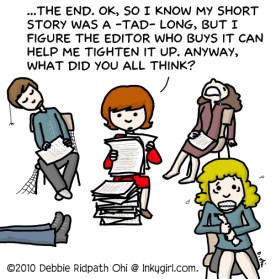
Critique_005I’ve been bogged down this weekend with family and community events. So, I’m sharing an oldie  but a goodie (1st published 2013), but with a few tweaks and additional information. Enjoy.

Critiques are a part of every writer‘s life. Whether it’s a one on one partner, or a group providing feedback. Having another set of eyes on your stories, essays, or novels is essential for growth and success.

Accomplished writers already understand the value of a good critique partner. For newer writers or those who have yet to take part in a group, I’d like to share my critique cheat sheet. I hope you’ll find the information provided here helpful.

A Few Things to Remember:

  1. The format and function may differ from group to group.
    Know the rules before joining to ensure the commitment is one you are willing to make.
  2. If you don’t know the group’s process, ask before your first meeting.
  3. Don’t rubber stamp each submission presented with, “I loved it,” without providing further constructive feedback. Doing so is unfair to the author. Those who submitted work want and deserve a genuine response and critique.
  4. Critique groups are not about safeguarding a writer’s feelings. It’s about providing quality feedback.
  5. If this is your first group, familiarize yourself with the terminology groups use. (genre, protagonist, antagonist, point of view (POV), voice, conflict, backstory, info dump, pacing, opening and resolution).

My Cheat Sheet for the Short Story Critique and Things to Consider:

  1. Did you enjoy the story? If not, why.
  2. Could you identify the story’s setting? Or, did you get lost in too much backstory?
  3. Did the story engage you and draw you in? Did you want to keep reading?
  4. What about the opening sentence or paragraph? Did they make you want to read further. If not, why? What made you hesitate?
  5. Was the protagonist clear to you? Did you understand the goals?
  6. Did you have enough information about the main character? Did you like the character or care about his/her situation (goals versus conflict).
  7. Were the stakes facing the protagonist, high enough to make you care?
  8. Did you find the dialog believable? Too much internal dialogue?
    Were you able to identify the genre?
  9. Did the story progress in a natural flow, or were there places that left you confused? Explain.
  10. Was there a resolution? Did the ending make you happy or, leave too many unanswered questions?
  11. Could you identify the theme?
  12. Explain the things that gave you pause. Make notes in the margins of the submitted piece indicating pertinent information. It could be a wrong word choice, sentence length, credibility, pacing, or something else.

Articulating your impressions provide the author with specific feedback. They can then decide to use or not use the information to strengthen their story. Sometimes, we’re too close to our work to see the flaws. Another set of eyes helps point out the weaknesses or holes in our story.

Good critique partners are an invaluable resource and asset to writers of all levels and I encourage you to find one in your area or online.

Want more information on critique partners and groups? Ryan Lantz gives excellent pointers, in his post, Critique Partners 101: Everything You Need to Know Before Pairing Up.

Interested in starting a group? Janice Hardy, from Fiction University, provides the lowdown on how to start a group, Are You Looking for a Critique Group or Partner?

Here’s to wonderful critique partners.

I’d love to hear your comments. Talk to me. Tell me your story. And as always, you can follow me on Facebook at SheilaMGood, Pinterest, Bloglovin, Twitter @cofcmom, and Contently.