Are Your Commas in the Wrong Place?

images-12One would think with years of education stored in my brain I would have conquered sentence structure and those damnable commas – I haven’t. If you’ve been following my blog, you may remember I wrote about this some time ago in Confessions of a Comma Whore.

Recently, I had the opportunity for an editor to review the first chapter of my novel. I was pleased with his comments and surprised to see only a few red marks on the pages.

Here’s some of what he had to say:

“You need to review participial phrases, which is quite a common mistake. Additionally, I recommend learning about restrictive VS nonrestrictive phrases, which will help you better place a few troublesome commas.”

Well, Hells Bells! It looks as if those damn commas will haunt me till I die. Thank God for editors. Forgive me if I’m insulting anyone’s intelligence but I thought I’d review these “quite common mistake’s.”

Participial Phrases

participle is a verb used as an adjective, and they end in – ing, d, t, or n.

An example: Barking dogs (Bark = verb)

A participial phrase is a group of words containing the participle and any complements or modifiers.

xbasic_diagram_participial_phrase.jpg.pagespeed.ic.QxRA8-JccHThanks to Grammar Revolution, here’s how a participle phrase looks diagrammed:

Restrictive versus Nonrestrictive Clauses

restrictive clause is part of a sentence that explicitly restricts the noun.

Dogs that jump on people annoy me.

The words “that jump on people” restrict the kind of dogs I find annoying. Restrictive clauses do not require commas.

A nonrestrictive clause provides additional information but when left out doesn’t change the meaning of the sentence.

My, fluffy white, Bichon Frisé is a lap dog.

Removing the words “fluffy white” doesn’t alter the meaning of the sentence. It just provides more information. Non-restrictive clauses require commas.

I did well in college. English was one of my favorite subjects. The fact that commas remain my nemesis can only be explained in one of two ways – This Southern gal likes to write the way she talks, or my brain cells just aren’t what they used to be.

Many thanks to James from Storymedic for his feedback and encouragement.

“… very minor corrections. I could immediately tell that you possess a more developed craft, well beyond average.”

Want to know more about those pesky participles and clauses? Check out these resources:

  1. Grammar Revolution (Diagram it)
  2. Grammar Girl: Quick and Dirty Tips
  3. The Elements of Style by Strunk and White
  4. English Plus
  5. Purdue Owl Online Writing Lab
  6. The Grammarly Handbook

Do you still struggle with certain grammar issues? I’d love to hear your comments. Talk to me. Tell me your story and look for me on Facebook at SheilaMGood,  PinterestBloglovinTwitter@sheilamgood, Contently, and Instagram.

Change Does Not Happen Overnight

I’ll admit it’s been difficult to think about writing or anything else this week. The horror in Orlando has occupied my mind as I’m sure it has yours – everything else seemed trivial to me.

As I’ve followed the recent events of this past week, it brought to mind a post I’d shared recently on the benefits of anger –  How to Show Anger in Your Characters. That post was written from a writer’s perspective. Today, I’d like to discuss anger from a personal perspective and how we can use it in our daily lives, for good.

The past few days have been harrowing. The mass murder of 49 individuals and 53 injured in Orlando have left us stunned, angry, and hungry for answers. I cannot imagine the pain the parents and loved ones of those cut down in the prime of their life are feeling or how they’re possibly getting through each day. My prayers are with each one of them.

Our nation is angry too and rightfully so – it feels as if we’re under attack. We want to fight back, blame someone or something and therein lies the danger.

Speculations and accusations abound among the few facts provided by the authorities. Nasty tweets, articles, slanted Facebook posts, demonization of any number of groups, and cries to change fundamental laws are on nearly every social networking site on the internet. Instead of conversations or healthy debates, angry words are spewed out like the venom of the deadliest snake.

Not All Anger is Bad

When not checked anger is a negative and counterproductive emotion. However, as I said in my previous post – it has benefits too.

  1. It motivates us to seek change.
  2. Expressing it, appropriately, can help interpersonal relationships.
  3. Provides insights if we’re willing to listen to others.
  4. Aids in negotiations to bring about change.

Bad things happen to good people every day. I wish they didn’t. When horrific things happen, we all feel angry but, in spite of the terror, we have the opportunity to be better, to do better, and become an agent for change.

“When bad things happen, we have three choices. We can either let it define us, destroy us, or strengthen us.” Click to Tweet 

As we all take a step back and contemplate the horror of this last week, let the system do its job, embrace those who are hurting, remember the victims, and take a  deep breath.

“Life is a marathon – not a sprint.” Click to tweet 

Change does not come overnight.

What’s Your Favorite Thesaurus? Share It To Unlock The WHW Prize Vault


It is a writer‘s job to draw readers into the fictional story so completely that they forget the real world. Our goal is to render them powerless. Despite the late hour, the mountain of laundry, or workday ahead, they cannot give up the journey unfolding within the paper-crisp pages before them.

Strong, compelling writing comes down to the right words, in the right order. Sounds easy, but as all writers know, it is anything BUT. So how do we create this storytelling magic?

How can we weave description in such a way that the fictional landscape becomes authentic and real—a mirror of the reader’s world in all the ways that count most?

The Setting Thesaurus DuoWell, there’s some good news on that front. Two new books, released this week may change the description game for writers. The Urban Setting Thesaurus: A Writer’s Guide to City Spaces and The Rural Setting Thesaurus: A Writer’s Guide to Personal and Natural Spaces.

These books look at the sights, smells, tastes, textures, and sounds a character might experience within 225 different contemporary settings. And this is only the start of what these books offer writers.

In fact, swing by and check out this hidden entry from the Urban Setting Thesaurus: Police Car.

And there’s one more thing you might want to know more about…

Rock_The_Vault_WHW1

Becca and Angela, authors of The Emotion Thesaurus, are celebrating their double release with a fun event going on from June 13-20th called ROCK THE VAULT. At the heart of Writers Helping Writers is a tremendous vault, and these two ladies have been hoarding prizes of epic writerly proportions.

A safe full of prizes, ripe for the taking…if the writing community can work together to unlock it, of course.

Ready to do your part? Stop by Writers Helping Writers to find out more!

Do you have a favorite thesaurus? I can’t wait to add these two new resources to my library. What about you? I’d love to hear what you think and let Angela and Becca know too.

Talk to me. Tell me your story and look for me on Facebook at SheilaMGood,  PinterestBloglovinTwitter@sheilamgood, Contently, and Instagram.

It Was a Simpler Time

The Daily Post Prompt:  Childhood

I realize I’m behind the eight-ball on this prompt, about four days late, in fact, but this one spoke to me. My week has been the week from hell, so I apologize for my tardiness, Sometimes life gets in the way, plain and simple.

***

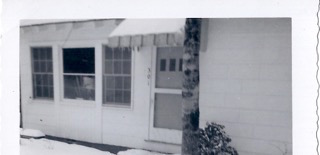
White House Image-108

Our Little White House

I don’t remember the name of our street, but I remember the small, white, square-shaped house with the back porch that sat high off the ground. Mom was always yelling for us not to run out the back door for fear one of us would break our necks. As I recall, one us (don’t remember which one) did eventually run right off that damned porch but luckily – no broken bones.

My childhood was a simpler time; a time when children couldn’t wait to get outside. On Saturdays when were young, my sisters and I shoveled down breakfast (usually oatmeal and toast), threw on clothes, and ran from our bedroom hitting the sweet spot of the screen door at full force. Mama started yelling the minute she heard our feet hit the hardwoods running down the hall.

“Don’t slam the screen door!”

We tried to slow down, but the resounding loud slap of wood against wood always followed. Come Spring and summer we were in bare feet most of the time, running full speed ahead for swing sets or the boys down the street. Together we’d ride our bikes, without helmets or shoes, through the adjoining streets of our neighborhood.

It never crossed our minds to sit in front of a television all day, not when all the adventures of outdoors awaited us. On more than one occasion and most Saturdays, Mama latched the screen door behind us. Hours later, sweaty, and dirty we gathered on the steps of the front porch only to find the door locked.

Pressing our faces against the screen we started yelling, “Mama! Let us in; we want something to drink!” I’m not sure what she was doing, but she always kept us waiting.

“Ya’ll stay outside and play. I’ll call you when lunch is ready.”

“But mama, we’re thirsty!”

She’d point to the side of the house. “There’s a garden hose outside, use it if you think you’re going to thirst to death before lunch,” she’d say, before walking away. I think mama might’ve been paying us back for slamming the screen door, but then again, a water fight was always fun on those hot, summer days.

To be fair, in the early to mid-1950’s, playing outside was a natural and easy choice. Televisions were black and white with only three local channels, and mama never allowed us free access to the TV. After homework, we were limited to cartoons in the afternoon, and once they ended, Mama shooed us out to play.

On the street I grew up, neighbors talked to neighbors, mothers shared supervision, looking out for each other’s kids. We rode our bikes on daylong explorations and walked to school or the community pool without fear. Families sat down together every night for dinner and spent Sundays at Grandma’s. Parents and teachers were the authority, demanding respect and children understood manners.

All of the parents were on the same page, speaking the same language and if Mama received a phone call from another mama down the street about something I had done, she didn’t take my side. Talking back or being rude to any adult was never tolerated. Mama knew how to swing a belt, and she did; spanking was still in vogue on my small town street.

We played hard as children, riding bikes, playing hide and seek, swimming, and catching fireflies till dark. We helped Daddy wash cars and Mama in the kitchen. We washed and dried the dinner dishes and made our beds every morning.

We didn’t have a lot of material things in that little white house, but we got to be kids and as I look back at on those very early days of my childhood – It was a simpler time, a safer time, and it was good.

What about you? Did you grow up in a simpler time?

I’d love to hear your comments. Talk to me. Tell me your story and look for me on Facebook at SheilaMGood,  PinterestBloglovinTwitter@sheilamgood, Contently, and Instagram.