Where to Find Help for Your Grammar Sins

Do you have a grammar sin? One you find repeatedly in your writing? I do. I’ll confess. When I began my writing journey more than a year ago, I discovered a horrible truth.

I was a comma whore. I placed commas the way I spoke not according to accepted grammar rules. Even with a graduate degree in hand, I had  forgotten, over the years,  how to write a well-structured sentence. How humiliating! 

Once I realized the error of my ways, courtesy of my writer’s group, I took off  to the bookstore. It was time for a refresher course.  Strunk & White’s, The Elements of Style, was my first purchase. It is the number one grammar book recommended for writers everywhere. If you don’t have copy, pick one up.

Cover of

 In addition to Strunk & White,  I also found a number of software programs available online and easy to download. Bear in mind, while not perfect, they are excellent resources.  

The programs won’t do everything for you. They won’t complete your unfinished manuscript, but they will teach you a lot about grammar and editing.

Want to tighten your writing skills? Improve your grammar? Come on, confession is good for the writing soul….

Unburden yourself. Confess your grammar sins, then check out these wonderful editing tools.

Here, you’ll find some of my favorites, acquired along the way in my effort to shed my own grammar sin. I’m a work in progress.

AutoCrit  

  1. About: Is an easy online download book editor can manage from 400-100,000 words, depending on the membership you choose. 
  2. What it Does: The program analyzes your writing sample for the following: overused words, sentence variation, cliches & redundancies, repeated words & phrases, pacing, dialog, initial pronouns, readability and homonyms. 
  3. Cost/Membership: ranges from free which is word limited to fee based ($47-117/year).

My favorite of all the programs, I chose to pay the fee and have found that the benefits, for me, outweigh the cost.

Writer’s Diet Test       Is your writing flabby or lean?

  1. About: Designed by Helen Sword, this program evaluates writing samples of   100-1000 words.
  2. What it Does: each category: verbs, nouns, adjectives/ adverbs, prepositions, and waste words (is, that, this, there) is scored  from lean to heart attack zone 
  3. Cost/Membership:  A great, free tool!
  1.  About: Is a copy editor that helps refine your writing. A copy and paste Beta program, it is word limited.
  2. What it Does: Identifies common mistakes, such as adverbs, passive voice, weak words, ‘said’ replacements, ending with prepositions and often-misplaced words. 
  3. Cost/Membership: Free for the using. 

EditMinion is another good tool for identifying those pesky adverbs.

Grammarly  

  1. About: An automated proofreader and grammar coach. Windows compatible, it can be downloaded as an office add-in to your WordPerfect and used as an additional grammar tool. Grammarly is not fully compatible for Mac users; although Mac users can utilize the program by copying and pasting.
  2. What it Does: Checks writing samples for grammar, punctuation, writing style, and even plagiarism.  
  3. Cost/Membership:  $39.95  every 3 months.

Last but not least…

  1. About: A fantastic and fun site on teaching grammar to anyone.
  2. What it Does: Offers lessons, courses, free PDF books and ongoing emails on grammar from beginning to advanced. 
  3. Cost/Membership: Some books do have a fee, others are free for download. Please refer to the site. Sign up to receive bimonthly grammar quiz emails and challenge yourself. If you have children, keep this site bookmarked!
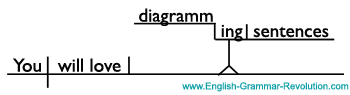
So, Do you have a hidden grammar sin? Do you want help? Check these software programs out and let me know what you think. Did they help you? Did the quality of your writing improve? Send me a well-written sentence and let me know how you’re doing.

Make Good Art

“MAKE GOOD ART”

I haven’t been enjoying the ride as much as I should be. This was a great reminder of why I write.  His advice was simple and to the point. I hope you will take a moment to be inspired.


Wow! I just watched an amazing and inspiring video commencement speech by Author, Neil Gaiman University of Arts Class of 2012.

1. “Be wise, and if you cannot be wise, pretend to be someone who is, and behave as they would behave.”
2. Make amazing, useful mistakes; “mistakes mean you’re doing something.”
3. Go beyond the Rules.
4. “If you have an idea of what you want to do, or what you were put here to do; just go and do it.”
5. Leave the World a more Interesting place.
6. Make good Art: “Make it on good days & bad; Make the art only you can make, using your voice, your mind, your story, and your vision…”

7. Enjoy the ride.

Writing Referee?

I need a referee for my writing time. Someone in a striped get-up with a whistle to blow every time someone, steps out of  bounds into my writing arena. I can see it now, the shrill scream of the whistle as the referee throws his arm out, screaming, “Out of bounds! You’re outta here!”

But, I haven’t been very lucky persuading my husband the need for another man around the house. Go figure. With that option off the table, I’m left having to re-evaluate my time management. Or, better yet find a balance.

80/20

The 80/20 Rule, also known as the  Pareto Principle, states that 20 percent of our efforts produce 80 percent of your results.  Boy, I’ve been working too hard! Perhaps, I’ve simply worked poorly. Trying to juggle family, friends, and trying to find time for writing. I can tell you, it hasn’t been working well. My output and creativity have suffered. I’ve been sidelined the last few weeks. On the bench, and out of the game. Why?

Sidetracked: 

  1. Distractions:  The everyday kind. The phone. You know the thing that never leaves our hands or        hips. The email or tweets that beep and chirp constantly. The house that needs attending. Grocery Shopping. Life. The unexpected.
  2. Family and friends: Including the four legged kind. We love them, but family activities can be demanding on our time. Whether it is the child/grandchild, your spouse, the aged parent needing attention, or the dog who needs walking, there are only so many hours in the day. At times, it seems, everyone is pulling on our apron strings (so to speak).
  3.  And then there is work: I’m fortunate enough to be retired, thank God, but I understand the demands of a full time job. They can be exhausting. Add all the rest, and finding time for writing takes a lot of planning.

What to Do:

  1. Be realistic and change your expectations. Otherwise you’ll lose the joy, passion and desire you had to begin writing.
  2. Set a schedule. Work it into your day-to-day, but build in some flexibility for those unforeseen situations that will always arise.
  3. Set Priorities. I know all about the hype on social networking. Tweet, LinkedIn, Pin interest, Facebook and the zillion other sites on the net. They are intoxicating, captivating and additive. They also can rob you of value time.
  4. Focus: What is it you want to accomplish? A novel? Anthology of short stories, Self-publish an Ebook? Short fiction guru? Competition? Publication in literary magazines? All are great goals, and I believe one can do some of those things simultaneously. However, when time is an issue, can one do them well?
  5. Re-evaluate your goals. When things are hectic it might be time to look over your goals. Are they too lofty, for right now? Too much? Too soon? Can you accomplish your project in smaller sections? In other words, take smaller bites.
  6.  Re-evaluate your time: Put your life  and writing in perspective. 80/20 it.
  7. Change it up. Do something different. Take a break. Breathe. Whether it’s reading a good book, different from your favorite genre, trying your hand at poetry or painting, make a change. Give yourself permission to relax.
  8. I don’t need a referee and neither do you. We need perspective. Writing is about inspiration, fun and passion. Our words aren’t going anywhere, but family and friends do. Our kids grow up, move away, friends drift into their own lives, and parents grow old, forgetful and leave us. A little balance sounds good to me.

Emotional Nuance

One of the most difficult things for me, as a new writer, is to put feelings and emotions down on paper.  I started paying attention to other author’s and the way they described emotions. I started out believing emotions were easy to write, they aren’t. Many nuance’s of expression bring emotion to life and make it real. I was missing that subtle difference in shade of meaning, expression or sound.

Most of the time our emotions are reactions. Flares of intense moments. Some are more subtle than others, but how often do you stop to think about what you’re doing, how you’re moving,  the tone in your voice, the look in your eye, the strength in your touch, or your stance? We don’t. We simply do what we do in the moment.

Try writing a scene without thinking about  all of those things, and you’ll have a boring, stilted, emotional scene. I know, because I’ve written quite a few along the way. However, there are resources for us newbies, and I’ve found a great one! The book shelf muse. This is a wonderful blog offering a slew of  resources for writers on character traits,  emotional thesaurus, and others. Check them out. Their hard copy book and ebook will be coming out May 14th.

So, the next time you sit down to write and you can’t get the emotion right, well…. I hope you’ll take a closer look. Break it down. As for me, I have a big Easter weekend with my family planned. So, I’ve been busy, cleaning, cooking, and right now I’m drumming my fingers on the table as I run through my to-do-list, focusing on our family event (anticipation).

Happy Easter  to every one! Happy Emotional Writing!