The ABC’S Of Writing

November is a huge month. We select a new President and a slew of writers of all levels will take on the challenge of NaNoWriMo. Starting November 1st, participants  all over the country will write a complete 50,000-word novel in one month. Oh, how I would love to sign on for the challenge, but the truth is I don’t have the guts nor the time and I’d have be in the land delusion to even try attempt such a feat.

As much as I strive to have a structured time and place for writing, life happens. Over the last year or so many of you have read my resolutions to write a certain number of words per day and each time I gave it my best shot, but for the most part, I fell short. Things  haven’t happened the way I planned. Why? Simple, life happens. I’m not the only person in my universe.

As I read through some of my favorite blogs the other day, I found a number of them to be on the   same issues: How to overcome writer‘s block, become more inspired or tricks and prompts to keep you writing. I read each one with the intention of using their best advice offered. It didn’t happen, life did.

Instead of being productive, I became frustrated. I couldn’t keep up with all the reading, weekly prompts, tweets and blogs, my own writing, writer’s group and family responsibilities. I needed an attitude adjustment.

Joanna Penn from The Creative Penn gives three tips on how she keeps herself from being distracted.

1. Diary scheduling – days scheduled for nothing else but writing.

2. Working out of the Library

3. Setting a timer for ninety minutes -broken into four sessions, per day.

The first one would take an act of congress, divorce, giving my dogs away, or moving out of the country, but occasionally it happens. The second one works, and I’ve been stealing a couple of hours away from home to cut down on distractions. The third one, I’m trying this week. Emails, twitter, and research have a tendency to suck the hours out of a day and I get lost. The timer will be good for me, as long as I don’t reset it.

Life does happen to all of us. It’s unavoidable. We must learn to roll with the punches. It was easier when I was younger and a great multi-tasker, but that was then.

CJ Lyons in her blog No Rules Just Write, offered the best advice. She said there is no secret recipe to writing a good book or story and no one can tell you the right way to write.  Her own secret was “as simple as ABC: APPLY BUTT TO CHAIR”.

Sounds like good advice.


Related articles


How To Critique A Novel Chapter by Chapter


CHAPTER  by CHAPTER 

Our writer‘s group raised the question recently, “How do other groups critique novels, chapter by chapter?” With several authors bringing novels in for critique, we wanted to know if we had the best  process in place.

So, I took the challenge and decided to do a little research of other critique groups. I found the process other groups used were as individual as the groups themselves, but the content and the components  required to  make a well written chapter, varied not at all.

My writing group has been invaluable. However, after my research I  realized  we’d  glossed over or failed to mention  a number of elements in our critiques.  Seems we’d gotten into a rut, mentioning the same glaring things from one critique to the other. It was time we started digging a little deeper into our critiques and being specific.

Let me explain.

How many times have you walked into a book store and picked up a book, opened it to the first page and began reading? If you bought the book after reading the first few paragraphs or page, you were hooked. If not, you put the book back on the shelf and picked up another one.

To keep the book from going back on the shelf is exactly what an opening line, sentence or paragraph is supposed to do. Did the opening line hook you? Did it make you want to turn the page or buy the book? Of all the chapters, chapter one is the most important chapter of a novel. I was reminded to pay more attention to the details and dig deeper when critiquing the first chapter, not only the opening line, but the introduction of the main characterthe setting, voice, and the POV. 

The main character deserves a closer evaluation than whether  we like  them or not. Are they believable? Readers want  to understand the conflicts, problems, and obstacles placed in the character’s way. They want to connect with, cheer on, fear for, and worry about the character. So, evaluate the character from a readers perspective.

The inciting event is “something” that happens which propels the character into action and the story forward. This is the one thing that turns the character’s world upside down and on which all other action or reactions are based. Is the inciting event clear? Did it work, and is there a clear transition into the next scene or chapter? In subsequent chapters or scenes, you should see the domino effect from the inciting event, leading to more complications. Does the event make sense based on what you know about the character so far? It reminds me of Newton’s Law: For every action there is a reaction. So, talk about this in your critiques.

Which leads me to stakes, conflict and tension; every scene should have one of these elements. In order to keep the story moving and the reader interested, the author must raise  stakes for the character  or increase the tensionWithout them, the reader will be bored to death. All of which is worth mentioning in a critique.

You don’t want the reader to lose hope for your character or have the sensation  they’re racing through the story; is it a fast or slow read? That’s why pacing is an essential aspect to good critique. A well written story will have some periods of narrative for down time.  Look for the action and active verbs and evaluate whether the backstory is done naturally and only as necessary. I had glossed over this aspect of the critique before, but understand now, how crucial pacing is to the novel as a whole.

Dialogue is rarely overlooked in a critique but, the tendency is to look at dialogue tags or the use of passive voice, but there is much more than tags to evaluate. Is the dialogue difficult to read, incongruent with the characters, too stiff or confusing? Does the dialogue move the scene forward? (When the dialogue doesn’t move the story forward, consider its merits and don’t be afraid to recommend the author cut unnecessary dialogue).

Voice is one of those hard to define things for many people and is often overlooked in critiques. However, voice is very important. Voice is the way the story is written. It creates the mood and tone of the story. The question to ask is, does the voice reflect the right mood and tone for the story? Is the voice cohesive and does it work? This is something rarely mentioned in critiques, but voice does matter. I recently had a short story rejected, and in the letter, the reason was, “…the tone of the story wasn’t what we were looking for….”

The end of the Chapter (break) cannot be ignored in the critique. Transitioning from one chapter to the next is critical in determining whether the reader will continue and turn the next page. One of the things to evaluate in a critique is whether the chapter break was placed strategically. Was the tension high? Did the reader receive new information? Did something happen leaving the reader in suspense? Did you want to keep reading?

A thorough critique can be a time consuming process. To  help improve our methodology I recreated a checklist for our group to utilize as a reference tool. We use it as a reminder to be specific when critiquing fellow writers. You or your group may use a different process, but feel free to utilize the checklist on the link below.

Please leave a comment and let me know what you think about the checklist. I’d love to hear from you.


Critique a Novel


How to Map Out Your Manuscript With Microsoft Word

If you do not have a writing software program such as Scrivener, you will enjoy learning about the Document Map feature in Microsoft Word. With this feature, you can navigate your manuscript or other long document with ease. 


Matthew MacNish and the Middle Grade Group at Project Mayhem  has a terrific tutorial on how to use this feature.  They have graciously agreed to let me share it with you. Thanks team!

Matt used Microsoft Word 2007  to demonstrate this feature. I have included snap shots of the MAC version of MS Word 2011 for those using MAC’s, as the layout is slightly different. 

Document Map has been a part of MS Word since 2003. Should you have a version prior to 2007, you can find  information  online at MS Office Support. 

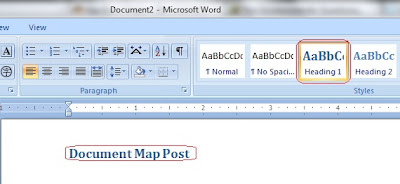
In WORD, click on the VIEW tab, select Print Layout and check Document Map. 


 For MAC users, it will be found on the sidebar. Icons are used instead of text.


To create your first heading (Title), go back to the HOME tab and select STYLE.  Type your TITLE/HEADING and click Heading 1. You may want to change the default font.

The easiest way to edit color or font in Styles is by modifying them at the same time. On MAC, look for the Icon in the STYLE box. In the Modify box, select the heading you want to modify, select all and click New Style. A box will come up where you can adjust font, text and format.

You’ll need at least one subheading to create a directory.  Once you have created your document it is easy to navigate. Want to find something in a particular chapter or section, simply click on that chapter or section in your map and you will go right to 

Here, is Matt’s sample Document Map outline:


Here, my simple Document Map (MAC) 


If you want more information check out Project Mayhem or Iain Broome’s tutorials. 


Walking The Walls of a Writer’s Life by Guest Luke Reynolds

Today, I have the distinct honor of introducing Luke Reynolds to you as my guest blogger.

Over the last month, I’ve had the pleasure of working with Luke, author of  Keep Calm and Query On as he mentored me through the process of writing a query for my first novel, HELLO HELL. I won this opportunity through a recent blog giveaway, courtesy of  The Bookshelf Muse and it has been an incredible experience.

In Keep Calm and Query OnLuke discusses his journey as a writer with all its bludgeoning defeats and small triumphs. Luke’s journey as a writer is accompanied by interviews with fourteen other powerful and prolific authors. They discuss their worst rejections, first publications,what keeps them motivated,  and why they believe in the power of words.

Luke currently makes his home in York, England with his wife Jennifer and son Tyler.  


Walking the Walls of a Writer’s Life           

By Luke Reynolds

Where we live in York, England, walls surround the city. 1.9 miles of 1000-year old Roman walls enclose the heart of the city. Tourists comes from all over to see the walls and walk on top of them, gazing out at the city that stretches through nooks and crannies and yet still feels like a village.

1000 years ago, the walls were an intricately planning defense, allowing the Romans a massive advantage over any enemy invaders. Today, they’re an attraction, something on which one would walk before stopping in the local cafe for a cappuccino and a muffin.

Recently, when my wife Jennifer and I and our three-year son, Tyler, ventured out for a walk on a section of the walls we’d never before traversed, Tyler decided that he wanted to wear his pirate costume. No strangers to creativity and fun, Jen and I wholeheartedly agreed. (And I deeply wished they made adult-size pirate costumes for Daddies so we’d be a tandem team.)

As Jen and I and our little pirate walked the walls, tourists pointed at our son, smiled, and laughed. We laughed with them, joking about Tyler’s great exuberance for imagination. It struck me hours later that walking walls in this way is about the best advice for us writers on how to stay awake to the joy of what we do.

For writers, walls are everywhere. Every minute of every day, we’re confronted by walls that seem to wrap themselves around the heart of our dreams: walls in the form of writing blocks, walls in the form of rejections, walls in the form of revision needs, walls in the form of publishing, walls in the form of sales, walls in the form of criticism. 

And essentially, we have two choices. We can stand and look at those walls the way Roman enemies once did, and say, Dude! We’ll never capture the heart of this city! Did you SEE those walls? No way!

Or, we can realize that it’s possible to walk on top of those walls. We can don some crazy outfit, let loose our imaginations, and circumnavigate the heart of the dream city of a writer, all the while laughing with those we meet along the journey. This happens when we realize that the joy of the journey isn’t in destroying the walls, but rather in learning how to navigate them while keeping alive our own creativity, imagination, and fun.

And good thing for us writers: none of the previous three entities rely on success. Success doesn’t enhance our creativity, imagination, and fun. Success corroborates our efforts and validates what has already occurred. And that’s cool—but success doesn’t help us walk the walls.

Instead, walking the walls of a writer’s life is a choice we have to make, and we have to make it every day. It isn’t easy initially, but the more we focus on which costume we’ll choose for the day, which way we’ll walk, and who we’ll walk alongside, the less we see the walls as barriers and the more we see them as a part of the journey. Strong, yes, but not invulnerable.   

Thanks Luke!

Have you faced any WallslatelyPlease comment.


Luke is represented by Ammi-Joan Paquette of Erin Murphy Literary Agency.He is co-editor of Dedicated to the People of Darfur: Writings on Fear, Risk, and Hope (Rutgers University Press, 2009) and of Burned In: Fueling the Fire to Teach (Teachers College Press, 2011). A Call to Creativity: Writing, Reading, and Inspiring Students in an Age of Standardization (Teachers College Press, 2012).