Anatomy of the Personal Narrative Essay

Photo Courtesy of funnymama.com

Besides writing flash fiction, and working on my novel, I’ve been exploring personal essays. For those of you interested in writing essays and don’t want the frustration of college days, here are a few pointers I’ve learned along the way.

Narrative means a written account of connected events; a story. Written in first person and most often in the past tense, a narrative essay tells the story of an experience and the significance of that event to the writer.

Structure:  A personal essay includes three essential parts: 1) the opening statement or introduction. 2) Body of the essay, and 3) Conclusion.

1. Introduction:  Basic components of the introduction include: Opening statement, scene, and theme.

Opening: The opening is the hook and can consist of a statement of facts, a pertinent quote, or a question. A strong, engaging opening will entice the reader and keep them interested in what you have to say.

Scene: In order for the reader to stay engaged, every essay should include the three W’s: Who, what and where. Set the stage: Who are the characters? What happened and where did the event take place? In addition, clarify whether the story happened to you, someone you know or is fiction.

Theme: Essays can begin with the event itself: The crowd, waiting to board the train, pushed me over the edge of the platform.

Lessons learned: I will never stand close to the platform’s edge again.

How the experience changed your life: When waiting to ride the metro, I stay well behind the safety line, and ta the rowdy crowds of anxious passengers. 

Or to share something more universal: The metro is stressful and dangerous if you aren’t aware of your surroundings.

2. Body:
The body of the essay is where your story begins. Place the readers in your experience by using details and vivid descriptions; show don’t tell. Use all five senses, not just your sight. What sounds were amplified? What did you feel?

 I heard the screeching sound of metal on metal, felt the vibrations and tasted bile as I stumbled toward the edge. 

In other types of essays, corroborating evidence is needed to support your position. But, in a narrative essay, your experience is the supporting evidence. Your story and the lessons learned may be unique, but the events in your essay should support the significance of that experience to you.

The most common narrative format is from beginning to end: first, next and last or, in chronological order with new paragraphs showing a change in action. Either way, transition words are necessary to make sure the reader understands how the event occurred.

Transition words help connect not only the sequence of events, but also the end of one paragraph to the start of the next. Examples include: before, after, when, finally, suddenly and therefore.

Suddenly, the crowd surged, knocking me off-balance and I fell forward toward the tracks as the train entered the tunnel.

3. Conclusion:
Your story ends here by evaluating the event, its significance, how the experience changed you, and the universal message or the moral of the story you want to share.

A stranger saved me when he grabbed the strap of my handbag and pulled me to safety. After my near miss, I approached riding the metro with greater respect and caution. I focused on being aware of my surroundings, staying well behind the safety line, and mindful of other passengers.

The metro, although convenient, is a stressful and crowded form of transportation. Showing respect for others and their personal space reduces anxiety, aggression, and accidents.

Photo Courtesy of immediacy.newschool.com

Want more information on writing essays, check out:

Longreads.com Best of Essay Writing.

Writer’s Digest: How to Write a Reader Friendly Essay by Rachel Scheller ay

Related articles

Ten Things to Make Your Critique Group a Success

I apologize for being absent lately. Sometimes we have to make choices and prioritize to address more pressing matters.  Thank you for being patient.
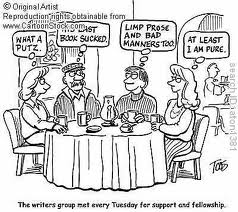
Two articles came to my attention this week on writing and critique groups. Guide to Literary Agents, Chuck Sambuchino, in his article, discusses The Top Ten Worst Types of Critique Partners.  Included among the attendees one might encounter were: The Snob, The Time Hog, The Retro, The Distractor, The Harsh Critic/The NiceyPiecey, The Debater, The Picker, The Sulker, The Boss, and The Sporadic.
images-8
Elmowrites describes in Critique and Critics, the attendees to her first group with slightly different names. The Fan, The Ogre, The Stuck Record, The Feeler, The Mechanic, and The Holy Grail. You get the gist.

Having belonged to a critique group for the last couple of years, the titles intrigued me. The “type casting” of members, however, left me wrinkling my brow. I won’t rehash the definitions here; you can read them for yourself. Whether it was one of the above personalities or group dynamics, the experience left a less than stellar impression on the authors. Still, in the end, both acknowledged the importance of feedback and encouraged writers to keep looking for a writing or critique group. Reading these articles made me wonder, was this the group experience of most people? It hasn’t been my mine.

I belong to a wonderful writer’s group, the South Carolina Writer’s Workshop (SCWW). We’re diverse in our experience, opinions, and genres. I imagine there are things in areas other than writing we might not see eye-to-eye on; I wouldn’t know and I don’t ask. We discuss writing. We focus on genuine critiques, helping each other improve, and get published. We promote each other’s blogs, author pages, websites, and publications.   We’re writers supporting writers.

So, here’s what I say: You can have a good group experience, but you have to participate. You can’t just be an observer. Here are my ten suggestions for a successful group experience.

  1. Find a group, or start one of your own. Growth comes faster with feedback.
  2. The group should have a designated leader who can moderate a meeting.
  3. Make the focus on writing, not people.
  4. Be prepared. Members are less disruptive if they’re prepared and know what to expect before the meeting. We find sending work in prior to the meeting an effective method.
  5. Don’t confuse social activities with the group meeting. The focus gets lost in the gossip.
  6. When difficult members do surface, let the leader or group moderator handle the situation one-on-one. 
  7. Don’t take it personally.  
  8. Be respectful of each other’s, work, time, and the group.
  9. Take time to familiarize yourself with group etiquette. If your group has guidelines, honor them.
  10. Know your own voice. It’s your story.

Ultimately, you are responsible for your writing and any experience you may or may not have. All critique groups are not the same, don’t give up the first time. It takes time to get to know people and the dynamics of a group. Instead, stick around, learn to listen, and speak up. You might just find yourself a group.

 Leave me a comment. Let me know about your group experience.

 Related articles

Grammar Revolution Anyone?

I was surprised recently to learn grammar was no longer being taught in our school systems. As writer’s we know the importance of grammar. A great story poorly written will end up on the slush pile, unpublished every time. In 2012,  Progress in International Reading Literacy (PIRLS) released its findings. US students once again lagged behind other countries in reading. Our country spends more on each student than any other country. Yet, for some reason, the basics are not getting through.

I have my own theories as to why our children lag behind in reading, have poor grammar and communication skills; there are many reasons, but I believe one in particular plays a huge role – technology and more specifically texting. As convenient as texting makes our lives, it robs us the chance to genuinely communicate. Acronyms replace words, and 140 characters replace intimate face-to-face conversations. No wonder the next generation is lagging behind, losing the ability to communicate or understand basic language skills. For that, we have done them a disservice.

As a writer and a grand mother having heard the latest dismal education statistics of US students, I thought  I’d pass a great project on to you. It’s the least I can do. We have a responsibility to help re-educate our children and grandchildren. They are the future.  

David & Elizabeth O’Brien of Grammar Revolution are taking the issue head on with their Kickstarter Grammar Revolution Project.


 In addition, you may want to check out their website Diagram It, where they offer Puzzlers like the one below.  It’s a great site to share with your children or grandchildren. So drop me a line and tell me. Do you agree with David  & Elizabeth? Do we need Grammar Revolution?

  This is an old slogan for Energizer batteries.

  1. It keeps going and going.
  2. It is a declarative sentence with a transitive active verb.
  3. The direct object is compound, and it is made up of two gerunds.
  4. Gerunds are verbs + -ing acting as nouns.
  5. The skeleton for your diagram looks like this.sentence diagram

Do you know the answer? Can you diagram it? When you’re finished, check your answer here. Do you want to learn more? Learn how to diagram sentences with these exercises.

Intuition

I can’t believe Christmas is here. The week has flown by with last-minute preparations for family, and as the year winds down, I’m contemplating the direction I want my writing to go for next year.  As, of now, I’m now sure which direction I plan to go, but I’ll share more later. In the meantime, I along with the rest of you will be taking a few days off to be with family and friends to enjoy this sacred holiday.

But, before I go, I’d like to pass on a great article, I read this week, The Moo of Intuition.

The article was written by one of my friends Nan Lundeen, author of The Pantyhose Declarations. Nan teaches The Moo of Writing Workshop, and you can find her columns in Female First.

This week she wrote about listening to your intuition,  and the role it plays in our creativity. For me, listening to intuition goes hand in hand with authenticity, especially in writing, staying in tuned to both is the key. I highly recommend Nan’s article.

You can find her book, The Pantyhose Declarations  at Amazon, and it’s on sale now for those of you who may still be looking for last-minute gifts.

Merry Christmas and God Bless