My Top 5 Gift Subscriptions For Every Writer

It’s that time of year when we’re all trying to figure out the perfect gift for friends and loved ones. And, gifts for the writer in our circle is one of the hardest to find. Here are my top five recommendations to make your shopping easier. Enjoy.

51NYqYBHXsL._SY300_1. Writer’s Digest – An excellent resource for writers at all levels. Covering all genres, this magazine is your go-to-resource on writing. Available in print or digital,  a year’s subscription will cost $19.96 (8 issues).

issue_95_cover_450x6752. Glimmer Train Stories – One of the best magazines in print, this magazine loves to showcase emerging and new writer’s.  Forty percent of stories last years was from first time authors. Represented in  the Pushcart Prize: Best of the Small Presses Henry Prize StoriesNew Stories from the South, and Best American Short Stories. A year’s subscription will cost you $35.00.

Crazyhorse_88_cover-1025x10243. Crazyhorse – This College of Charleston literary magazine, located the beautiful coastal city in  South Carolina has published the works of established and  emerging writers for the last 50 years. Work from the journal’s pages has been reprinted in the Best American PoetryBest American Short StoriesBest American Nonrequired Reading and The Pushcart Prize annual anthologies. Issues and stories are available online and in print.  Offering 25% off a one year subscription – $15.00 USD, $25.50 USD; ends 12/31/2015.

Issue60ForWeb-14. American Short Fiction – Publishes work from both emerging and new writers. Stories published by American Short Fiction are anthologized in Best American Short StoriesBest American Non-Required ReadingThe O. Henry Prize Stories, and The Pushcart Prize: Best of the Small Presses, and elsewhere. A year’s subscription will cost $25.00. Current issues and back issues available for $7.00 – $10.00.
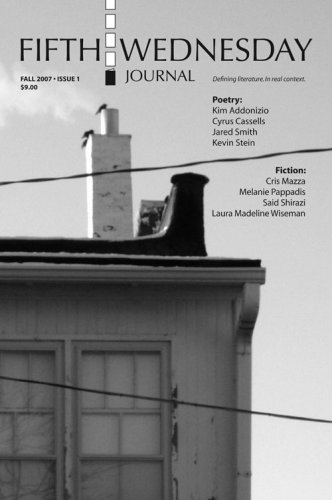
41BSSXcYaSL5. Fifth Wednesday Journal– An independent print literary magazine published twice a year. Focusing on contemporary literary and photographic arts, this magazine accepts contributions of short fiction, poetry, essays, interviews, book reviews, and black and white photography.    A one-year-subscription will cost you $20.00 per year. Individual issues, $11.00 each.

Happy shopping!

I’d love to hear your comments. Let’s have a conversation. Talk to me. Tell me your story. And as always, you can follow me on Facebook at SheilaMGood, PinterestBloglovinTwitter@sheilagood, and Contently.


You Asked: Secrets That Will Help You Get Published

Welcome to another, You Asked, the Experts Answer, segment. This week ‘s question is: Is there a secret to getting published in literary magazines?

Well yeah, sort of.  Lincoln Michel, a Buzzfeed contributor, takes us behind the scenes in his two-part article, The Ultimate Guide To Getting Published in a Literary Magazine.

This is one of  the most in-depth articles on getting published I have ever read. We’ve all heard the tips :

  • Submit often
  • Read the magazines
  • Follow the guidelines
  • Proofread

But, we’ve never understood what happens behind the scenes or how literary magazines actually select those they choose to print. Well, now you will. Lincoln goes into great detail about editors, readers, the slush pile, solicited and non-solicited work, and even “carpet bombing.”

“Most editors would probably consider at least 60% of the slush pile to be unpublishable, period. Twenty percent shows promise but needs some work, and 10% is publishable but not in the journal being submitted to. That leaves 10% of work that might deserve real consideration.”

Here’s a few important things I gleaned from the article, but I still encourage each of you to read it in its entirety.

  1. Submissions go first to the slush pile.
  2. 60 % of those in the slush pile are unpublishable.
  3. Acceptance rates are about 1% for good magazines.
  4. Submissions are sometimes solicited by editors or through agents (I had no idea).
  5. 20-100% of works published come from the slush pile.
  6.  Connections are important.
  7. Editors are not the first to read your work, readers are (typically 2).
  8. Readers are volunteers, or students.
  9.  The first paragraph and page is important in making it past the readers.
  10. Persistence in submitting is one of the main keys to success.
  11. Know the Cover letter No-No’s (see the article).
  12. Selective your top 3 to 5 magazines and go for it; again & again.

Where to Find the Right Market for Your Story?

Many sites offer information on Magazines open for submission. Here are my top five resources.

  1. Every Writer’s Resource 
  2. Duotrope
  3. The Review Review
  4. The Writer’s Database
  5. Clifford Garstang’s Pushcart Rankings

I’ve only given you the teasers from the article, but I can tell you it’s one worth keeping for the files. What do you think? Are you seeing submission success? Do you have a favorite market site?

I’d love to hear your comments. Talk to me. Tell me your story. And as always, you can follow me on Facebook at SheilaMGood, PinterestBloglovinTwitter@sheilagood, and Contently.

You Asked: 7 Things You Can do to Identify Your Genre

Welcome to another, You Asked, the Experts Answer, segment. This week ‘s question is: How do I know If I’ve chosen the right genre?  

Choosing a genre is something many writers struggle with and the biggest reason is being  unfamiliar with the different genres. Unfamiliarity breeds confusion, which in turn makes it difficult to know which to choose.

Whether you plan to self-publish or go the traditional route, selecting the right genre is essential for success. After all, you want people to find your book.

Why is Genre so Important?

  1. It gives you clarity for pitching to the right agents.
  2. It’s how the publishing world will view your work.
  3. It’s easier to find your target audience.
  4. Makes it easier for readers to find your book.
  5. Helps you write a succinct pitch.
  6. Helps the industry know how to market your book.

7  Easy Steps to Find Your Genre

  1. Ask yourself: What readers would like my story? What books are similar to mine?
  2. Review Amazon’s bestseller list and check out the list of genre’s.
  3. Go to your neighborhood bookstore, look at where the books are shelved. Fantasy? Mystery?
  4. Select five-six books and  read the descriptions; make a note of the core story in each. What stands out?
  5. Look at titles – can you determine the genre?
  6. On what shelf do you see your book?
  7. Know what your story is about and be able to verbalize it in a succinct manner.

The Downside of Getting it Wrong

  1. You will get rejected and your book will end up in the slush file.
  2. You won’t know how to market your book, which in turn makes it hard to sell.
  3. You’ll miss  your target audience and, likewise, they will miss your book.
  4. Getting it wrong will make agents think twice about you and your work.

We all want to see our books on Amazon or our local bookstore shelves. But, in order to do that, we must not only write a compelling story but know who our audience is and choose the correct genre. For more information, check out these great resources for writers on writing in your genre.

Resources:

  1. Identify Your Novel’s Genre
  2. How to Pick the Right Genre for Your Novel
  3. Where Does My Book Fit? Figuring Out Your Genre
  4. Don’t Know Your Book’s Genre? Here’s What to Do
  5. How to Pick the Right Genre for Your Novel

I’d love to hear your comments. Talk to me. Tell me your story. And as always, you can follow me on Facebook at SheilaMGood, PinterestBloglovinTwitter@sheilagood, and Contently.

Forget About Getting Rich

via The Average Earnings of Authors | A Writer’s Path and Guest post contributed by Sara Wolf at the Blooming Twig. The Blooming Twig is an independent publishing house that also produces writing blog posts. For more information, check out the Blooming Twig and A Writer’s Path

A big thanks to Ryan Lanz and Sara Wolf for bursting my bubble. I’m no Stephen King or J.K. Rowling, but hey, I have aspirations for my still unfinished novel. I imagined my book on the New York Times bestselling list and after selling the movie rights, visions of rolling in money. But, according to a report by the University of London, it ain’t gonna happen.

Photo Courtesy of toonbarn.com and Google

Here are the highlights of the University’s study  (based on 2,500 working writers):

  • 54% of traditionally published authors and 80% of self-published authors earn less than $1,000 a year.
  • In 2013, 17% of authors made no money writing.
  • Less than 1% of self-published and more than 5% hybrid writers earn more than $100,000 per year. (Hybrid writer -an author who utilizes both the traditional and self-publishing systems in order to retain control of  her own work).
  • According to award-winning author, Phillip Pullman, over the past ten years, publisher’s earnings have remained steady; writers incomes have decreased an average of 29%.
  • Fiction authors make more money than non-fiction or academic writers.
  • Women writers make 80% of what male writers make. (What! Who’s surprised?)
  • The report summed it nicely, “It appears that writing is a profession where only a handful of successful authors make a very good living while most do not.”

There you have it; not many of us will become rich from writing. Most of us write because we love to; it’s part of who we are.

I published my first article in 1989 and the excitement I felt is hard to describe. It’s an accomplishment of which I am still very proud. That first article happened a long time ago, but each time a story or article of mine is published, I get those same feelings. There’s something special about knowing other people are reading and enjoying the words I have written.

What about you? Do you write for fame and riches? Have you earned income from your writing? Share your success. Want to read the full article? You can find it here.

I’d love to hear your comments. Talk to me. Tell me your story. And as always, you can follow me on Facebook at SheilaMGood, PinterestBloglovin, Twitter @cofcmom, and Contently.