The Benefits of Making To-Do Lists

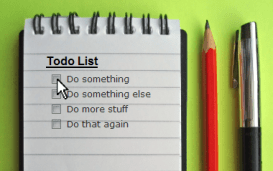
20071126-todo-listI realize it has been more than a week since my last post and I apologize to my readers.  An unexpected hospitalization took me out of commission. Although I’m better, I’m  not quite back to full speed. So, today’s post is one I wrote a while back in response to a prompt on lists. Enjoy.

For those close to me, they know I love lists. I’ve been a list-maker as long as I can remember. There’s something innately satisfying about striking through or checking off a task.

The types of lists are limitless. Grocery, spring cleaning, Christmas shopping, books to read, stories to write, blog posts, bucket list, and the, ever helpful, pros and cons list.

Shortly after we married (second marriage for both of us), I discovered a pros and cons list my husband had begun when we started dating! Obviously, the pros won out and 23 years later, we often pull it from its place of safekeeping and enjoy a good laugh. There are many benefits to making lists, including finding Mr. or Mrs. Right.
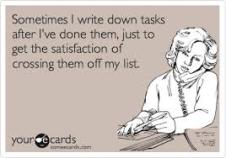
Photo courtesy of homeonderanged.com & GoogleBenefits of List Making

Our world is often a whirlwind of busyness. In the rush to meet everyone’s needs, we often forget important appointments or feel overwhelmed with to-do tasks.  Lists help:

  1.  Keeps us on track.
  2. Prioritize, and create a plan of action.
  3. Provide accountability.
  4. Establish goals
  5. Reduces Stress

It’s not always about staying on track. Sometimes it’s about clearing the cobwebs of our mind.  Stress-relief is one of the major benefits for list making. With each check mark or line crossed through a task, there is an incredible sense of accomplishment and in some cases, relief. Reduced stress means more Zzz’s and a clearer mind. And, trust me, I need all the help I can get in that department.

Want more information on the benefits of list making? Check out The List Producer.

Having a list at our disposal has never been easier. We all have cell phones and there are numerous Apps we can utilize. I’m partial to the Reminder App and Sticky Notes.

Want to explore the best Apps for list making? You can check out, Forbes – The 9 Best To-Do List Apps for 2014.


Are you a list maker? What are your favorite lists?

I’d love to hear your comments. Talk to me. Tell me your story. And as always, you can follow me on Facebook at SheilaMGood and  Twitter @cofcmom.


A Mother’s Day Message to My Daughters

Mother’s Day, the traditional time, of year when children of all ages honor their mother through cards, flowers, or special dinners. Receiving such recognition is always a blessing and much appreciated, but on this Mother’s Day, I have something to say to my daughters.

The minute I realized your tiny heart was beating inside of me, my life changed forever, even my world looked different. Everything I did or hoped to do, from the clothes I bought to my career path, centered on the underlying anthem, how will this make my children’s lives better?

Almost thirty-eight years ago God blessed me with two precious daughters. It seems like only yesterday you were young and clingy, wanting mom to make it all better. Happy to wrap my arms around you, kiss your wounds and whisper, “Mommy’s here,” I admit I miss those days, but time stops for no one.

You’ve both grown into smart, strong, beautiful, and independent women, of whom I am very proud. And, although you don’t need, me as much as you once did to kiss away skinned knees or hurt feelings. On this Mother’s Day, I want you to remember I will always be here.

My sweet girls, being your mother brought me a lifetime of joy and has been the greatest honor of my life. Given the chance, I would do it all over again.

Anatomy of the Personal Narrative Essay

Photo Courtesy of funnymama.com

Besides writing flash fiction, and working on my novel, I’ve been exploring personal essays. For those of you interested in writing essays and don’t want the frustration of college days, here are a few pointers I’ve learned along the way.

Narrative means a written account of connected events; a story. Written in first person and most often in the past tense, a narrative essay tells the story of an experience and the significance of that event to the writer.

Structure:  A personal essay includes three essential parts: 1) the opening statement or introduction. 2) Body of the essay, and 3) Conclusion.

1. Introduction:  Basic components of the introduction include: Opening statement, scene, and theme.

Opening: The opening is the hook and can consist of a statement of facts, a pertinent quote, or a question. A strong, engaging opening will entice the reader and keep them interested in what you have to say.

Scene: In order for the reader to stay engaged, every essay should include the three W’s: Who, what and where. Set the stage: Who are the characters? What happened and where did the event take place? In addition, clarify whether the story happened to you, someone you know or is fiction.

Theme: Essays can begin with the event itself: The crowd, waiting to board the train, pushed me over the edge of the platform.

Lessons learned: I will never stand close to the platform’s edge again.

How the experience changed your life: When waiting to ride the metro, I stay well behind the safety line, and ta the rowdy crowds of anxious passengers. 

Or to share something more universal: The metro is stressful and dangerous if you aren’t aware of your surroundings.

2. Body:
The body of the essay is where your story begins. Place the readers in your experience by using details and vivid descriptions; show don’t tell. Use all five senses, not just your sight. What sounds were amplified? What did you feel?

 I heard the screeching sound of metal on metal, felt the vibrations and tasted bile as I stumbled toward the edge. 

In other types of essays, corroborating evidence is needed to support your position. But, in a narrative essay, your experience is the supporting evidence. Your story and the lessons learned may be unique, but the events in your essay should support the significance of that experience to you.

The most common narrative format is from beginning to end: first, next and last or, in chronological order with new paragraphs showing a change in action. Either way, transition words are necessary to make sure the reader understands how the event occurred.

Transition words help connect not only the sequence of events, but also the end of one paragraph to the start of the next. Examples include: before, after, when, finally, suddenly and therefore.

Suddenly, the crowd surged, knocking me off-balance and I fell forward toward the tracks as the train entered the tunnel.

3. Conclusion:
Your story ends here by evaluating the event, its significance, how the experience changed you, and the universal message or the moral of the story you want to share.

A stranger saved me when he grabbed the strap of my handbag and pulled me to safety. After my near miss, I approached riding the metro with greater respect and caution. I focused on being aware of my surroundings, staying well behind the safety line, and mindful of other passengers.

The metro, although convenient, is a stressful and crowded form of transportation. Showing respect for others and their personal space reduces anxiety, aggression, and accidents.

Photo Courtesy of immediacy.newschool.com

Want more information on writing essays, check out:

Longreads.com Best of Essay Writing.

Writer’s Digest: How to Write a Reader Friendly Essay by Rachel Scheller ay

Related articles