Look, Look, And Look

Before I send my manuscript to the editors, I’m doing my best to clean up my draft copy.

For those of you beginning this process, here are a few tips:

  1. Print out a hard copy – It’s easier to spot errors, holes.
  2. Make notes for obvious holes in the story, and correct grammar/punctuation, redundancies, and repetition.
  3. Turn off autocorrect to avoid missing homonyms ( words with the same spelling but different meaning/ wrong word for the sentence, e.g., pole, pole. Or, the homophones ( words with the same pronunciation but different meanings, or spelling (e.g., to, two, too.
  4. Eliminate weasel words: and/ or weasel words (“to be” verbs: is, are, was, were, had, had been).
  5. Use your search tool to seek out:
    1. Misused Words: e.g.,. Who vs. that; few vs. less, which vs. that, in vs. into, etc.
    2. Words to avoid: (can usually cut without losing a thing from the sentence), e.g., that, then, about, almost, begin, very, really, somewhat, up, down, over, around, only, just, even.
    3. Telling Words: e.g., seemed, knew, thought, felt, wondered, mused, because, suddenly, realized, prayed, considered, hope.
    4. Rethink these words – Are they necessary? Is it showing? Or, can you rewrite the sentence to make it stronger? e.g., as, while, since, although, though, though, because, when, before, until.
  6. Repetition – Lord have mercy! I had no idea how often I used certain words. e.g., look/looked, maybe, watch, or good. 

It isn’t advisable to do extensive rewrites before sending to an editor, but it’s recommended you send the cleanest copy you can. First up for me is a developmental editor. If you have recommendations for one in women’s fiction, I love the connection.  In the meantime, here are a few other resources to help with those first draft run through.

Do have other tips or resources? Share them with the fence jumpers. I’d love to hear your thoughts on the subject. Join the conversation. Talk to me or tell me your story. I’m all ears and look for me on Facebook at SheilaMGood,  PinterestBloglovinTwitter@sheilamgood, Contently, and Instagram. You can follow my reviews on Amazon and Goodreads.

Stories to Share

There is no shortage of talented writers out there, but if you’re like me, finding time to read all of the great stories that come across our screens can prove to be difficult. However,  I encourage you to make the time. Not only will you enjoy some great stories but also learn a bit about the craft of writing short fiction.

Reasons to Read Other’s Stories

Here are a few of things I’ve learned from reading the work of other writers.

1. With each story, I learn something new about the craft.

  • Story structure.
  • The use of a theme.
  • Character development.
  • The use of imagery
  • And, the lyrical language of prose.

2.  I also learn about the magazine, contest, or journal. The types of stories they like and publish most often. The more you read from a magazine, the better feel you have of what your story might need to achieve acceptance and publication. Of course, it goes without saying, read the guidelines before making any submission. 

3. I love to pass these stories on. As a writer, I know the work that goes into perfecting a story. It’s a labor of love and one we all like recognized.

It’s my honor to share these stories with you, and I hope you will pass them on. So, without further ado, happy reading:

Cadenza by Naira Kuzmich – carvezine.com/story/2018-winter-kuzmich

This Too Shall Pass by Shannon Stocker – WOW Essay Contest 1st Place Winner

Two Slices of Toast  by Dan Belmont – The Weekly Knob

As always, give the author a shoutout and let them know how much you enjoyed their work.

I’d love to hear your comments. Talk to me. Tell me your story. I’m all ears and look for me on Facebook at SheilaMGood,  PinterestBloglovinTwitter@sheilamgood, Contently, and Instagram. You can follow my reviews on Amazon and Goodreads.
 

Procrastination: There’s an App for That

9ce2ef07-3537-4422-b7d0-d20142fcdf33_zpsxmohyn1a-compressorDo you have a project you’ve been working on since Edison invented the light bulb? You want to get to the finish line but for some reason, you haven’t.
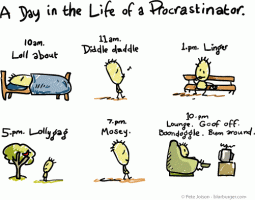
I know, it’s the hours in the day ( they haven’t changed), the retired husband (I sympathize), the grandkids, laundry, HBO (had to catch up), Twitter, Facebook, or any number of excuses we come up with to justify not reaching the finish line.

“I have not failed. I’ve just found 10,000 ways that won’t work.” Thomas Edison
Tweet this

toon_procrastinator-compressor

Procrastination is one of those insidious things that – surprise, surprise, do not get better with age. But, cheer up – there’s an app for that!

Thanks to Amy Rolph from Unstuck Advice, we can now have a digital monitor. The Unstuck app helps identify the type of procrastination you’re exhibiting and offer solutions.

Are you a drifter, deflated doer, waffler, perplexed planner, avoider, or just a fuzzy forecaster? Check out the Unstuck App to find out, and get the project completed!use_unstuck_btn-compressor

I’d love to hear your comments. Talk to me. Tell me your story and look for me on Facebook at SheilaMGood,  PinterestBloglovinTwitter@sheilamgood, Contently, and Instagram. You can follow my reviews on Amazon and Goodreads.

My Top Twenty Websites for Writers

images

Photo: courtesy of wikipedia.org

I don’t know about you, but I rely on the expertise of other writers and bloggers. I have collected an array of blogs that are my go-to resources for writing advice, critiques, editing, grammar, writing prompts, research, publishing, and blogging.

I’m sure you have your favored sites, but I thought I would share with you my top 20 websites for writers. Enjoy and if you have one, you think my readers, or I would like them, please pass the link on in the comment section below.

  1. Fiction University with Janice Hardy – one of all time favorite resources on writing.
  2. WOW- Women on Writing – designed to support women writers through all stages of writing.
  3. Live Write Thrive with CS Lakin – copywriter, editor, and writing coach.
  4. Writer Unboxed – all about the writing of fiction.
  5. The Review Review – a source for all writers interested in submitting to literary magazines; read reviews and interviews with the editors, her.
  6. Mash Stories – started out as a competition site, now a platform.
  7. Every Writer’s Resource – Literary Magazine with all kinds of resources for the writer.
  8. Now Novel– a structured method to help anyone write a novel.
  9. Story Medic – professional editing blog.
  10. Crimespree Magazine – an award-winning print magazine that covers all aspects of crime fiction writing.
  11. Melissa Sugar Writes: Have You Heard -if you love legal thrillers, Melissa is your gal.
  12. The Short Mystery Fiction Society Blog – Markets for mystery and crime short fiction.
  13. Crime Writer Sue Coletta – A crime writer’s resource.
  14. The Memoir Writing Club – Mentors and courses for those interested in memoir writing.
  15. Sister’s in Crime – With chapters all over the US, this organization’s mission is the recognition, advancement, and development of women crime writers.
  16. One Stop for Writers – the library of resources for storytellers and writers.
  17. No Rules, Just Write – CJ Lyons – Pediatric ER Doctor turned thriller writer.
  18. Writer’s Digest – both print and online magazine with every resource the writer may need.
  19. Mystery Writers of America – open to the public, this organization is for crime writers (all levels).
  20. Freelance Writing – Everything you need to know to get started and more.


I’d love to hear your comments. Talk to me. Tell me your story and look for me on Facebook at SheilaMGood,  PinterestBloglovinTwitter@sheilamgood, Contently, and Instagram. You can follow my reviews on Amazon and Goodreads.