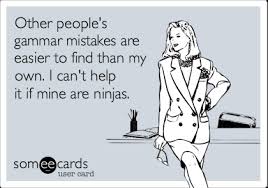
Self-Editing: Fighting Emotion with Logic

An excellent post on self-editing with practical advice. Thanks to the quintessentialeditor.

Corey Truax's avatarCorey Truax

cute kitten.jpg Please don’t sacrifice me to the writing gods…

You’ve written your book.  The masterpiece has been marinating in a drawer (or buried on a hard drive) for weeks.  Somehow, you managed to not tear into it early, despite it whispering into your ear at night.  Let’s face it, you both needed some time and space from one another.  Good job.  The time has come though.  You unlock the drawer or double click that icon and staring you in the face is months worth (maybe more) of neatly typed words. The manuscript gazes back at you with worried eyes.  It knows.  You are about to tear it to pieces.  The question is; will you tear yourself to pieces in the process?

Many people think writing a book is the hardest thing you can do.  Then an editor comes along and breaks your heart.  As an editor, telling a writer…

View original post 1,087 more words

Are Your Commas in the Wrong Place?

images-12One would think with years of education stored in my brain I would have conquered sentence structure and those damnable commas – I haven’t. If you’ve been following my blog, you may remember I wrote about this some time ago in Confessions of a Comma Whore.

Recently, I had the opportunity for an editor to review the first chapter of my novel. I was pleased with his comments and surprised to see only a few red marks on the pages.

Here’s some of what he had to say:

“You need to review participial phrases, which is quite a common mistake. Additionally, I recommend learning about restrictive VS nonrestrictive phrases, which will help you better place a few troublesome commas.”

Well, Hells Bells! It looks as if those damn commas will haunt me till I die. Thank God for editors. Forgive me if I’m insulting anyone’s intelligence but I thought I’d review these “quite common mistake’s.”

Participial Phrases

participle is a verb used as an adjective, and they end in – ing, d, t, or n.

An example: Barking dogs (Bark = verb)

A participial phrase is a group of words containing the participle and any complements or modifiers.

xbasic_diagram_participial_phrase.jpg.pagespeed.ic.QxRA8-JccHThanks to Grammar Revolution, here’s how a participle phrase looks diagrammed:

Restrictive versus Nonrestrictive Clauses

restrictive clause is part of a sentence that explicitly restricts the noun.

Dogs that jump on people annoy me.

The words “that jump on people” restrict the kind of dogs I find annoying. Restrictive clauses do not require commas.

A nonrestrictive clause provides additional information but when left out doesn’t change the meaning of the sentence.

My, fluffy white, Bichon Frisé is a lap dog.

Removing the words “fluffy white” doesn’t alter the meaning of the sentence. It just provides more information. Non-restrictive clauses require commas.

I did well in college. English was one of my favorite subjects. The fact that commas remain my nemesis can only be explained in one of two ways – This Southern gal likes to write the way she talks, or my brain cells just aren’t what they used to be.

Many thanks to James from Storymedic for his feedback and encouragement.

“… very minor corrections. I could immediately tell that you possess a more developed craft, well beyond average.”

Want to know more about those pesky participles and clauses? Check out these resources:

  1. Grammar Revolution (Diagram it)
  2. Grammar Girl: Quick and Dirty Tips
  3. The Elements of Style by Strunk and White
  4. English Plus
  5. Purdue Owl Online Writing Lab
  6. The Grammarly Handbook

Do you still struggle with certain grammar issues? I’d love to hear your comments. Talk to me. Tell me your story and look for me on Facebook at SheilaMGood,  PinterestBloglovinTwitter@sheilamgood, Contently, and Instagram.

Editing Made Easy – 7 Free Tools for the Writer

Day 5: 

images

pinterest.com

One of the most annoying, time-consuming and necessary aspects of writing is editing.

For me, after writing a piece, I find it difficult to spot all the things I might need to revise or eliminate.

Because I can’t afford to hire an editor for every short story or chapter I write, I use editing tools available to me via software downloads.

Each tool has pros and cons, and it’s worth repeating, no software can take the place of a good pair of editing eyes, but it’s a start and a good resource to have at your fingertips.

My top 7 Free Editing Tools

  1. Hemingway App – assesses the number of adverbs, complex words, passive voice, and readability.
  2. ProWritingAidprovides analysis, identifies overused words, sentence length, redundancies, clichés, plagiarism, consistency, and writing style.
  3. EditMinion – one of my favorite, uncomplicated tools. It checks for weak and overused words, passive voice, adverbs/prepositions, homonyms, and more.
  4. Word & Phrase Frequency Counter: This tool does exactly what it says, counts the number of time you use a word or phrase.
  5. Readability Score – indicates reading ease, grade level, text statistics, and keyword density.
  6. Cliché Finder – afraid you might have used a cliché or two? Identify them with this handy tool.
  7. The Writer’s Diet Is your writing flabby or lean? This simple, automated feedback tool provides a quick look at some of the sentence-level grammatical issues which weigh writing down.

My top 3 Paid Editing Tools 

  1. GrammarlyEnhances clarity and meaning, identifies most writing errors, vocabulary enhancer, contextual spelling checker, and offers a Safari extension. A little pricey for the premium plan @ $139.95/yr. – a monthly and quarterly plan is also available ranging from 29.95/mo. – $59.95/quarterly.
  2. GingerBasic- $ 61.20/yr. – Offers a browser extension, unlimited grammar checker, translations, and definitions. An upgrade to $111/yr. will give you sentence rephrasing, analysis of mistakes, text reader and more. The software is available on a month-to-month basis ranging from $8.30 -$14.60/month.
  3. AutoCrit – An online manuscript editing tool specifically for fiction writers. Ranging from $60 – $144/yr. This tool provides analysis in 25 areas in your work, highlights key elements, fiction style errors, repetition, pacing, word choice, and a comparison of your manuscript to published fiction.

There you have it, my favorite editing tools. Although it will never replace a good set of eyes, any one of these will make the process of editing easier, faster, and smoother.

I’d love to hear your comments. Talk to me. Tell me your story. You can find me on Facebook at SheilaMGood,  PinterestBloglovinTwitter@sheilagood, and Contently.

You Asked: How To Stop Overusing Pronouns

despicablememminions.org

Welcome to another, You Asked, the Experts Answer, segment. This week ‘s question is: How can I stop overusing pronouns?

Pronouns: a word that can functions by itself as a noun/phrase and refers either to participants (e.g., I, you) or to someone or something mentioned elsewhere in the discourse.”  

Words such as I, he, she, you, it, we, or they are examples of pronouns used instead of a noun or noun phrase.

We overuse pronouns because we get attached to a character or the name is often easier. I can relate to this problem. However, easy doesn’t always translate to better writing.

Norma crept by the sofa where Adam had passed out after Adam’s little welcome home. The kitchen looked like one of those Norma had seen on TV after a tornado. Norma opened the cabinet, pulled out a trash bag, and began picking up the scattered groceries.”

I tend to write like I talk and as a result, overuse pronouns especially in the draft stage. But, there is a method to the madness and used correctly, pronouns will enhance your writing. The paragraph above reads like someone in love with the name Norma or had an aversion to pronouns.

Tweet: “Pronouns are those clever little inventions that allow us to replace nouns and avoid clunky repetition.” K.M. Weiland

“Norma crept by the sofa where Adam had passed out after his little welcome home. The kitchen looked like one of those she had seen on TV after a tornado. She opened the cabinet, pulled out a trash bag, and began picking up the scattered groceries.”

Repeating the characters names, once introduced isn’t necessary. We understand Norma is the “she” picking up groceries and “his” refers to Adam.

Used Incorrectly Pronouns:

  • Creates choppy and boring sentences.
  • Pulls the focus away from the action in the scene.
  • Confuses the reader as to the who or what.
  • Pulls the reader from the story.
  • Tells rather than shows who and what is taking place.

Used correctly Pronouns:

  • Prevents repetition.
  • Creates a realistic flow of the narrative.
  • Keeps the focus on what’s happening in a scene.
  • Provides a sense of intimacy between characters.
  • Provides invisibility – like the tag “said,” readers process but don’t notice them.

When to Use Pronouns:

  • When only one character is present.
  • When two characters of opposite gender are present.
  • The pronoun’s reference is clear to the reader.

Tweet: “Ensure your pronouns have an unambiguous antecedent that is both before and near each pronoun.” Grammar Girl

Use Names:

  • To introduce your character, item, or event
  • To ensure clarity between characters when there are more than two characters in a scene.
  • To emphasize a character or his name.

No matter what your grammar sin may be, get your story down first. The revision stage and a good editor will help you make the necessary corrections. Below you’ll find a wealth of knowledge from the experts.

Resources:

  1.  Janice Hardy from Fiction University will help you Clarify Ambiguous Pronouns.
  2. Grammar Girl’s Quick & Dirty Tricks explains how to avoid the three most common errors in Pronoun and Antecedents.
  3. Writing World’s offer us, Crafting Fabulous Fiction: Pondering Personal Pronouns by Victoria Grossack

What about you? I’d love to hear your comments. Talk to me. Tell me your story and look for me on Facebook at SheilaMGood,  PinterestBloglovinTwitter@sheilagood, and Contently.