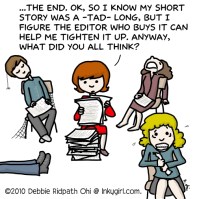
How to Deal With Manuscript Critiques

ANNABEL SMITH

I have my manuscript out to my first beta readers and am anxiously awaiting their feedback and critiques. I’ll admit, it’s nerve-wracking. Will they like it? Were my characters well-developed? Was the plot cohesive? Was the story compelling? 

I really want to hear what they have to say. I want honest opinions, but how do I handle the comments and critiques? What if it simply wasn’t their favorite genre? What if I disagree? What if, what if, what if…

Janice Hardy gives us 8 tips in her post, 8 Tips for Reviewing a Manuscript Critique.

  1. Here’s a sneak peek:
  2. Take comments seriously
  3. If you agree, change it; if you don’t agree, don’t.
  4. Not sure? Give it consideration. Why did the reviewer think or make that comment?
  5. Grammar or punctuation – look it up. The Elements of Style by Strunk & White
  6. If something is confusing, fix it. Clarity is essential to the story.
  7. Do what makes your story the best.
  8. Be objective.

Janice covers each of these in more details and provides additional resources. So, stop by and check out her post,
8 Tips for Reviewing a Manuscript Critique.


I’d love to hear your comments. Talk to me. Tell me your story. I’m all ears and look for me on Facebook at SheilaMGood,  PinterestBloglovinTwitter@sheilamgood, Contently, and Instagram. You can follow my reviews on Amazon and Goodreads.


SaveSave

SaveSave

SaveSave

To Clara: Regarding Your Critique

I don’t often reblog, not because there isn’t a mountain of beautiful posts out there worth sharing. I tried to offer my readers my thoughts and stories (for whatever that’s worth), but once in a while I come across a post, article, or story that is so profound, so moving, or simply amazing that I must share – not doing so, would be remiss of me.

There are a couple of blogs I will be sharing this week with you and first up is from The Drabble: To Clara: Regarding Your Critique by Keith T. Hoerner. This is one of the most moving and poignant pieces I have ever read, and it’s is something all writers can relate.

The Drabble's avatar

adult-1846488_1280

By Keith T. Hoerner

You shared your writing with me. An extension of friendship, like a handshake. More like the reaching out of hands with the chance to be held – or swatted – open palmed. Sharing … emptying pockets to reveal hidden things among the embarrassment of collected lint, is a dangerous proposition. Your shadows merged with mine, achieving the density of darkness that brings on the dawn. How can I thank you? For selflessly taking my hands and guiding me to an unknown resting place within the pages of you. I spoke in an attempt to reciprocate. My words: sandpaper to your beach of memory.

View original post

How to be an Effective Critique Partner

Critique_005I’ve been bogged down this weekend with family and community events. So, I’m sharing an oldie  but a goodie (1st published 2013), but with a few tweaks and additional information. Enjoy.

Critiques are a part of every writer‘s life. Whether it’s a one on one partner, or a group providing feedback. Having another set of eyes on your stories, essays, or novels is essential for growth and success.

Accomplished writers already understand the value of a good critique partner. For newer writers or those who have yet to take part in a group, I’d like to share my critique cheat sheet. I hope you’ll find the information provided here helpful.

A Few Things to Remember:

  1. The format and function may differ from group to group.
    Know the rules before joining to ensure the commitment is one you are willing to make.
  2. If you don’t know the group’s process, ask before your first meeting.
  3. Don’t rubber stamp each submission presented with, “I loved it,” without providing further constructive feedback. Doing so is unfair to the author. Those who submitted work want and deserve a genuine response and critique.
  4. Critique groups are not about safeguarding a writer’s feelings. It’s about providing quality feedback.
  5. If this is your first group, familiarize yourself with the terminology groups use. (genre, protagonist, antagonist, point of view (POV), voice, conflict, backstory, info dump, pacing, opening and resolution).

My Cheat Sheet for the Short Story Critique and Things to Consider:

  1. Did you enjoy the story? If not, why.
  2. Could you identify the story’s setting? Or, did you get lost in too much backstory?
  3. Did the story engage you and draw you in? Did you want to keep reading?
  4. What about the opening sentence or paragraph? Did they make you want to read further. If not, why? What made you hesitate?
  5. Was the protagonist clear to you? Did you understand the goals?
  6. Did you have enough information about the main character? Did you like the character or care about his/her situation (goals versus conflict).
  7. Were the stakes facing the protagonist, high enough to make you care?
  8. Did you find the dialog believable? Too much internal dialogue?
    Were you able to identify the genre?
  9. Did the story progress in a natural flow, or were there places that left you confused? Explain.
  10. Was there a resolution? Did the ending make you happy or, leave too many unanswered questions?
  11. Could you identify the theme?
  12. Explain the things that gave you pause. Make notes in the margins of the submitted piece indicating pertinent information. It could be a wrong word choice, sentence length, credibility, pacing, or something else.

Articulating your impressions provide the author with specific feedback. They can then decide to use or not use the information to strengthen their story. Sometimes, we’re too close to our work to see the flaws. Another set of eyes helps point out the weaknesses or holes in our story.

Good critique partners are an invaluable resource and asset to writers of all levels and I encourage you to find one in your area or online.

Want more information on critique partners and groups? Ryan Lantz gives excellent pointers, in his post, Critique Partners 101: Everything You Need to Know Before Pairing Up.

Interested in starting a group? Janice Hardy, from Fiction University, provides the lowdown on how to start a group, Are You Looking for a Critique Group or Partner?

Here’s to wonderful critique partners.

I’d love to hear your comments. Talk to me. Tell me your story. And as always, you can follow me on Facebook at SheilaMGood, Pinterest, Bloglovin, Twitter @cofcmom, and Contently.


How to be an Effective Critique Partner

Critique_005I’ve been bogged down this weekend with family and community events. So, I’m sharing an oldie but goodie, with a few tweaks and additional information. Enjoy.

Critiques are a part of every writer’s life. Whether it’s a one on one partner, or a group providing feedback. Having another set of eyes on your stories, essays, or novels is essential for growth and success.

Accomplished writers already understand the value of a good critique partner. For newer writers or those who have yet to take part in a group, I’d like to share my critique cheat sheet. I hope you’ll find the information provided here helpful.

A Few Things to Remember:

  • The format and function may differ from group to group.
  • Know the rules before joining to ensure the commitment is one you are willing to make.
  • If you don’t know the group’s process, ask before your first meeting.
  • Don’t  rubber stamp each submission presented with, “I loved it,” without providing further constructive feedback. Doing so is unfair to the author. Those who submitted work want and deserve a genuine response and critique.
  • Critique groups are not about safeguarding a writer’s feelings. It’s about providing quality feedback.
  • If this is your first group, familiarize yourself with the terminology groups use. (genreprotagonist, antagonist, point of view (POV), voice, conflict, backstory, info dump, pacing, opening and resolution).

 My Cheat Sheet for the Short Story Critique and Things to Consider:

  1. Did you enjoy the story?  If not, why.
  2. Could you identify the story’s setting? Or, did you get lost in too much backstory?
  3. Did the story engage you and draw you in? Did you want to keep reading?
  4. What about the opening sentence or paragraph? Did they make you want to read further. If not, why? What made you hesitate?
  5. Was the protagonist clear to you? Did you understand the goals? Did you have enough information about the main character? Did you like the character or care about his/her situation (goals versus conflict).
  6. Were the stakes facing the protagonist, high enough to make you care?
  7. Did you find the dialog believable? Too much internal dialogue?
  8. Were you able to identify the genre?
  9. Did the story progress in a natural flow, or were there places that left you confused? Explain.
  10. Was there a resolution? Did the ending make you happy or, leave too many unanswered questions?
  11. Could you identify the theme?
  12. Explain the things that gave you pause. Make notes in the margins of the submitted piece indicating pertinent information. It could be a wrong word choice, sentence length, credibility, pacing, or something else.

Articulating your impressions provides the author with specific feedback. They can then decide to use or not use the information to strengthen their story. Sometimes, we’re too close to our work to see the flaws. Another set of eyes helps point out the weaknesses or holes in our story.

Good critique partners are an invaluable resource and asset to writers of all levels and I encourage you to find one in your area or online.

Want more information on critique partners and groups? Ryan Lantz gives excellent pointers, in his post, Critique Partners 101: Everything You Need to Know Before Pairing Up.

Interested in starting a group? Janice Hardy, from Fiction University, provides the lowdown on how to start a group, Are You Looking for a Critique Group or Partner?

Here’s to wonderful critique partners.

I’d love to hear your comments. Talk to me. Tell me your story. And as always, you can follow me on Facebook at SheilaMGood, PinterestBloglovin, Twitter @cofcmom, and Contently.