EDITING 101: 02 – Description Depression…

Descriptions, like backstory can be difficult for writers. When and how to introduce a character, setting, or motivation, if not done well comes across like a glob of information dumped in the middle of the page. When this happens, the readers often skips ahead or stops reading.

Chris the story reading Ape, does a great job discussing descriptions in the post below. Be sure to let him know you like it.
Also, for additional help with descriptions, check out the Physical Feature Thesaurus and The Urban/Rural Settings Thesaurus at http://writershelping writers.net.

Thanks Chris!

Chris The Story Reading Ape's avatarChris The Story Reading Ape's Blog

Originally posted as the Dun Writin’—Now Whut? series on this blog, EDITING 101 is a weekly refresher series for some of you and brand new for others.

Courtesy of Adirondack Editing

 Do You Have Description Depression?

Are you a writer who uses rich, lush descriptions for their settings and characters? Or one who just wants “the facts, Ma’am, just the facts”? Is it an effort to decide how much description to use, where, and exactly what?

If you struggle with Description Depression in your writing, you’re not alone. There isn’t a “correct” way to use description in fiction, although, in my humble opinion, you’re better off using too little than too much.

In over describing, a writer runs the risk of annoying their readers. Many readers admit to skipping over large amounts of description. It didn’t used to be that way. Before the age of movies, television, the Internet, and smartphones…

View original post 486 more words

How to Show Anger in Your Characters

hqdefault-2Daily Post Prompt:  Angry

Anger – a strong feeling of annoyance, displeasure, or hostility. Usually consisting of a three-part reaction: negative thoughts, frustration, and acting out (screaming, shaking fist, or violence).

Whether it’s in the form of nasty tweets or highly-charged protests, the media and social networks are rampant with demonstrations of anger.  And, although most people think anger is a negative and counterproductive emotion – it does have benefits worth noting.

Benefits of Anger to Individuals

  1. It motivates us.
  2. Makes us feel more confident.
  3. Acknowledging anger helps lower stress and pain.
  4. Expressing anger rather than bottling it up, benefits interpersonal relationships.
  5. Provides insight if we’re open to looking inward.
  6. Aids negotiations.

In life, anger isn’t always a bad thing. But, how do we use it in writing? Part of making our characters well-rounded and real, is capturing their emotions – including anger. Anger equals conflict and conflicts move the plot forward.

Reasons Characters get Angry:

Just like us, our characters get angry when they feel helpless, confused, frustrated, jealous, embarrassed, or hurt, to name a few.  But, how do we show anger without being melodramatic? First of all, forget the clichés and don’t rely entirely on the actions of the character (remember show don’t tell).

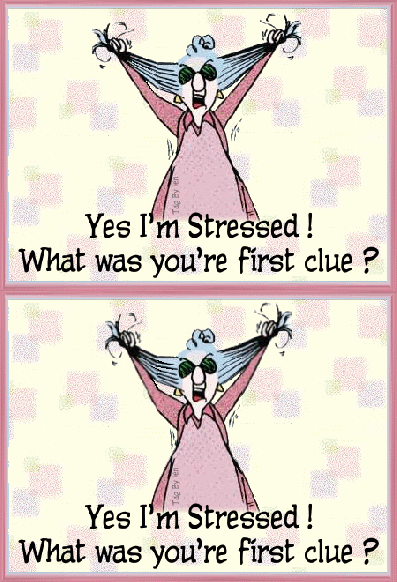
We show anger in the way we speak, the tone of our voice, and body language. Below is a small sample of the ways you can show anger in your characters.MAXINE1131313

Angry Speech:

  • Stammer with rage
  • Taunt
  • Sputter
  • Scream
  • Speak in grudging tones
  • Sarcasm

Angry Tones of Voice:

  • Strained
  • rising an octave
  • Tinged with menace
  • Dripping with Spite
  • Cool, icy
  • Voice shaking

Facial Expressions:

  • Scorching look
  • Eyes narrowing with contempt
  • Withering stare
  • Regard bitterly
  • Warning look
  • Glower
  • Eyes that are cold
  • Nostrils flaring
  • jaw clenching
  • Eyebrows drawing together
  • Reddened face

Other Body Expressions:

  • Clenching fists
  • Stomping
  • Punching, kicking, throwing
  • Body tense
  • Veins visibly pulsing
  • Breathing deeply
  • Muscles quivering
  • Slamming doors, etc.

For more on how to write about anger, check out these resources:

  1. 37 Ways To Write About Anger by Amanda Patterson
  2. Creating Emotional Frustration in Your Characters61zuks2byenl-_sx348_bo1204203200_
  3. Emotional Rollercoaster: Writing Anger by Apryl Duncan
  4. The Emotion Thesaurus: A Writer’s Guide to Character Expression
  5. The Writer’s Digest Sourcebook for Building Believable Characters 1st edition by Marc McCutcheon 51pt853khal-_ac_ul480_sr312480_

Anger is one of those emotions that make us uncomfortable, but it is an essential component of who we are and thus your characters.

How do you show anger in your characters?

I’d love to hear your comments. Talk to me. Tell me your story and look for me on Facebook at SheilaMGood,  PinterestBloglovinTwitter@sheilamgood, Contently, and Instagram.

Unusual Character Traits

Day 21:  #AtoZChallenge

The characters in our stories and novels are often very complex. We spend a lot of time getting to know them, asking questions, describing them and giving them a personality.

We want our readers to visualize our characters and recognize them every time they speak. But, what can we do, besides names, ages, or gender to make our characters memorable?

Give them unusual character traits or as John Yeoman from the Village Academy calls it, a signature. We all have our idiosyncrasies, so give your characters  a few; make them mimic real people. To get you started, here are a few suggestions.

30  Unusual character traits worth considering:

  1. Meaningful repetitions – for instance in my novel, one of the characters uses the term, “Dear” when speaking to others.
  2. Twirls hair when preoccupied or worried.
  3. Bites nails when nervious.
  4. Taps fingernails or pencils against a hard surface when nervous.
  5. Chain smokes.
  6. Always carries water, tea, or other beverage with them.
  7. A hugger or touchy-feely person or the reverse – can’t stand to be touched.
  8. Always chews gum – but only one flavor.
  9. Has a movie quote for every situation.
  10. A speech impediment – stutter, or lisp.
  11. A distinctive accent.
  12. Clumsy – in movements or socially.
  13. Intolerant and impatient.
  14. A peculiar dresser – loud colors or mismatched clothing.
  15. A jokester.
  16. Refuses to use slang – always correcting others.
  17. Superstitious – carries a rabbit’s foot or another talisman for luck.
  18. Whistles non-stop.
  19. Compulsively washes hands or straightens items on his desk.
  20. Colorblind.
  21. Carries a cigar and chews on it but never lights it.
  22. Draws squiggles in the border of every piece of paper or notepad in front of them.
  23. Photographic memory.
  24.  A facial tic.
  25. A crooked smile.
  26. Eyes that are a different color.
  27. Meticulous or expensive dresser.
  28. Calls every younger man “son.”
  29. Hates dirt.
  30. Only eats the “green” jelly beans or M & M’s.

Those listed above are a few among many unusual traits. People are a bit weir, sometimes. It’s our backgrounds, genetics, and life experiences that make us different. It’s also what gives us our uniqueness.Wheather your characters are lovable or detestable, make them real, unique and memorable.

Want to know More? Check out these recources:

Writers Helping Writers – Home to the The Emotion Thesaurus: A Writer’s Guide to Character Expression. 

What about your characters? Are they memorable? Do they have an unususal trait?

I’d love to hear your comments. Talk to me. Tell me your story and look for me on Facebook at SheilaMGood,  PinterestBloglovinTwitter@sheilamgood, and Contently.

A2Z-BADGE 2016-smaller_zpslstazvib