Dark Cloud Hovering

DAILY PROMPTClouds

She couldn’t remember the last time she noticed the clouds. One day, like a magician’s trick, they disappeared – poof.  She missed the metallic smell of rain and scared didn’t begin to describe what the country was feeling. The first and last words on the radio or news channels were, “The worst drought since …” Blah, blah, blah.

Shit, for that matter, all the heat made it difficult for her to remember the year. Her brain felt as fried as the landscape. Dead shrubs, grass that crumbled into sawdust under your feet, and flowers with their blooms bowed and shriveled was all that was left. A rose is a rose until it’s no more. Damn, that sounded sad.

Sweat beaded on her forehead and trickled down her sides. She slipped on her sunglasses, moved to the curb and raised her hand praying for a cab and the comfort of air-conditioning.

Her hair fluttered across her face in the same instant a gust of wind lifted her skirt, and a breeze tickled her sticky thighs. Wind!

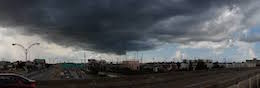
The air turned nippy, and the sky darkened. Removing her sunglasses, she watched the large dark cloud moved overhead and hovered. The whole country had prayed for rain. Maybe, God had heard.

She checked for the small pocket umbrella hiding in the bottom of her bag; it wasn’t there. Why add the weight of something you don’t need to an already bulging bag? Who cares at this point, she’d love the chance to dance in the rain.

The cloud grew darker and expanded. Something about the way it swirled and danced made her shiver and nervous. The electricity in the air was palpable making the hairs on her arms stand at attention. Bouncing on her toes, she scanned the streets for her rescue. Jesus, where were the cabs?

The earth shook with a sudden roar and rumble. The sound was deafening. The wind rushed against her back, pushing her into the street. Flailing against the invisible assault, she dropped her purse and portfolio into the street. Papers flew into the air and scattered. Jesus H Christ!

She scrambled for the pages littering the landscape, grabbing what she could and running after the others as the wind lifted them skyward beyond her reach. Her ragged breath echoed in the middle of an empty street. Fear slithered down her spine like a snake. Everyone was gone. The familiar storefronts blackened as if they’d never existed.

She whirled around searching for anyone. Her heart pounded as she let the last piece of crumbled paper fall from her fist and covered her ears as the dark, angry clouds roared.

The ground shook, knocking her to her knees. She clawed at the pavement and tried to hold on as the darkness of Hell enveloped her, robbed her of oxygen and the rain of a thousand years drowned out her cries. Why me?

I’d love to hear your comments. Talk to me. Tell me your story and look for me on Facebook at SheilaMGood,  PinterestBloglovinTwitter@sheilamgood, Contently, and Instagram.

You Asked: What the Heck is a Beta Reader? Do I Need One?

Beta ReaderWelcome to another,  You Asked, the Experts Answer, segment.  This week’s question is: What are Beta Readers and do I need one?

A Beta Reader is someone who reads your manuscript before you release it and provides feedback.

Similar to technology companies who release software updates to Beta Testers for the purpose of identifying any bugs before releasing the software to everyone.

A Beta Reader does the same sort of thing for you. It’s a test run of your manuscript.

Is it the Same as a Critique?

No. Critiques, are more in-depth and focused on grammar, plot holes, and the mechanics of writing.

A Beta Reader focuses on reading your manuscript. Feedback received includes their overall impression and any glaring mistakes. They will also provide a review after the release of your book.

Do I Need One?

Based on what publishers and other experts say, yes. For those who choose to self-publish, using Beta Readers is, particularly, important. By the time we’ve finished a manuscript, our eyes stop seeing the holes or mistakes. Beta Readers are your test readers. Sending a book out into the world without utilizing this valuable resource can make or break your book’s success.

Where To Find Beat Readers

  1. Social networking with other authors and writers in your genre. Twitter, LinkedIn, and Facebook Groups are all excellent.
  2. GoodReads has an online Beta Reader Group.
  3. A local group.
  4. Fellow Bloggers.

Things to Remember:

  • Beta Readers should not be family or close friends.
  • They should, ideally, be within the target audience for your book –  age, gender, genre, and interest.
  • They’re avid readers.

Want More? Check out these other great posts on Beta Readers.

Coming soon, a request for Beta Readers for my soon-to-be-released Collection of Short Stories. More about that later. Until then, I’d love to hear your comments. Talk to me. Tell me your story and look for me on Facebook at SheilaMGood,  PinterestBloglovinTwitter@sheilamgood, Contently, and Instagram.
Stories to Share

Time to ShareIt’s time to honor my fellow writers for giving us great stories to read. If you’re like me, a well-written story can stay on your mind for days. Sometimes, it motivates our creativity or nudges us to work harder on our stories.

For your reading enjoyment here are this week’s selections and don’t forget to share.

Editor’s pick: The 21st Floor @ Your Story Club by Athul Krishna. Interested in seeing your story published? Check out Your Story Club.

From No Extra Words Podcast, “Dial 116”  by Robert Lunday.

Wow – Fall 2015 Flash Fiction Contest – 2nd Place; Where Charlotte Lay by Beth Everette. Submit to the WOW Summer 2016 Flash Fiction Contest, now.

An Unexpected Death by P.S. Hoffman. You can follow P.S. Hoffman’s blog,  here.

Happy reading!

I’d love to hear your comments. Talk to me. Tell me your story and look for me on Facebook at SheilaMGood,  PinterestBloglovinTwitter@sheilamgood, Contently, and Instagram.


Are Your Commas in the Wrong Place?

images-12One would think with years of education stored in my brain I would have conquered sentence structure and those damnable commas – I haven’t. If you’ve been following my blog, you may remember I wrote about this some time ago in Confessions of a Comma Whore.

Recently, I had the opportunity for an editor to review the first chapter of my novel. I was pleased with his comments and surprised to see only a few red marks on the pages.

Here’s some of what he had to say:

“You need to review participial phrases, which is quite a common mistake. Additionally, I recommend learning about restrictive VS nonrestrictive phrases, which will help you better place a few troublesome commas.”

Well, Hells Bells! It looks as if those damn commas will haunt me till I die. Thank God for editors. Forgive me if I’m insulting anyone’s intelligence but I thought I’d review these “quite common mistake’s.”

Participial Phrases

participle is a verb used as an adjective, and they end in – ing, d, t, or n.

An example: Barking dogs (Bark = verb)

A participial phrase is a group of words containing the participle and any complements or modifiers.

xbasic_diagram_participial_phrase.jpg.pagespeed.ic.QxRA8-JccHThanks to Grammar Revolution, here’s how a participle phrase looks diagrammed:

Restrictive versus Nonrestrictive Clauses

restrictive clause is part of a sentence that explicitly restricts the noun.

Dogs that jump on people annoy me.

The words “that jump on people” restrict the kind of dogs I find annoying. Restrictive clauses do not require commas.

A nonrestrictive clause provides additional information but when left out doesn’t change the meaning of the sentence.

My, fluffy white, Bichon Frisé is a lap dog.

Removing the words “fluffy white” doesn’t alter the meaning of the sentence. It just provides more information. Non-restrictive clauses require commas.

I did well in college. English was one of my favorite subjects. The fact that commas remain my nemesis can only be explained in one of two ways – This Southern gal likes to write the way she talks, or my brain cells just aren’t what they used to be.

Many thanks to James from Storymedic for his feedback and encouragement.

“… very minor corrections. I could immediately tell that you possess a more developed craft, well beyond average.”

Want to know more about those pesky participles and clauses? Check out these resources:

  1. Grammar Revolution (Diagram it)
  2. Grammar Girl: Quick and Dirty Tips
  3. The Elements of Style by Strunk and White
  4. English Plus
  5. Purdue Owl Online Writing Lab
  6. The Grammarly Handbook

Do you still struggle with certain grammar issues? I’d love to hear your comments. Talk to me. Tell me your story and look for me on Facebook at SheilaMGood,  PinterestBloglovinTwitter@sheilamgood, Contently, and Instagram.