Stories to Share

There is no shortage of talented writers out there, but if you’re like me, finding time to read all of the great stories that come across our screens can prove to be difficult. However,  I encourage you to make the time. Not only will you enjoy some great stories but also learn a bit about the craft of writing short fiction.

Reasons to Read Other’s Stories

Here are a few of things I’ve learned from reading the work of other writers.

1. With each story, I learn something new about the craft.

  • Story structure.
  • The use of a theme.
  • Character development.
  • The use of imagery
  • And, the lyrical language of prose.

2.  I also learn about the magazine, contest, or journal. The types of stories they like and publish most often. The more you read from a magazine, the better feel you have of what your story might need to achieve acceptance and publication. Of course, it goes without saying, read the guidelines before making any submission. 

3. I love to pass these stories on. As a writer, I know the work that goes into perfecting a story. It’s a labor of love and one we all like recognized.

It’s my honor to share these stories with you, and I hope you will pass them on. So, without further ado, happy reading:

Cadenza by Naira Kuzmich – carvezine.com/story/2018-winter-kuzmich

This Too Shall Pass by Shannon Stocker – WOW Essay Contest 1st Place Winner

Two Slices of Toast  by Dan Belmont – The Weekly Knob

As always, give the author a shoutout and let them know how much you enjoyed their work.

I’d love to hear your comments. Talk to me. Tell me your story. I’m all ears and look for me on Facebook at SheilaMGood,  PinterestBloglovinTwitter@sheilamgood, Contently, and Instagram. You can follow my reviews on Amazon and Goodreads.


Thanks for The Honor

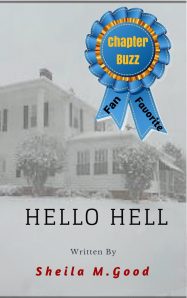
HELLO HELL

Fan Favorite Award

It’s hard to believe it’s been almost a year since I participated in the ChapterBuzz 10K Social Writing Challenge to work on my novel, Hello Hell.

It’s been an honor to meet so many talented writers and read so many extraordinary books. Thanks to Timothy Pike for the lovely feature article on my participation. Read it here, As a writer, how do you overcome paralyzing self-doubt? This author knows how.

Then, get your pencils sharpened, your paper ready,  and  hop on over to sign up for the upcoming 10K Social Writing Challenge beginning March 1st!cropped-pencils-762555__480.jpg

Please check out my novel, Hello Hell on ChapterBuzz, now up to 62, 861 words, as well as,  all of the other award-winning books by an ever-growing list of talented writers.

I’d love to hear your comments. Talk to me. Tell me your story. I’m all ears and look for me on Facebook at SheilaMGood,  PinterestBloglovinTwitter@sheilamgood, Contently, and Instagram. You can follow my reviews on Amazon and Goodreads.
 

Communicating the Old-Fashion Way is So Much Better

If you read nothing else, read  Duck-Face for the Deceased by kalanleitch.

A Friend and often guest blogger here in the Cow Pasture takes an honest look at how we communicate condolences on the day of tragedies, whether a local, state or worldwide event.

I realize people mean well, but so often we get caught up in the social media bombardment of the moment. We feel bad. We want to do something, offer our expressions of concern, sympathy, or comment on the “trending sentiments”.

But, stop for just a moment and think before jumping on the bandwagon. Is there a better way? Could you send a personal, hand-written note? Call and ask what they might need? Donate? Send flowers? Take a dish by, or call and have a real conversation?

Social media has taken the place of personal interaction, real communication, and emotions. It becomes so easy to hide behind an emoji, Twitter handle, or other distance and impersonal handle. So, take a second, check out kalanleitch‘s post, Duck-Face for the Deceased and rethink that next social media “Like,” condolence, or Tweet.

We are first and foremost people who thrive on personal interaction, touch, eye-contact, the much-needed shoulder or a hug.

Just my two cents and thanks to kalanleitch for sharing.

I’d love to hear your comments. Talk to me. Tell me your story. I’m all ears and look for me on Facebook at SheilaMGood,  PinterestBloglovinTwitter@sheilamgood, Contently, and Instagram. You can follow my reviews on Amazon and Goodreads.

For Every Action

newton-s-cradle-balls-sphere-action-60582.jpgIf you remember much from your school days (which is getting harder by the year for this fence jumper) you’re familiar with Newton’s Third Law of MotionFor every action, there is an equal and opposite reaction (a force when an object interacts with another interaction).

For example, if I throw a rubber ball against the wall in anger, the wall is gonna push back and one of several things will happen: 1) I’ll catch it; 2) I will miss it and it will crash into my antique lamp; or 3) it will fly back and sock me in the nose (the most likely scenario). That’s a silly example, but you get the drift. Now, think about writing and how this law relates to your characters and their dialogue.

Dwight V. Swain, author of Techniques of the Selling Writer discusses how to identify “the code of efficient prose, Motion-Reaction Units (MRU); and, in her post, Motivation-Reaction Units: Cracking the Code of Good Writing, K.M. Weiland breaks it down even further by providing excellent examples.

Simply put, something motivates your character to react. An action, deed, event, conversation, impulsiveness, or fear, to name a few. The possibilities of what that motivation is depends on your character, and your story. The list of motivations can be long, winding, and provide depth to your story. Whatever it is that motivates a  character to action, the reactions will help propel the story forward, introduce complications, the ante, and used to reveal.

A Few Things to Keep in Mind When Using MSU’s:

  1. Motivations, the actions and reactions must run in a logical manner.  They have to make sense to your reader. Introducing a  reaction before the cause or motivation sows confusion.
  2.  According to K.M. Weiland, MRU’s typically are divided into three parts: feelings/thoughts, action, and speech.
  3. Not all three of these elements are always necessary; well-written dialogue can reveal a lot about the characters reaction.
  4. Reaction doesn’t always mean a  physical reaction; sometimes, it’s mental or emotional. It should, however, be clear to the reader.

Using MRU’s is a tool which we can use to bring our scenes, characters, and dialogue to life, making them feel real and authentic to the reader. Check out K.M. Weiland’s post, Motivation-Reaction Units: Cracking the Code of Good Writing and tell me what you think. Do you use this technique or something different? Share it with the Fence Jumpers, we’d love to hear all about it.

I’d love to hear your comments. Talk to me. Tell me your story. I’m all ears and look for me on Facebook at SheilaMGood,  PinterestBloglovinTwitter@sheilamgood, Contently, and Instagram. You can follow my reviews on Amazon and Goodreads.

SaveSave