How to Successfully Keep Track of Submissions

Charles Canary

Now, that you’re thinking about submitting your work, you need an easy method for tracking all those submissions.

 Why keep track?

  1. Turn around time can vary from a few days to nearly a year. The average response time is more like 2-3 months.
  2. You need a record of who, where and what you submitted to avoid sending the same query to the same publication/editor.
  3. Keeps track of  documents and word counts. We all have more than one version and/or word count and being able to identify the appropriate document is helpful as market guidelines may differ.
  4. And, builds your own statistics regarding response times, acceptance rates, or those offering feedback and critiques.

Resources to Keep Track:

You can find many resources online, some easier to use than others:

  1.  Duotrope Digest –  A huge searchable database, and due to the large membership, statistics are readily available. Information is entered manually. The cost – $5/month.
  2. The Writer’s Database:  A free, online database which functions similar in fashion to Duotrope. Requires manual entries in a smaller database.
  3. Use folders on your computer. Arrange by time, publication, or title. Good labeling is the key to organizing your files.
  4. Or, use a spreadsheet, as I do and NOW, you can too.

Below is my  FREE  gift to you:

My Free Gift to You

An easy and quick submission tracker at your fingertips. Header columns include: Title, Category/genre, Submission Date, Status, Publisher, Website, Reply/Comments and Document links. You can change them to suit your needs. Click the link or image to download your copy today.

Submission Tracker Log Sheet1

Submission Tracker Log

Click image to download

How to Create Documents Links for Your Tracker:

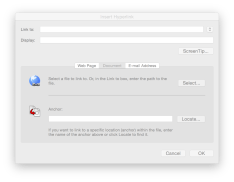
By creating a link to the actual document, you  are able to see the version submitted with a click. To create the hyperlink follow these steps:screenshot
  1. In Word, open the document.
  2. Select Insert, Hyperlink.
  3. Select Document, then select File.
  4. Locate your file in the Finder, select and the link is automatically entered.
  5. Open File Properties and enter the link in the Summary Section under Hyperlink Base.

I hope you will enjoy this gift and find it helpful in keeping track of your submissions. I’d love to hear from each of you and what you think about the tracker.

Happy writing and success on your submissions.

Submit or Not to Submit

Photo courtesy of google & groggrog.blogspot.com

In the last several days, three friends have recommended writing contests to me. Intrigued I began the process of reviewing  each site,  contests details, and the guidelines. Hour’s later after reading back issues and making a list of deadlines, I’m exhausted. Submitting is hard and time-consuming work.

But life has taught me, the best things come with hard work and perseverance.

Even if your story or essay isn’t accepted, submitting on a regular basis, provides advantages.

What’s in it for you?

  1. Themed contests are like prompts, spurring imagination and the desire to write.
  2. Deadlines help you prioritize time.
  3.  Reading the works of others, introduce you to other writers and genres.
  4.  Many magazines offer feedback and/or a written critique from the judges (a favorite perk of mine.) Who wouldn’t want to receive information which will improve your skill as a writer and likewise, increase your chance of acceptance?
  5.  Practice makes perfect. You gain experience and knowledge with every submission and in the end, you might achieve your goal.
  6.  Provides a venue for others to discover your work.

As you well know, if you follow Duotrope, statistics on acceptance rates for many are dismal. However, when you receive that acceptance letter or email, it’s magic and well worth the time and effort.

A note of Caution When Submitting:

  1. Read and follow the guidelines. A lack of compliance is a frequent complaint from many editors.
  2. Check and double-check spelling and grammar. Read aloud, listen to it on your Kindle, or ask a respected friend for feedback.
  3. Stay within the designated word count. Sounds easy enough, however, sometimes the title counts, sometimes it doesn’t. Knowing which will determine whether your story lands in the consideration or rejection pile.
  4.  Know the basics of the contest. Is there a theme, particular genre, or is the contest open?
  5.  Know whether it’s a blind submission or requires author identification.
  6.  Format according to submission guidelines. The guidelines differ for each magazine or contest.
images-2

Photo courtesy of google & http://www.smartfitbykatemartin.com

So, take the leap. Review the Call for Submissions in the sidebar; check out Duotrope,  Every Writer’s Resource, and The Write Life for their list of current contests.

Remember, no risk, no gain.

Happy writing, submitting, and best of luck!

Do You Have Story Attachment Syndrome?

WORLD YOU LOVE

Story Attachment Syndrome (SAS), as I like to call it, is similar to Helicopter parenting. And for those of you unfamiliar with the term, I’ll paraphrase. Helicopter parents hover over their children in a state of extreme concern, protect them from real or imagined harm, resolve stressful situations and get them out of trouble, even if they misbehave. Experts say overprotective parents hinder a child’s ability to grow into mature and responsible adults.

Writers often behave in a similar pattern when it comes to writing a story close to the heart. Our stories are our babies. We know them inside and out or think we do, and don’t want anyone else telling us a scene, character or, God forbid, the whole plot isn’t working. They hover, protect and refuse to accept constructive feedback, make revisions or edits, even when doing so would make the story stronger

We’ve  all been there at some point in our writing journey, but the key to finding a cure, as with anything, is to recognize we have a problem. SAS is no respecter of persons and can affect writers of all levels of experience. Long-term effects cause less confidence,  a floundering work in progress (WIP), sense of hopelessness causing one to stuff the WIP in a drawer in defeat, or arrogance and sending a poorly written story to the world.

You Might be Suffering from SAS if:

  1. You have a manuscript or story you’re struggling to complete (extreme concern). Think, as in years.
  2. If you protect parts of your story, you know in your gut, may be detrimental to the story as a whole.
  3. You insist certain scenes or characters are essential to your story, despite feedback they need revision or not working.
  4. You avoid feedback altogether because it’s safer.

Children learn from making mistakes if we let them. So do writers. Overprotecting children or manuscripts, for the sake of avoiding failure,  will result in the very thing we wish to avoid. Trial and error help us become skilled, confident writers and published authors.

Fortunately, like Helicopter parenting, SAS is curable.

How to overcome SAS?

  1. Step back and honestly evaluate your story or solicit the help of a trusted editor or Beta reader.
  2. Don’t shy away from thinking outside your plotline. Revisions are part of growing as a writer.
  3. Remove your protective blinders and listen to constructive feedback.
  4. Believe in yourself – not every story will be perfect, but practice does make perfect.

As someone who has been working on my novel, for several years, I can relate. I’ve revamped a few things in my story, changed the timeline, and scenes are in the trash.

My helicopter has landed.

If you would like more information, check out Jennifer Blanchard‘s video on story attachment.

What about you? Do you suffer from SAS? I’d love to hear your story.

Revise, Persevere, or Trash it?

Photo Courtesy ofhttp://www.google.com/info.agmednet.com

Photo Courtesy ofhttp://www.google.com/info.agmednet.com

I started writing my first novel, several years ago. Since then, I’ve revised, cut, changed the timeline, and rethought some of the characters in my current work in progress (WIP).

Am I going about the process the right way? Perhaps and perhaps not, opinions differ.

Janice Hardy at Fiction University (a favorite of mine) has a thought-provoking post on this today, “OnwardNo? Write to the End or Go Back and Edit.” The reasons, she suggests, writers get into the revision and edit mode  include:

  • The first chapter isn’t where the story starts.
  • The story just isn’t working.
  • You’ve decided the story you’re writing, isn’t the real story.
  • The character you thought was the protagonist isn’t.
  • Or, you’ve studied the craft, learned a few techniques, and want to fix your mistakes.

As part panster and part planner, I’ve experienced all of the above. I do study the craft; I read and sometimes make revisions and edits. I hope my novel will be better for it.

At any rate and well past 30,000 words,  I’m too far to stop now. I plan to see this first draft to fruition.

Want more information on writing a novel, check out these resources:

Janice Hardy’s, Planning Your Novel: Ideas and Structure

Larry Brooks, Story Engineering @ Storyfix.com

C.S. Larkin’s, The 12 Key Pillars of Novel Construction: Your Blueprint for Building a Strong Story

or James Scott Bell’s, Super Structure: The Key to Unleashing the Power of Story