Look, Look, And Look

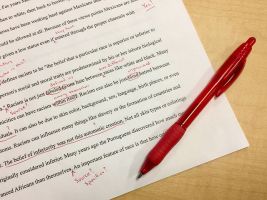
Before I send my manuscript to the editors, I’m doing my best to clean up my draft copy.

For those of you beginning this process, here are a few tips:

  1. Print out a hard copy – It’s easier to spot errors, holes.
  2. Make notes for obvious holes in the story, and correct grammar/punctuation, redundancies, and repetition.
  3. Turn off autocorrect to avoid missing homonyms ( words with the same spelling but different meaning/ wrong word for the sentence, e.g., pole, pole. Or, the homophones ( words with the same pronunciation but different meanings, or spelling (e.g., to, two, too.
  4. Eliminate weasel words: and/ or weasel words (“to be” verbs: is, are, was, were, had, had been).
  5. Use your search tool to seek out:
    1. Misused Words: e.g.,. Who vs. that; few vs. less, which vs. that, in vs. into, etc.
    2. Words to avoid: (can usually cut without losing a thing from the sentence), e.g., that, then, about, almost, begin, very, really, somewhat, up, down, over, around, only, just, even.
    3. Telling Words: e.g., seemed, knew, thought, felt, wondered, mused, because, suddenly, realized, prayed, considered, hope.
    4. Rethink these words – Are they necessary? Is it showing? Or, can you rewrite the sentence to make it stronger? e.g., as, while, since, although, though, though, because, when, before, until.
  6. Repetition – Lord have mercy! I had no idea how often I used certain words. e.g., look/looked, maybe, watch, or good. 

It isn’t advisable to do extensive rewrites before sending to an editor, but it’s recommended you send the cleanest copy you can. First up for me is a developmental editor. If you have recommendations for one in women’s fiction, I love the connection.  In the meantime, here are a few other resources to help with those first draft run through.

Do have other tips or resources? Share them with the fence jumpers. I’d love to hear your thoughts on the subject. Join the conversation. Talk to me or tell me your story. I’m all ears and look for me on Facebook at SheilaMGood,  PinterestBloglovinTwitter@sheilamgood, Contently, and Instagram. You can follow my reviews on Amazon and Goodreads.

Revision Versus Rewriting – What’s the Difference?


book-proofreading.jpg

Annabel Smith

I’ve tasted the victory of typing the last line on my first full-length novel. The exhilaration of writing “The end” lasted for about a day because now, the real work begins. But, where do I begin?

To find out what my next steps involved, I started where I always do – with research and looking at what the experts had to say.

First, let’s look at a few definitions and terms – Here’s what I discovered:

Revision – means to you take a second look; read it through with fresh and critical perspective.

  • includes reviewing and amending the story.
  • is not a one-time run through.
  • often requires a back and forth between drafts. (I’m told many writers go through multiple drafts and revisions before moving to the next stage.
  • it requires a large-scale overview of the story.
  • You’re looking for the overall flow and structure of the story.
    • looking for holes or loose threads
    • organization of the story
    • character development
    • issues of credibility or believability in the plot, character, or settings.
    • logistics/timeline
    • conclusion

Rewriting – When you rewrite an entire scene, chapter, or add additional information to expand a scene, delete an unnecessary character, or make a character fuller.

Note:  Inline annotations are a good way to make note of areas that may require a rewrite.

Editing and ProofReading –  I tend to think these two things go hand in hand.

  • Editing involves getting the words right and making sure the sentence flows.
  • Proofreading means getting into the nitty-gritty of grammar, spelling, and punctuation; line by line. Things to look for during this process:
    • sentence structure and length
    • those pesky waste words
    • weak verbs
    • Remove unnecessary, vague words, clichés, or jargon
    • Remove awkward or mixed metaphors
    • redundancy
    • rhythm
    • smooth transitions
    • homonyms – words with the pronunciation but different meanings; or, two or more words with the same spelling but different meanings.

Finishing that first draft is exhilarating, but don’t let impatience to see it in print cause you to skimp on the revision process. We all want to see our book on the shelves, but we want a polished book one where our readers get lost in the story and not distracted by poor story organization or sloppy typos.

For More on the Revision Process, check out what this expert has to say.

  1. Are You Making These 3 Common Revision Mistakes? By Janice Hardy. 
  2. General Strategies Before Your Proofread
  3. Revising Drafts

Do you have pointers on revising a draft? Please, share with us. I’d love to hear your comments. Talk to me. Tell me your story. I’m all ears and look for me on Facebook at SheilaMGood,  PinterestBloglovinTwitter@sheilamgood, Contently, and Instagram. You can follow my reviews on Amazon and Goodreads.

Ask the Experts: Tips for Self-Editing

 As many of you know, I have been hard at work on my first novel. Currently, my focus has been on getting the story down and for once, have not disappeared down the rabbit hole of editing while I write, although the temptation has been great. After more than two years, I finally can see the end in sight and couldn’t be more excited!

I do plan to hire an editor for this novel, but in the meantime, I will clean up some of the apparent errors.  As a practice, I use three-four editing tools for all my work, and I must say, I find them an essential tool in my writing.

  1. The Writer’s Diet is one of the first tools I use. A free resource, this tool provides an overview of your writing. Insert 100-1000 words to find out if your is writing is lean or flabby.
  2. The Hemingway Editor  – available for both MAC and Windows, provides an incredible array of convenient tools:
  • Use it anywhere;  even without internet connection.
  • Format your prose
  • Publish directly to WordPress & Medium
  • Export to Microsoft Word or other editors – a New feature
  • Send Hemingway highlights to colleagues –  a New feature

3. Grammarly –  an excellent grammar, punctuation, and vocabulary tool.

4.  Autocrit – A manuscript editing software, specifically for fiction writers.

These are my tips, but, since I’m still learning, I checked with the experts.

Jacqui Murray offers specific and detailed tips in her article, 19 Self-editing for Your Writing.  Tips include:

  • eliminating weak/waste  words – very, was, it, but, just;
  • eliminate redundancies and word repetition, and as many dialogue tags when possible.
  • Limiting adverbs, gerunds, qualifiers, prepositional phrases,
  • Secure place and time in each chapter; verify timeline.
  • Change passive to active words and phrases.

To read more from Jacqui and get the details, as well as other resources she can recommend, check out her article.

Other resources you might want to check out, include:

What about you? Do you have some advice for this writer on self-editing? I’d love to hear all about it.  I’m all ears and look for me on Facebook at SheilaMGood,  PinterestBloglovinTwitter@sheilamgood, Contently, and Instagram. You can follow my reviews on Amazon and Goodreads.

5 Quick and Dirty Tips on Sentence Structure

As someone working hard this month to complete a draft of my novel, I appreciate posts like this one from Sacha Black and Writers Helping Writers,  Getting Jiggy with the Nitty Gritty, or, Improving Your Sentences.

This is a keeper and one I will use to start the editing process when ( notice I said when) I finish my novel.  In the meantime, if you’re looking for some quick and dirty tips on sentence structure, check out Sacha’s post and these 5 Tips.

  1. Filtering
  2. Juxtapositions
  3. ‘Sense’-ational Sentences
  4. Crutch Words, Wordiness, and Clichés
  5. First and Last Lines

It’s well worth a read. And, if you would like to follow the progress of my novel, you can read it and Buzz me at http://www.chapterbuzz.com/sheilamgood.

I’d love to hear your thoughts on the subject. Join the conversation. Talk to me or tell me your story. I’m all ears.