My mother once told me, the older you get, the faster time flies. She was right. The time between October 1st and the New Year gets shorter every year. It’s as if I blinked and we’re on the precipice of Valentine’s Day.
This is my first real post since taking a medical leave just after Thanksgiving. I owe big thanks to all my Cow Pasture Contributors and guest authors for helping to keep the conversations going while I was away. I hope you enjoyed their excellent posts.
I’m not at a hundred percent, but I’m getting there. In the meantime, I thought the best way to get back into the groove was to take a look back at 2016 in the Cow Pasture.
For the last couple of years, WordPress did a great job sending out an annual year-end review for WordPress bloggers. However, this year, they decided against it. So, I decided to do my own.
Mine isn’t as artistic as the one offered by WordPress, but it was definitely enlightening.
The Numbers:
In 2016, there were 167 posts published; growing the total archive of this blog to 480 posts. The most popular day for posting- Friday and the most popular time – 9:00 am.
Traffic to the Cow Pasture almost doubled with 10,086 views; 5,543 visitors. My longest streak was in the month of April when I participated in the A-Z Blogging Challenge – posting daily for 30 straight days. The busiest month of the year was July with 2062 views.
To all my readers, Thank you, and, particularly, those who took the time to comment, interact, and share. Feedback is the lifeblood of the blogging community. I encourage each of you when you read something helpful, inspirational, or thought-provoking- speak up, say something, comment and even debate. Communication, after all, is what brings us together.
Here’s to an even bigger and better year for all of us.
I’d love to hear your thoughts on the subject. Join the conversation. Talk to me or tell me your story. I’m all ears.
Yes, I believe Facebook (FB) has become to relationships and society as a whole. I think it’s time for an honest evaluation of our social media. Before I get into why let’s look back at the origins of this social media conglomerate.
Origins
It may surprise you to know that the original idea behind Facebook was, shall I say, less than admirable. In fact, it was a bit self-serving. In 2003, Mark Zuckerberg thought it would be a great way to identify the “hottest” girls on campus. He fashioned this first attempt after a similar site, Hot or Not where users rated photos of women in terms of the most attractive. Nice, Zuckerberg! To generate the list, this enterprising entrepreneur hacked into the college system and stole the private, dormitory ID images of students. Called Facemash, the site had more than 22,000 photo views within the first four hours online. A couple of days later, the school shut it down.
Although, the site seemed like a good idea, at the time, Mr. Zuckerberg soon discovered stealing private information for the purpose starting a babe site had its drawbacks and consequences. Yet, in spite of the threat of expulsion and legal trouble, he was not to be dissuaded. Instead, he went back to the drawing board, wrote another program and in 2004, TheFacebook.com (later shortened to Facebook) was up and running. This time with a different or more expanded purpose — a place where the brilliant students of Harvard could connect and share notes (sure).
Initially, the program remained restricted to the Harvard campus, but soon expanded to all Ivy League schools. The site grew faster than kudzu in the South and By 2006, anyone over the age 13 could join, create a profile and start socializing — making “friends,” uploading pictures, videos, comment, and “liking” whatever suited their mood at the time.
Pinterest
The company went public in 2012 and in July of 2015, Standard & Poor’s 500 Index listed Facebook as the fastest growing social network in the world with a market cap, of $250 billion.
The Dark Side
There’s a dark side to Facebook that few want to acknowledge or discuss; but, with 1.65 billion active, monthly users, members have the ear of the world and little if any accountability.
What began as an avenue to share class notes, make new friends, and score a hot date, soon evolved into much more — a popularity contest of sorts. Young members started measuring their self-worth based on the number of friends, or likes they received. Pictures started pushing the boundaries with the express purpose of gaining more friends and “likes.” Bullies used it to wreck havoc on vulnerable teenager. Bullying had a new, secret and sinister avenue and pedophiles a picture gallery from which to choose and parents, far behind in technology, were clueless.
According to The Best Degrees, the seven most common FB crimes include: 1) Scams — enticing members to click on a link designed for the purpose of stealing private or financial information. 2) Cyberbullying — a particularly vicious crime against the youngest and most vulnerable with harmful and even deadly consequences. 3) Stalking — you know, repeatedly visiting ones profile, leaving or harassing messages, or threats often progressing to actual in person stalking and to the point the victim is terrorized. 4) Robbery — it never ceases to amaze me how often people on FB announce to the world they are going on vacation. With Google maps, it doesn’t take a rocket scientist to locate your home address. 5) Identity theft — hackers are more proficient than you can imagine. Opening the wrong link can provide all your vital statistics necessary to steal your identity. “More than 600,000 Facebook accounts are compromised very day.” 6) Defamation– posting false information about a person or business that affects them negatively. It’s more difficult that you think to prove an untruth. 7) Harassment– persistent messages, inappropriate comments, or threats (a common FB occurrence).
Seeds of Division
What began as a bridge connecting people has, instead, driven a wedge between us. Status updates have become soapboxes for the latest cause, opinion, or outright voice of animosity. Language once frowned upon in civil society is now commonplace, as is name-calling and shaming. Labels like bigot, racist, homophobe, xenophobe are thrown at each other as easily as hello. Family, friends, and even strangers, routinely find themselves in pissing contests over someone’s status update or comment. Emotions, raw with exaggerated or misplaced passions expose skin so thin, we’re offended at the slightest word. Trust is at an all time low and fear of saying the wrong thing at an all time high. The rancor and animosity expressed on FB throughout the presidential campaign and still, have left friendships strained and users frustrated. According to the Pew Research Center,
“More than one-third of social media users are worn out by the amount of political content they encounter, and more than half describe their online interactions with those they disagree with politically as stressful and frustrating.”
Facebook has evolved from its questionable “hot babes” startup to come full circle as an instrument of misinformation, bias, hatred, and where crimes are now streamed live, including rape, murder, suicide, and acts of terror. Connections between people have become tenuous, eroded trust, and created confusion. We no longer know whom or what to believe or how to differentiate between truth and lies. We reached out to connect with others but are find ourselves further apart than ever.
Without the nuances of genuine face-to-face conversations (facial expressions, tone, body language) we lose true connections. Our words become more about being right than connecting. When we can hide behind a user name, or don’t have to face the confusion and hurt on another’s face, words come easy regardless of the consequences.
Yes, I believe Facebook has become toxic to each other, our kids and society. We’ve lost the thread of common decency, civility, the ability to disagree or demonstrate old-fashioned manners.
Personally, I think it’s time we did something — perhaps sign off, pick up a phone, invite someone to lunch and start connecting face to face, again.
I’d love to hear your thoughts on the subject. Join the conversation. Talk to me or tell me your story. I’m all ears.
Another guest post by K. Alan Leitch. My fellow fence-jumpers may not see me here for awhile, but feel free to stop by my blog for samples of my writing and tips that have helped me write, including my current series about YA fiction, The “Right Age” for Young Readers.
Give a man a megaphone, and he thinks he’s in charge.
The end of fun at the beach…
It’s always been that way, really. To a man—much more so than to a woman—an amplified voice is a sign of importance, and of authority. I live this as I cycle past the shorelines near where I live; a few years ago, amplification systems were installed in the lifeguard towers, and the concept of a quiet day at the beach changed forever. The surf that once hushed the cries of gulls was replaced: replaced by demands that we swim closer to shore, warnings about sun exposure, and general advice that it might be simplest to avoid fun altogether.
So, men with megaphones now rule our local beaches, but this is nothing new. History is rife with men who have shouted to be obeyed.
Would you attend a play against his advice?
Portraits of Elizabethan England make the whole place seem like it was a shouting match. Shakespeare and his contemporaries would shout from stages for the penniless to enter their theatres, while The Puritans would shout, from platforms outside, for the upper-crust to avoid those theatres or risk damnation. Both sides had a following, and I wouldn’t be surprised if victory depended on whose voice was louder one day or the next. Without megaphones, though, they were pitting their natural gifts—mostly tonsils and lungs—against one another. Our pantalooned patrons may have been limited by their voices, but that only made them shout more loudly for an audience.
Rose’s amplified voice demoralized the allies.
Time rattled forward, then, through an endless string of armed conflicts, until Japanese combatants during World War II had their TERA Rifles and Type 10 Grenades supplemented by long-range radio broadcasting: the ultimate megaphone of the day. Allied servicemen spent hours of their day listening to Tokyo Rose, whose voice was louder than theirs, so could depress them with all the demoralizing news of the war effort. While it is true that Tokyo Rose was a woman—probably several women—it doesn’t take much knowledge of history to know that men put her behind that microphone and handed her those scripts. Essentially, they were men with megaphones, trying to take charge of the world.
It’s difficult, indeed, to block out a megaphone entirely. We think we are ignoring them, but still we purchase clothes more expensive than we need, and cower from the broadcast threats of cowardly terrorists. Occasionally, good people might even elect a megalomaniac with a megaphone to political office. Resisting their noise and their allure is often impossible.
Where, then, are the messages of substance… the messages from quiet voices like Gandhi’s, and from amplified voices like Martin Luther King’s? This is where our zeal to be heard becomes sobering, because those messages are still out there: we just can’t hear them over the rush and chaos of all the boy-bands and cologne commercials. Each invitation to choose our own entertainment are lost in a thousand others; each urging to save our own souls are drowned in depravity. When one man teaches tolerance and another man hatred, we listen to the one whose voice scares us the most.
Now that everyone has a megaphone, it seems that we have flashed back to the Elizabethan culture, when those with the strongest tonsils would be heard.
It’s always been this way, really. Give a man a blog, and he thinks he’s in charge.
One thing is for sure, when you’re in the midst of a long-term recovery, you will get bored out of your mind. Top these circumstances with 2-3 days of snow and ice – someone is going to break the rules. Did I mention – me? To say I’ve been stretching the doctor’s instructions bit is an understatement.
Pardon my digression; the squirrels are playing havoc with my brain.
Back to the point of this post. Do you know your IP address IP (Internet protocol)? It is a unique number for your computer and links to all of your online activity.
It’s how a Macy’s ad, with the very thing you’re shopping for, just happens to show up on Facebook or other sites you might visit. It’s how Google and other search engines track what you like – through algorithms and your IP address. And, it’s how hackers find us – not that we’ve heard much about hacking lately?
More to the point, it’s why a suspect’s computer is confiscated and turned over for a forensics examination, following a crime. “Your honor, may I present Exhibit C into evidence. This will show that the defendant completed a search on, how to choke someone, undetectable, poisons, how to break a person’s neck, and how to get away with murder, no less than 200 times.”
You get the idea, but why do you care? Well, knowing one’s IPA is also helpful when determining if your computer or the information within has been compromised. For example, in 2005 my identity was stolen online. The culprits were tracked through an IPA to Amsterdam – a mega site for stolen identities. And just today, I attempted to sign in to Facebook. A message appeared:
“Your account has been locked due to a suspicious login attempt.” They provided the time, IPA, and location (Charlotte) of the incident. “Was this you? “They asked.
I wasn’t certain, but it prompted me to investigate. I got things straightened out, not that being locked out of Facebook was of concern – it wasn’t, but that’s a subject for another day.
If you want to find out more on the topic, as well as your own IP Address, check out these resources:
 My mother once told me, the older you get, the faster time flies. She was right. The time between October 1st and the New Year gets shorter every year. It’s as if I blinked and we’re on the precipice of Valentine’s Day.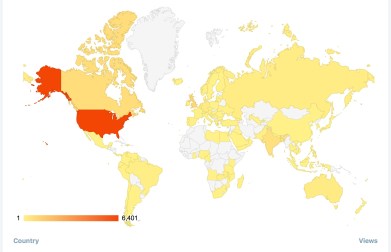









 COW PASTURE CHRONICLES