Feeling Overwhelmed

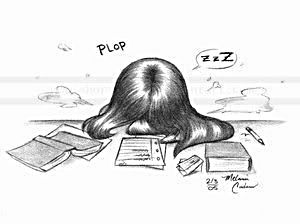
And, I thought writing the novel was a daunting task. It is more fun, for sure, but editing is tedious mind-numbing work. It can become overwhelming especially to those of us new to the craft of writing novels.

Thank God we have experts to help us along the way. Janice Hardy from Fiction University is one such expert. She is my number one go-to resource.

Janice understands the complexities of self-editing and offers some great advice in her article, How to Edit a Novel Without Feeling Overwhelmed.
The six main points:

  1. Decide whether you want to edit or revise. The processes are not the same.
  2. Don’t bite off more than you can chew, so to speak. Set a word count, a number of scenes to work on and stick to it – a must when you’re working with 70,000 words plus.
  3. Don’t try to cover all the bases, focus on one thing at a time – setting, character, dialogue, and so on.
  4. Set a time limit – Time management is a biggy for me. It’s easy to get lost in the process, or become impatient.
  5. Leave the advice books on the shelf while you’re editing – love this one! It’s so easy to get caught up in the ‘how-tos’ or the ‘should’s,’ and not get a thing accomplished.
  6. Make a plan and let it be your guide – Use a calendar, spreadsheet, or whatever planning tool helps you accomplish your goal.

For more information, check out, How to Edit a Novel Without Feeling Overwhelmed.

I’d love to hear your tips. Talk to me. Tell me your story. I’m all ears and look for me on Facebook at SheilaMGood,  PinterestBloglovinTwitter@sheilamgood, Contently, and Instagram. You can follow my reviews on Amazon and Goodreads.

How to Keep Up With the Details in Your Manuscript

As I’ve said before, writing  “The End” on the first draft is only the beginning of your work on the road to publication. One of the things I discovered, immediately after completing a 77,000 + word draft, is keeping up with the details, even with Scrivener, seems like a monumental task.

When did that character show up? Are the descriptions consistent? Does the timeline make sense? Do I need to name that character? Is the character necessary? And, so on. There are more details to keep track of than one imagine when you begin writing your story. 

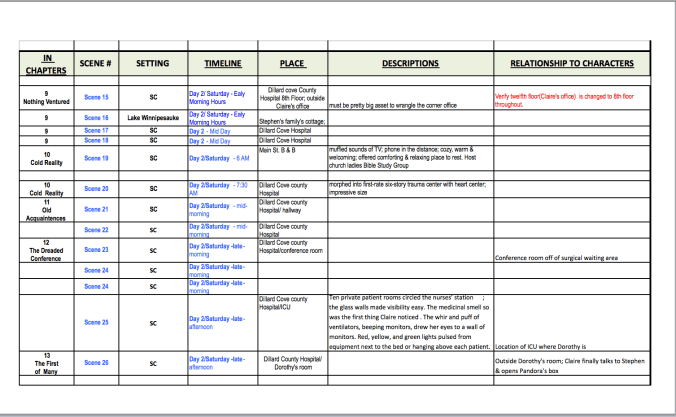
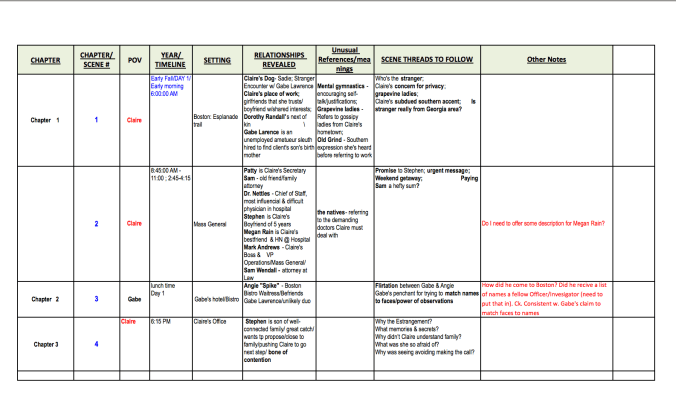
So here are a few spreadsheets I’ve come up with to help me. Feel free to copy the format, should you find these helpful.

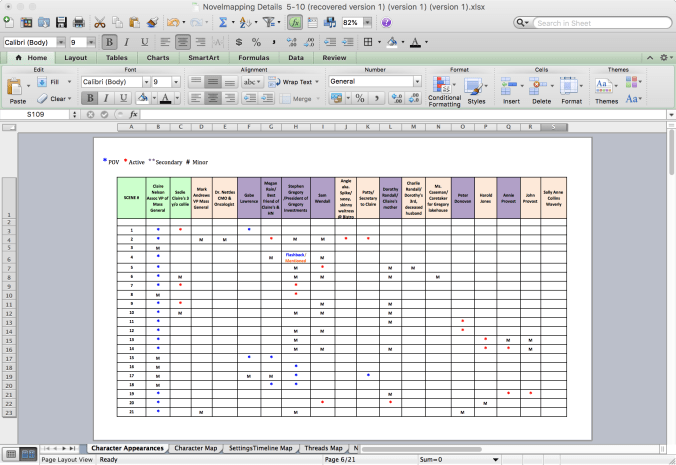
  • Character Appearance Spreadsheet –  Scene by scene. At a glance I can see where every character, including minor ones, appear in the novel. An * designates an active character and an ‘M‘ a walk-on or character mentioned in a conversation. This allows me to see the flow of the story, spot minor characters that I may not need to name, need at all, or POV inconsistencies.

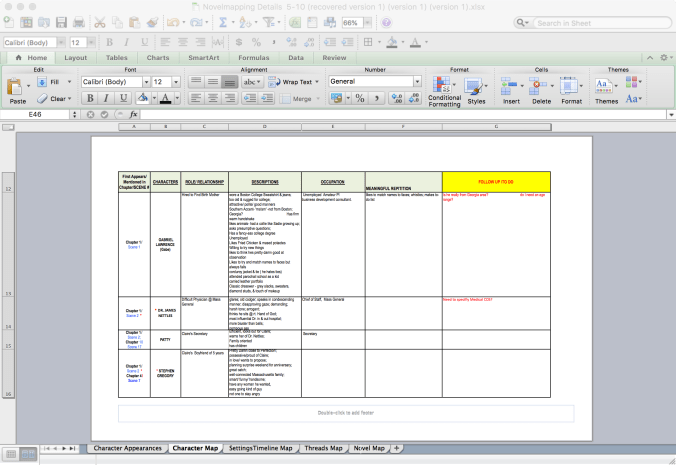
  • Character Map – includes every character (named or unnamed) and where they first appear in the novel;  their role, descriptions (from anywhere in the manuscript), occupation, relationships, meaningful repetitions, and notes. Again, this had provern helpful in spotting holes, inconsistencies, or help with character attributes and descriptions.

  • A setting and Timeline Spreadsheet – a list of the settings and timeline the story is taking place. It also includes descriptions of the setting (used anywhere in the manuscript), and the relationship the setting has to the character.  At a glance, I can tell whether I’m being redundant, inconsistent, or lack descriptions in my settings. It is also, a great way to see the holes in the timeline.


  • The Threads Map – Scene by scene, I  list the relationships revealed, useful repetitions, unusual phrases/words/references with meanings, threads I need to carry throughout the story, and any  notes on holes or things I need to follow up on during edits and rewrites. Helps me spot holes or unanswered questions, immediately.

Hope you will find these helpful and should you have suggestions for how you keep up with the details, please share it with us.


I’d love to hear your comments. Talk to me. Tell me your story. I’m all ears and look for me on Facebook at SheilaMGood,  PinterestBloglovinTwitter@sheilamgood, Contently, and Instagram. You can follow my reviews on Amazon and Goodreads.
Looking for a Contest Specific to Your Genre?

Reedsy Curated Contest Site

We all come across open themed or prompt contest, but what about contest specific to your genre?  Well, the search is over. Reedsy is an excellent resource for finding the perfect contest for you.

What’s even better, is it’s free! I Reedsy is one of those jewels you come across within writing communities. It is resource stocked with free courses on writing resources, editing and publishing.

In the meantime, here are  few to get you started.

    1. Reedsy’s weekly writing prompt – Deadline: December 21st, 2018 • Genre: Fiction, Short Story; Entry Fee : Free. Top prize $50.
    2. Remember in November Contest for Creative Nonfiction: Hippocampus Magazine; Memoir excerpts and personal essays up to 4,000 words; no theme. Deadline: July 15th, 2018 • Entry fee 💰: $12. Genre: Memoir, Non-fiction. Top prize –  $1000.
    3. Nowhere Magazine Spring 2018 Travel Writing Contest. Travel-specific pieces; Deadline: July 1st, 2018 • Entry fee 💰: $20. Genre: Fiction, Non-fiction. Top prize-$1000.
    4. Emerging Writer’s contest – Ploughshares. Authors are considered “emerging” if they haven’t published or self-published a book. Deadline: May 15th, 2018 (Expired) • Entry fee 💰: $24. Genre: Essay, Fiction, Non-fiction, Poetry, Short Story. Top prize – $2,000 for each genre and publication in the literary journal.

    5. Jim Martin Memorial Story contest – Arizona Mystery Writers. Open to anyone. Deadline: June 1st, 2018 • Entry fee 💰: $15. Genre: Crime, Short Story. Top prize – $200.

With more than 256 contests, you have lots to choose from to stretch those writing muscles. So, check out their contest site, pick one from your genre, and jump in!


I’d love to hear your comments. Talk to me. Tell me your story. I’m all ears and look for me on Facebook at SheilaMGood,  PinterestBloglovinTwitter@sheilamgood, Contently, and Instagram. You can follow my reviews on Amazon and Goodreads.
 

New Places to Submit Your Writing

It’s the beginning of summer. Most of us are busy getting ready for that much-anticipated vacation, or holiday barbecue.  But, if you’re like me you have a stack of file of short stories or even essays that have been sitting there gathering dust. Well, here’s your chance to shake the clean it up and send it out into the world for others to read.

Here are a few new places you might want to consider:

From the Author Publish, 16 Literary Journals which accept ‘blind’ submissions.

  1. Ars Medica – an online  journal of arts, medicine, and the humanities; prose and poems that related to medical issues.
  2. Spry – an online literary journal; poetry and prose.
  3. Perch – a non-academic literary journal; poetry, prose, visual art, and music related to mental health.
  4. Jaggery – focus on connecting South Asian diasporic writers, homeland writers, non-South Asians  with a South Asia connection.
  5. Burningword Literary Journal – poetry, flash fiction, and flash nonfiction; double-blind reading process.
  6. POUi – new and exciting writing; particularly international.
  7. The Matador Review –  an online  journal; looking for ‘alternative work; fiction, non fiction, flash fiction, visual art, and poetry.
  8. Chantwood Magazine-  Online journal; sci-fi, fantasy, speculative fiction, romance, literary fiction, historical fiction, and poetry.
  9. Into The Void –  a UK based literary journal; experimental literary work of poetry and prose.
  10. Toyon- a multilingual journal of literature; publish work in English and Spanish; accepts reprints.
  11. Radar – an online poetry journal.
  12. Sweet Tree Review – poetry and prose.
  13. The Fieldstone Review – poetry, fiction, creative non-fiction, and reviews.
  14. Border Crossing – writing that crosses boundaries in genre or geography.
  15. Stonecoast Review – poetry, fiction, creative non-fiction, dramatic works, and visual arts.
  16. tssf Journal – poetry, fiction, creative non-fiction related to issues of Africa.

For more imformation, click on the links of each journal and good luck!

I’d love to hear your comments. Talk to me. Tell me your story. I’m all ears and look for me on Facebook at SheilaMGood,  PinterestBloglovinTwitter@sheilamgood, Contently, and Instagram. You can follow my reviews on Amazon and Goodreads.
SaveSave

SaveSave

SaveSave