Submissions- Advice for Success

Day 19: #atozchallenge

images-8
As a writer, we all enjoy sending our words out into the universe and, particularly, achieving recognition. Submitting work takes careful consideration and time.

Success can be yours if you do these four basic things:

  1. Research the journals appropriate for your genre.
  2. Spend time reading the journals as well as the winning stories.
  3. Write a good story.
  4. Follow the guidelines of the journal in which you are submitting.

The article, 10 Observations from the Slush Pile by author and editor, Suzanne Vincent, is an excellent resource for the do’s and don’t of submitting your work. Check it out and take note.

Success is in the details.

When was the last time you submitted?

I’d love to hear your comments. Talk to me. Tell me your story and look for me on Facebook at SheilaMGood,  PinterestBloglovinTwitter@sheilagood, and Contently.

My Top 15 Research Resources for Writers

Day 18:  #AtoZchallenge

Researching a novel doesn’t have to be difficult but it is necessary. Research can be as easy as typing a question in Goggle for information, looking through old photos, sitting down with an expert, or actually visiting a facility or locale.

If you’re writing about a time other than the present, the research can be more difficult. In my current work in progress, I originally set the time frame in the mid 1980’s and quickly discovered the need to do more indepth research. For example, cell phones weren’t available until the late 80’s. Different airlines operated than the ones flying today and only a handful made flights to the area of the country in which my novel was situated.

My research took me inside the airline industry, including the lay out of the inside of a plane, the cell phone industry, and to historical registries. Other works have led me to reserach arson and forensics.

So, to make research easier for you, I’ve compiled a list of my 15 favorite research resources.

  1. Infoplease – covers anything from current events to historical timelines.
  2. The Library of Congress – the world’s largest library with millions of items in it’s collection.
  3. Refdesk referred to as the “Fact checker for the Internet” this online reference site provides links to headlines news, current events, and any imaginable question you might like to pose.
  4. Google Scholar – a specialized search engine providing information on academic research.
  5. Encylcopedia.com – offers 100 trusted sources.
  6. GoPubMdyour source for all sceince and medical research.
  7. Godcheckeryour God and Goddess resource.
  8. Writing World – for a primer of historical research.
  9. Find articles – offering more than 500 print periodicals covering present to 1998.
  10. Kiosko.net – a daily press directory with access to the world’s largest news sites and displays a readable image from today’s frontpage cover of each newspaper.
  11. InterFireonline – the complete resource for fire services, fire insurers, law enforcement and others whose duties involve arson investigation, fire investigation safety and fire scene training.
  12. The Writer’s Forensic Blog – forensic information for writers from D.P. Lyle, MD.
  13. Mystery File – the crime Fiction research journal.
  14. MooseRoots – research tool covering census records, imigration, military, death, marriage & birth records.
  15. Writers Helping Writers – all about characters including the character profile questionnaire and the emotional thesauraus.

A2Z-BADGE 2016-smaller_zpslstazvib

So tell me, how do you start your research? Do you have a favorite site? I’d love to hear your comments. Talk to me. Tell me your story and look for me on Facebook at SheilaMGood,  PinterestBloglovinTwitter@sheilamgood, and Contently.


Naming Your Characters

Day 14: #atozchallenge

When William Shakespeare’s Juliet discovered Romeo bore the name of her enemy, she asked:
NameWordle“What’s in a name?
That which we call a rose
By any other name would smell as sweet.”

 I  respectfully disagree with Juliet. To me, a rose is a rose, is a rose, and I venture to say others feel the same. To call a rose by any another name would be nonsense.

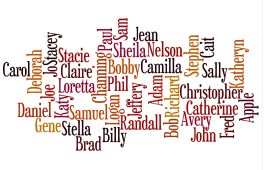
We all have certain mindsets when it comes to names. For example, Billy Bob denotes an image far different than the name Randolph. Naming a child, Elizabeth Marie Kennedy Thornton (fictitious) makes us think privileged.

Names conjure memories both good and bad. Ever time I hear the name Gene I am once again in the 5th grade. Our brothers, sisters, or distance cousins all provide us a mental picture of a person. It’s from life experiences and the individuals that cross our paths in which we draw inspiration for naming the characters in our stories.

Important Points to Remember:

  • Match the name to the character’s personality. Channing is not likely to make readers think of a shy introvert.
  • Don’t get stuck on a letter. Sure it might be easier, but Carol, Cait, and Cami will make the readers head spin trying to tell the characters apart.
  • Assigning cute or unusual names is tricky. When done, the character’s personality must fit the name like a glove. The name, Apple, however, popular in Hollywood, is never going to make me think of anything other than a red delicious.
  • Tread carefully when naming a character based on someone you know. Get too close to the real thing and you might just have a family member on your back.

Helpful Resources for Naming Characters:

It isn’t always easy to come up with the right name, or one we think fits the character, but there are resources.

Naming characters can be fun or frustrating but don’t let it get in the way of telling your story. You can change names anytime, just write the story.

How do you choose the names of your characters?

I’d love to hear your comments. Talk to me. Tell me your story and look for me on Facebook at SheilaMGood,  PinterestBloglovinTwitter@sheilagood, and Contently.

Loglines – What DoThey Do for You?

Day 12:   

What in the world is a logline?  A one or two sentence description of what your story is about. Think of it like a five-second sales pitch.

What Does it Do for You? A well-written logline enables you to answer without any hesitation the question, What is your story about?

In addition, it helps you, the author, stay on track and spot problems within the story structure.

Essential elements of a logline:WritingLoglines

  1. The protagonist
  2. The end goal
  3. The stakes

These elements are critical to include, but be concise and use phrasing that creates interest and hooks the reader.

Here’s an  example from my current work in progress: (Be kind, I’m still toying with it)

When Bostonian Claire Nelson (protagonist) is called home after sixteen years to care for her estranged mother (goal), the secrets of her past reveal a darker betrayal (stakes) and she forced make a choice (goal).

Have you written your logline? To learn more check out: How and Why to Write a Logline for Your Story by Becca Puglisi

I’d love to hear your comments. Talk to me. Tell me your story and look for me on Facebook at SheilaMGood,  PinterestBloglovinTwitter@sheilagood, and Contently.