Feeling Overwhelmed

And, I thought writing the novel was a daunting task. It is more fun, for sure, but editing is tedious mind-numbing work. It can become overwhelming especially to those of us new to the craft of writing novels.

Thank God we have experts to help us along the way. Janice Hardy from Fiction University is one such expert. She is my number one go-to resource.

Janice understands the complexities of self-editing and offers some great advice in her article, How to Edit a Novel Without Feeling Overwhelmed.
The six main points:

  1. Decide whether you want to edit or revise. The processes are not the same.
  2. Don’t bite off more than you can chew, so to speak. Set a word count, a number of scenes to work on and stick to it – a must when you’re working with 70,000 words plus.
  3. Don’t try to cover all the bases, focus on one thing at a time – setting, character, dialogue, and so on.
  4. Set a time limit – Time management is a biggy for me. It’s easy to get lost in the process, or become impatient.
  5. Leave the advice books on the shelf while you’re editing – love this one! It’s so easy to get caught up in the ‘how-tos’ or the ‘should’s,’ and not get a thing accomplished.
  6. Make a plan and let it be your guide – Use a calendar, spreadsheet, or whatever planning tool helps you accomplish your goal.

For more information, check out, How to Edit a Novel Without Feeling Overwhelmed.

I’d love to hear your tips. Talk to me. Tell me your story. I’m all ears and look for me on Facebook at SheilaMGood,  PinterestBloglovinTwitter@sheilamgood, Contently, and Instagram. You can follow my reviews on Amazon and Goodreads.

How to Keep Up With the Details in Your Manuscript

As I’ve said before, writing  “The End” on the first draft is only the beginning of your work on the road to publication. One of the things I discovered, immediately after completing a 77,000 + word draft, is keeping up with the details, even with Scrivener, seems like a monumental task.

When did that character show up? Are the descriptions consistent? Does the timeline make sense? Do I need to name that character? Is the character necessary? And, so on. There are more details to keep track of than one imagine when you begin writing your story. 

So here are a few spreadsheets I’ve come up with to help me. Feel free to copy the format, should you find these helpful.

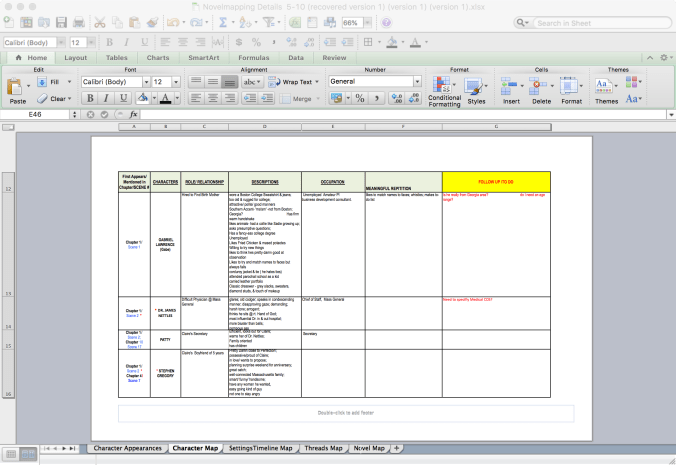
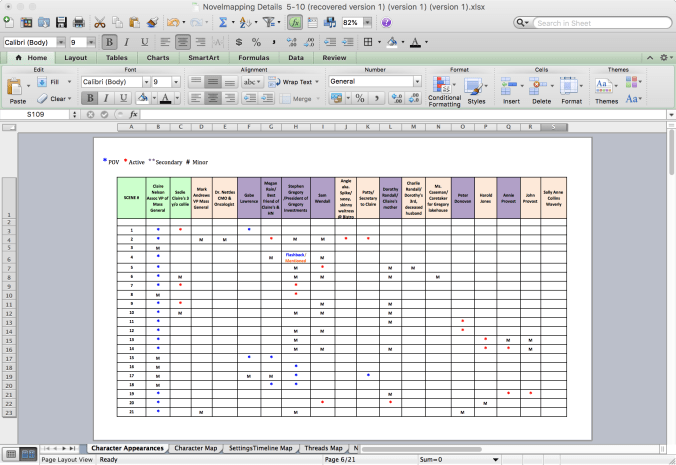
  • Character Appearance Spreadsheet –  Scene by scene. At a glance I can see where every character, including minor ones, appear in the novel. An * designates an active character and an ‘M‘ a walk-on or character mentioned in a conversation. This allows me to see the flow of the story, spot minor characters that I may not need to name, need at all, or POV inconsistencies.

  • Character Map – includes every character (named or unnamed) and where they first appear in the novel;  their role, descriptions (from anywhere in the manuscript), occupation, relationships, meaningful repetitions, and notes. Again, this had provern helpful in spotting holes, inconsistencies, or help with character attributes and descriptions.

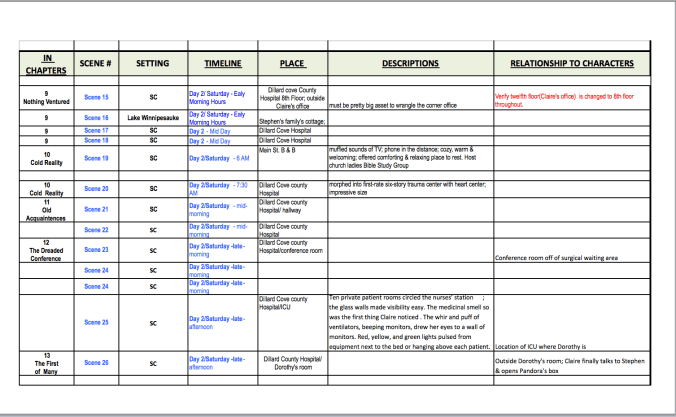
  • A setting and Timeline Spreadsheet – a list of the settings and timeline the story is taking place. It also includes descriptions of the setting (used anywhere in the manuscript), and the relationship the setting has to the character.  At a glance, I can tell whether I’m being redundant, inconsistent, or lack descriptions in my settings. It is also, a great way to see the holes in the timeline.


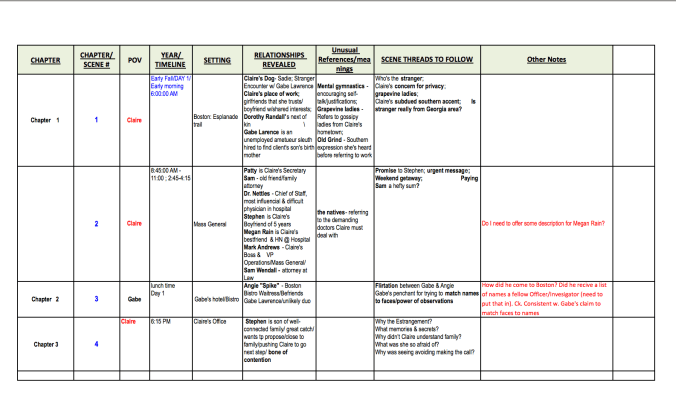
  • The Threads Map – Scene by scene, I  list the relationships revealed, useful repetitions, unusual phrases/words/references with meanings, threads I need to carry throughout the story, and any  notes on holes or things I need to follow up on during edits and rewrites. Helps me spot holes or unanswered questions, immediately.

Hope you will find these helpful and should you have suggestions for how you keep up with the details, please share it with us.


I’d love to hear your comments. Talk to me. Tell me your story. I’m all ears and look for me on Facebook at SheilaMGood,  PinterestBloglovinTwitter@sheilamgood, Contently, and Instagram. You can follow my reviews on Amazon and Goodreads.
Look, Look, And Look

Before I send my manuscript to the editors, I’m doing my best to clean up my draft copy.

For those of you beginning this process, here are a few tips:

  1. Print out a hard copy – It’s easier to spot errors, holes.
  2. Make notes for obvious holes in the story, and correct grammar/punctuation, redundancies, and repetition.
  3. Turn off autocorrect to avoid missing homonyms ( words with the same spelling but different meaning/ wrong word for the sentence, e.g., pole, pole. Or, the homophones ( words with the same pronunciation but different meanings, or spelling (e.g., to, two, too.
  4. Eliminate weasel words: and/ or weasel words (“to be” verbs: is, are, was, were, had, had been).
  5. Use your search tool to seek out:
    1. Misused Words: e.g.,. Who vs. that; few vs. less, which vs. that, in vs. into, etc.
    2. Words to avoid: (can usually cut without losing a thing from the sentence), e.g., that, then, about, almost, begin, very, really, somewhat, up, down, over, around, only, just, even.
    3. Telling Words: e.g., seemed, knew, thought, felt, wondered, mused, because, suddenly, realized, prayed, considered, hope.
    4. Rethink these words – Are they necessary? Is it showing? Or, can you rewrite the sentence to make it stronger? e.g., as, while, since, although, though, though, because, when, before, until.
  6. Repetition – Lord have mercy! I had no idea how often I used certain words. e.g., look/looked, maybe, watch, or good. 

It isn’t advisable to do extensive rewrites before sending to an editor, but it’s recommended you send the cleanest copy you can. First up for me is a developmental editor. If you have recommendations for one in women’s fiction, I love the connection.  In the meantime, here are a few other resources to help with those first draft run through.

Do have other tips or resources? Share them with the fence jumpers. I’d love to hear your thoughts on the subject. Join the conversation. Talk to me or tell me your story. I’m all ears and look for me on Facebook at SheilaMGood,  PinterestBloglovinTwitter@sheilamgood, Contently, and Instagram. You can follow my reviews on Amazon and Goodreads.
Revision Versus Rewriting – What’s the Difference?


book-proofreading.jpg

Annabel Smith

I’ve tasted the victory of typing the last line on my first full-length novel. The exhilaration of writing “The end” lasted for about a day because now, the real work begins. But, where do I begin?

To find out what my next steps involved, I started where I always do – with research and looking at what the experts had to say.

First, let’s look at a few definitions and terms – Here’s what I discovered:

Revision – means to you take a second look; read it through with fresh and critical perspective.

  • includes reviewing and amending the story.
  • is not a one-time run through.
  • often requires a back and forth between drafts. (I’m told many writers go through multiple drafts and revisions before moving to the next stage.
  • it requires a large-scale overview of the story.
  • You’re looking for the overall flow and structure of the story.
    • looking for holes or loose threads
    • organization of the story
    • character development
    • issues of credibility or believability in the plot, character, or settings.
    • logistics/timeline
    • conclusion

Rewriting – When you rewrite an entire scene, chapter, or add additional information to expand a scene, delete an unnecessary character, or make a character fuller.

Note:  Inline annotations are a good way to make note of areas that may require a rewrite.

Editing and ProofReading –  I tend to think these two things go hand in hand.

  • Editing involves getting the words right and making sure the sentence flows.
  • Proofreading means getting into the nitty-gritty of grammar, spelling, and punctuation; line by line. Things to look for during this process:
    • sentence structure and length
    • those pesky waste words
    • weak verbs
    • Remove unnecessary, vague words, clichés, or jargon
    • Remove awkward or mixed metaphors
    • redundancy
    • rhythm
    • smooth transitions
    • homonyms – words with the pronunciation but different meanings; or, two or more words with the same spelling but different meanings.

Finishing that first draft is exhilarating, but don’t let impatience to see it in print cause you to skimp on the revision process. We all want to see our book on the shelves, but we want a polished book one where our readers get lost in the story and not distracted by poor story organization or sloppy typos.

For More on the Revision Process, check out what this expert has to say.

  1. Are You Making These 3 Common Revision Mistakes? By Janice Hardy. 
  2. General Strategies Before Your Proofread
  3. Revising Drafts

Do you have pointers on revising a draft? Please, share with us. I’d love to hear your comments. Talk to me. Tell me your story. I’m all ears and look for me on Facebook at SheilaMGood,  PinterestBloglovinTwitter@sheilamgood, Contently, and Instagram. You can follow my reviews on Amazon and Goodreads.