So It Is With Writing…

Aw spring, my favorite time of the year is finally here. Budding new birth is everywhere you look; people are taking inventory, spring cleaning, clearing out cobwebs, and the clutter of their lives.

As a girl, we started every Spring by opening the windows and letting fresh air blow through the house removing the winter’s stale air. Then, we moved down mama’s list, decluttering closets, washing windows until they sparkled. We whitewashed scuff marks off baseboards, mopped, waxed, and polished the hardwood floors until they shined.

It was an exhausting time for my sisters and me, one we always dreaded, until lying on our beds late at night we inhaled the smell of a freshly spring-cleaned house as the breeze stirred the sheer curtains and the sounds of crickets serenaded us to sleep. Some things are worth the hard work.

So it is with writing …

You outline a novel and fill in the plot or as some do, fly by the seat of your pants until you reach the end of the story and a satisfactory word count. Of course, I’m over simplifying, but you get my drift. When things need to be done, you do them and cross them off your list. Not unlike when I was young and checking off mama’s spring cleaning to-do-list.

Perhaps you’ve wondered why no one was minding the Cow Pasture. Suffice to say; I was hard at work. Not writing, but working on something much harder so I could get back to writing – my health. In 1983, I was diagnosed with an autoimmune disease, Sjogren’s syndrome and others, but over the last five years, things had stabilized.

I thought I had this plot figured out, so to speak, but then what’s a good story without a twist, right? After many years of being manageable, the sleeping giant began attacking my central nervous system. Talk about a twist I wasn’t expecting, this was it. I didn’t know how to talk or write about what was happening, even in the Cow Pasture.

Over the last six months instead of working on my novel, blog or writing short stories, I’ve been outlining a plan to combat this disease and improve my outcome. I’m happy to say things are on track.

Some things are worth the hard work. 

I’m writing again, not using many outlines or sticking to a strict schedule, but writing when I can. Musing from the Cow Pasture Chronicles may include exerts from my novels, Hello HellCall Me Florence, a short story, flash fiction, writing topic, an opinion piece, or a chapter from my memoir. Who knows what I’ll share, I’m pretty much a panster these days.

Some things are meant to be enjoyed.

Related articles

Ten Things to Make Your Critique Group a Success

I apologize for being absent lately. Sometimes we have to make choices and prioritize to address more pressing matters.  Thank you for being patient.
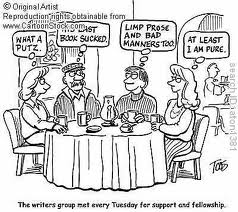
Two articles came to my attention this week on writing and critique groups. Guide to Literary Agents, Chuck Sambuchino, in his article, discusses The Top Ten Worst Types of Critique Partners.  Included among the attendees one might encounter were: The Snob, The Time Hog, The Retro, The Distractor, The Harsh Critic/The NiceyPiecey, The Debater, The Picker, The Sulker, The Boss, and The Sporadic.
images-8
Elmowrites describes in Critique and Critics, the attendees to her first group with slightly different names. The Fan, The Ogre, The Stuck Record, The Feeler, The Mechanic, and The Holy Grail. You get the gist.

Having belonged to a critique group for the last couple of years, the titles intrigued me. The “type casting” of members, however, left me wrinkling my brow. I won’t rehash the definitions here; you can read them for yourself. Whether it was one of the above personalities or group dynamics, the experience left a less than stellar impression on the authors. Still, in the end, both acknowledged the importance of feedback and encouraged writers to keep looking for a writing or critique group. Reading these articles made me wonder, was this the group experience of most people? It hasn’t been my mine.

I belong to a wonderful writer’s group, the South Carolina Writer’s Workshop (SCWW). We’re diverse in our experience, opinions, and genres. I imagine there are things in areas other than writing we might not see eye-to-eye on; I wouldn’t know and I don’t ask. We discuss writing. We focus on genuine critiques, helping each other improve, and get published. We promote each other’s blogs, author pages, websites, and publications.   We’re writers supporting writers.

So, here’s what I say: You can have a good group experience, but you have to participate. You can’t just be an observer. Here are my ten suggestions for a successful group experience.

  1. Find a group, or start one of your own. Growth comes faster with feedback.
  2. The group should have a designated leader who can moderate a meeting.
  3. Make the focus on writing, not people.
  4. Be prepared. Members are less disruptive if they’re prepared and know what to expect before the meeting. We find sending work in prior to the meeting an effective method.
  5. Don’t confuse social activities with the group meeting. The focus gets lost in the gossip.
  6. When difficult members do surface, let the leader or group moderator handle the situation one-on-one. 
  7. Don’t take it personally.  
  8. Be respectful of each other’s, work, time, and the group.
  9. Take time to familiarize yourself with group etiquette. If your group has guidelines, honor them.
  10. Know your own voice. It’s your story.

Ultimately, you are responsible for your writing and any experience you may or may not have. All critique groups are not the same, don’t give up the first time. It takes time to get to know people and the dynamics of a group. Instead, stick around, learn to listen, and speak up. You might just find yourself a group.

 Leave me a comment. Let me know about your group experience.

 Related articles

Learn How Writers Do It

A treasured pastime, I’ve been reading since early childhood. My mother belonged to the Book of the Month Club, and each month I couldn’t wait to see what selections she’d ordered.

By the time I was a teenager, my sisters and I were devouring books like candy. Instead of plopping in front of the television after school I raced to my room, grabbed my book, and planted myself belly first on the bed. Anxious to find what happened next, I turned to the page I’d dog-eared that morning before hopping on the school bus. I stayed lost among the characters of another world until mom forced me back to reality for dinner or some other household task.

Growing up in a house full of books, the love of words came early and easy. To me, reading was as natural as eating and sleeping. As soon as I finished one book, I picked up another. This small town Southern girl fell in love more than once with characters on a page. Two years ago, I decided to take a more serious approach to writing. Before long, I’d let studying consume all my time and allowed the pleasure of reading to take a back seat.

I’d forgotten how it felt to get lost in a good book. The descriptions so vivid it seemed as if you were standing on the street in the midst of the story. The scenes and dialog creating such tension you found yourself gripping the book cringing, gasping, sometimes crying, or laughing out loud. You couldn’t wait to turn the next page. Then it dawned on me. This is why writers read.

The many magazines and books I’ve read on the craft of writing have given me a wealth of information. They were instructional, explanatory, more like telling” me “How to write.” On the other hand, picking up a classic, best-selling novel, or even a well-written short story, “Shows me how to write.” 

So, I challenge you. Pick up a book for pleasure. Lose yourself in the story. Use the knowledge you’ve gained from the resources on writing, and take the story apart.  How did the author do it? Look at the descriptions, study the dialog, characters, and the plot. After that one, pick up another one. Reading will make you a better writer.

“I love books. I love that moment when you open one and sink into it. You can escape from the world, into a story that’s way more interesting than yours will ever be.” Elizabeth Scott

I’m reading Sister of Silence by Daleen Berry. What are you reading for pleasure? Leave me a comment.

Related articles
Read to Write
Mandatory Reading
What We’re Reading
MORNING PAGES: More or Less Reading?

Grammar Revolution Anyone?

I was surprised recently to learn grammar was no longer being taught in our school systems. As writer’s we know the importance of grammar. A great story poorly written will end up on the slush pile, unpublished every time. In 2012,  Progress in International Reading Literacy (PIRLS) released its findings. US students once again lagged behind other countries in reading. Our country spends more on each student than any other country. Yet, for some reason, the basics are not getting through.

I have my own theories as to why our children lag behind in reading, have poor grammar and communication skills; there are many reasons, but I believe one in particular plays a huge role – technology and more specifically texting. As convenient as texting makes our lives, it robs us the chance to genuinely communicate. Acronyms replace words, and 140 characters replace intimate face-to-face conversations. No wonder the next generation is lagging behind, losing the ability to communicate or understand basic language skills. For that, we have done them a disservice.

As a writer and a grand mother having heard the latest dismal education statistics of US students, I thought  I’d pass a great project on to you. It’s the least I can do. We have a responsibility to help re-educate our children and grandchildren. They are the future.  

David & Elizabeth O’Brien of Grammar Revolution are taking the issue head on with their Kickstarter Grammar Revolution Project.


 In addition, you may want to check out their website Diagram It, where they offer Puzzlers like the one below.  It’s a great site to share with your children or grandchildren. So drop me a line and tell me. Do you agree with David  & Elizabeth? Do we need Grammar Revolution?

  This is an old slogan for Energizer batteries.

  1. It keeps going and going.
  2. It is a declarative sentence with a transitive active verb.
  3. The direct object is compound, and it is made up of two gerunds.
  4. Gerunds are verbs + -ing acting as nouns.
  5. The skeleton for your diagram looks like this.sentence diagram

Do you know the answer? Can you diagram it? When you’re finished, check your answer here. Do you want to learn more? Learn how to diagram sentences with these exercises.