Is Your Social Media a Platform or Just another Tracking Tool?

A couple of weeks ago the news hit the fan. NSA has been tracking our emails. Or, so they said. Everyone became a little paranoid about what else was being tracked. Then today, I pick up the paper and read, Facebook says a bug in its system caused 6 million users contact information to be inadvertently exposed.”

This is nothing new, remember the Hoover files?  If you don’t, one of my all time favorite books by Robert Ludlum, The Chancellor Manuscript, can fill you in.  It’s an old book, but if you can find a copy, it is well worth the read.

I’m not here to get into a political discussion, spying by our government has been around a long time. I understand the argument – safety versus liberty, and, there in lies the rub.

As writers, we’ve all been encouraged to build and engage in a healthy social network. Open up a Twitter account, an Author Facebook Page, join LinkedInPinterest, start a Blog, and network on a regular basis. The purpose is to exchange ideas, knowledge, and get to know others interested in the same things you are.

The more name recognition you have and people you know in the industry, the more mentors available to you. Writers of all genres, beta readers, editors, critique and writing groups, all are a part of the social media network to assist writers in improving their craft. Or, so they say.

For me, I find all social media to be time eating suckers. I sit down planning to spend fifteen minutes and waste a morning scrolling through other peoples dramas. True, I’ve met many talented people and made wonderful connections at times, but Twitter will eat your soul.

And Facebook? I’m not sure what has happened to that site. Lately, all I see are pictures of food, which make me hungry, pictures of pets, or other stupid things.  I receive more requests from people asking for endorsements on LinkedIn than you can shake a stick at, and what the hell is candy crush? I don’t  have a clue.

Technology is creating the surveillance state
By John R. Quain Personal Tech Published June 19, 2013, FoxNews.com

It isn’t the NSA you need to worry about. We’ve all had a hand in this via social media.  Google, has lured us down the path as easily as the Pied Piper led children. We thought it was cool Google maps could show us a location, by satellite, right down to the house, until we learned it was our house. Or that, Google was supplying the government information, along with Verizon and the smart phones we can’t live without. Some call it security others marketing.

With every click of your button, the technology you love, track and register information about your habits likes and dislikes, online orders, and Apps. The books you download on your shiny new Kindle, including the words you highlight are a captured, categorized and tailored to market and advertise specifically to you. Their aim is to influence the way you shop, think, sway social values, and, yes vote. Think subliminal advertising on steroids.

They call it marketing, developing a platform and teach you how through  SEO, keywords, Google analytics, etc. to reach the biggest audience. It sounds as if we may all have larger audience than we realized.

I didn’t like mama looking over my shoulder when I was growing up either. The least they can do is leave a comment. I don’t know about you, but I’m almost ready to go back to hardback books, paper billing, and old-fashioned pen and paper.  What about you? What do you think?

What are Your Writing Priorities?

To be successful writers, we are encouraged to set goals, make writing a priority, establish a daily routine, stick to it, and we do.

We set word goals, weekly goals, join challenges, write story prompts, and enter contests, all to improve our craft, establish a platform, and reach the ultimate goal – A completed novel, publications in a prestigious literary magazine, and validation.

However, life isn’t always that simple. I attended my critique group for the first time in six months or so. It was like a breath of fresh air and a shot of energizing encouragement. Maybe, I would resume writing. I hadn’t stopped writing, I couldn’t write. It wasn’t a lack of time or writer’s block. I just couldn’t write.

I have an autoimmune disease, which I’ve lived with since 1983. Last June my disease became active and the last year has been a battle. In times like these, you choose your battles and rearrange priorities. I’ve read a number of articles recently about finishing the things you start. I believe it’s an admirable value and one I do my best to live by. I have two novels and memoir I plan to finish when is not as clear now as before.

I realize die-hard writers will say you can find five minutes a day to write. Hell, I think in one my last blogs, I said ten minutes. Sometimes, we have to eat our words. The truth is, it boils down to choices, sometimes you have one, sometimes you don’t, and sometimes you have to make one.

When I began writing, I wanted to leave a legacy to my children and grandchildren. I thought completing my novel would be an incredible accomplishment for me and a gift for them. We all want to be remembered.

This year has been tough not just on me, but our entire family. I’m improving, but as I prepare to sit with my forty-year-old, step-daughter for her first round of chemotherapy, comfort the other step-daughter as she helps her forty-three-year-old husband recover from his first heart attack, or babysit my grandchildren when my daughter is recovering from an acute Crohn’s attack, my priorities must change.

I’m not negating all the advice we receive as writers to work hard toward success. I embrace them, I too pass them on and encourage others to set those same goals and priorities. I love to write, I want to write, and hope one day to have books and stories for my children and grandchildren to pass down. But, the legacy I want most to leave is, Mom was always there when we needed her. 

Do you choose your writing priorities or do they choose you?

So It Is With Writing…

Aw spring, my favorite time of the year is finally here. Budding new birth is everywhere you look; people are taking inventory, spring cleaning, clearing out cobwebs, and the clutter of their lives.

As a girl, we started every Spring by opening the windows and letting fresh air blow through the house removing the winter’s stale air. Then, we moved down mama’s list, decluttering closets, washing windows until they sparkled. We whitewashed scuff marks off baseboards, mopped, waxed, and polished the hardwood floors until they shined.

It was an exhausting time for my sisters and me, one we always dreaded, until lying on our beds late at night we inhaled the smell of a freshly spring-cleaned house as the breeze stirred the sheer curtains and the sounds of crickets serenaded us to sleep. Some things are worth the hard work.

So it is with writing …

You outline a novel and fill in the plot or as some do, fly by the seat of your pants until you reach the end of the story and a satisfactory word count. Of course, I’m over simplifying, but you get my drift. When things need to be done, you do them and cross them off your list. Not unlike when I was young and checking off mama’s spring cleaning to-do-list.

Perhaps you’ve wondered why no one was minding the Cow Pasture. Suffice to say; I was hard at work. Not writing, but working on something much harder so I could get back to writing – my health. In 1983, I was diagnosed with an autoimmune disease, Sjogren’s syndrome and others, but over the last five years, things had stabilized.

I thought I had this plot figured out, so to speak, but then what’s a good story without a twist, right? After many years of being manageable, the sleeping giant began attacking my central nervous system. Talk about a twist I wasn’t expecting, this was it. I didn’t know how to talk or write about what was happening, even in the Cow Pasture.

Over the last six months instead of working on my novel, blog or writing short stories, I’ve been outlining a plan to combat this disease and improve my outcome. I’m happy to say things are on track.

Some things are worth the hard work. 

I’m writing again, not using many outlines or sticking to a strict schedule, but writing when I can. Musing from the Cow Pasture Chronicles may include exerts from my novels, Hello HellCall Me Florence, a short story, flash fiction, writing topic, an opinion piece, or a chapter from my memoir. Who knows what I’ll share, I’m pretty much a panster these days.

Some things are meant to be enjoyed.

Related articles

Ten Things to Make Your Critique Group a Success

I apologize for being absent lately. Sometimes we have to make choices and prioritize to address more pressing matters.  Thank you for being patient.
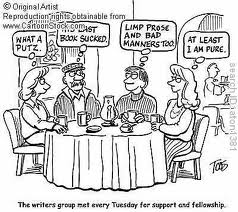
Two articles came to my attention this week on writing and critique groups. Guide to Literary Agents, Chuck Sambuchino, in his article, discusses The Top Ten Worst Types of Critique Partners.  Included among the attendees one might encounter were: The Snob, The Time Hog, The Retro, The Distractor, The Harsh Critic/The NiceyPiecey, The Debater, The Picker, The Sulker, The Boss, and The Sporadic.
images-8
Elmowrites describes in Critique and Critics, the attendees to her first group with slightly different names. The Fan, The Ogre, The Stuck Record, The Feeler, The Mechanic, and The Holy Grail. You get the gist.

Having belonged to a critique group for the last couple of years, the titles intrigued me. The “type casting” of members, however, left me wrinkling my brow. I won’t rehash the definitions here; you can read them for yourself. Whether it was one of the above personalities or group dynamics, the experience left a less than stellar impression on the authors. Still, in the end, both acknowledged the importance of feedback and encouraged writers to keep looking for a writing or critique group. Reading these articles made me wonder, was this the group experience of most people? It hasn’t been my mine.

I belong to a wonderful writer’s group, the South Carolina Writer’s Workshop (SCWW). We’re diverse in our experience, opinions, and genres. I imagine there are things in areas other than writing we might not see eye-to-eye on; I wouldn’t know and I don’t ask. We discuss writing. We focus on genuine critiques, helping each other improve, and get published. We promote each other’s blogs, author pages, websites, and publications.   We’re writers supporting writers.

So, here’s what I say: You can have a good group experience, but you have to participate. You can’t just be an observer. Here are my ten suggestions for a successful group experience.

  1. Find a group, or start one of your own. Growth comes faster with feedback.
  2. The group should have a designated leader who can moderate a meeting.
  3. Make the focus on writing, not people.
  4. Be prepared. Members are less disruptive if they’re prepared and know what to expect before the meeting. We find sending work in prior to the meeting an effective method.
  5. Don’t confuse social activities with the group meeting. The focus gets lost in the gossip.
  6. When difficult members do surface, let the leader or group moderator handle the situation one-on-one. 
  7. Don’t take it personally.  
  8. Be respectful of each other’s, work, time, and the group.
  9. Take time to familiarize yourself with group etiquette. If your group has guidelines, honor them.
  10. Know your own voice. It’s your story.

Ultimately, you are responsible for your writing and any experience you may or may not have. All critique groups are not the same, don’t give up the first time. It takes time to get to know people and the dynamics of a group. Instead, stick around, learn to listen, and speak up. You might just find yourself a group.

 Leave me a comment. Let me know about your group experience.

 Related articles