Feeling Overwhelmed

And, I thought writing the novel was a daunting task. It is more fun, for sure, but editing is tedious mind-numbing work. It can become overwhelming especially to those of us new to the craft of writing novels.

Thank God we have experts to help us along the way. Janice Hardy from Fiction University is one such expert. She is my number one go-to resource.

Janice understands the complexities of self-editing and offers some great advice in her article, How to Edit a Novel Without Feeling Overwhelmed.
The six main points:

  1. Decide whether you want to edit or revise. The processes are not the same.
  2. Don’t bite off more than you can chew, so to speak. Set a word count, a number of scenes to work on and stick to it – a must when you’re working with 70,000 words plus.
  3. Don’t try to cover all the bases, focus on one thing at a time – setting, character, dialogue, and so on.
  4. Set a time limit – Time management is a biggy for me. It’s easy to get lost in the process, or become impatient.
  5. Leave the advice books on the shelf while you’re editing – love this one! It’s so easy to get caught up in the ‘how-tos’ or the ‘should’s,’ and not get a thing accomplished.
  6. Make a plan and let it be your guide – Use a calendar, spreadsheet, or whatever planning tool helps you accomplish your goal.

For more information, check out, How to Edit a Novel Without Feeling Overwhelmed.

I’d love to hear your tips. Talk to me. Tell me your story. I’m all ears and look for me on Facebook at SheilaMGood,  PinterestBloglovinTwitter@sheilamgood, Contently, and Instagram. You can follow my reviews on Amazon and Goodreads.

How to Keep Up With the Details in Your Manuscript

As I’ve said before, writing  “The End” on the first draft is only the beginning of your work on the road to publication. One of the things I discovered, immediately after completing a 77,000 + word draft, is keeping up with the details, even with Scrivener, seems like a monumental task.

When did that character show up? Are the descriptions consistent? Does the timeline make sense? Do I need to name that character? Is the character necessary? And, so on. There are more details to keep track of than one imagine when you begin writing your story. 

So here are a few spreadsheets I’ve come up with to help me. Feel free to copy the format, should you find these helpful.

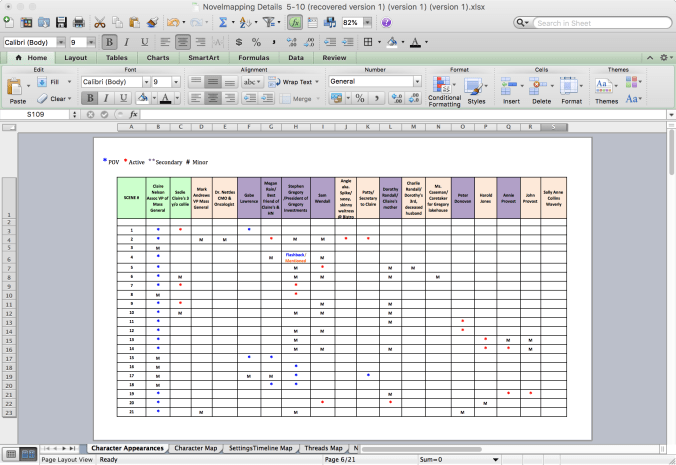
  • Character Appearance Spreadsheet –  Scene by scene. At a glance I can see where every character, including minor ones, appear in the novel. An * designates an active character and an ‘M‘ a walk-on or character mentioned in a conversation. This allows me to see the flow of the story, spot minor characters that I may not need to name, need at all, or POV inconsistencies.

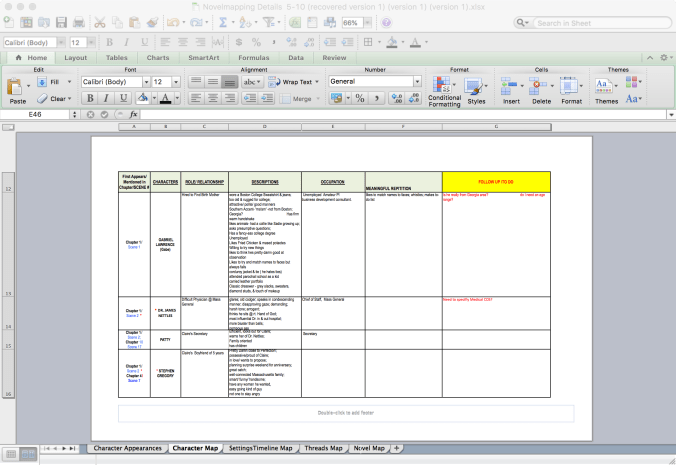
  • Character Map – includes every character (named or unnamed) and where they first appear in the novel;  their role, descriptions (from anywhere in the manuscript), occupation, relationships, meaningful repetitions, and notes. Again, this had provern helpful in spotting holes, inconsistencies, or help with character attributes and descriptions.

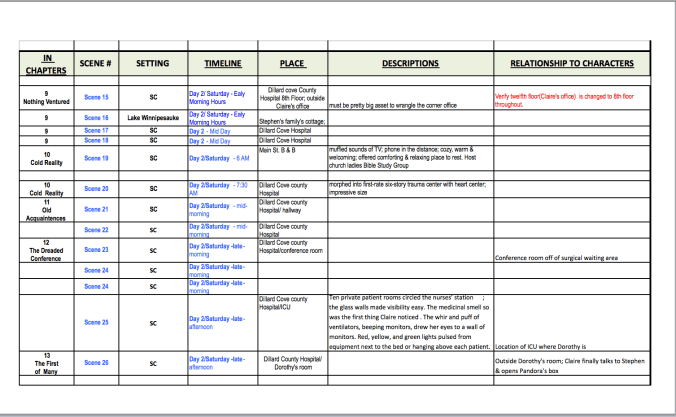
  • A setting and Timeline Spreadsheet – a list of the settings and timeline the story is taking place. It also includes descriptions of the setting (used anywhere in the manuscript), and the relationship the setting has to the character.  At a glance, I can tell whether I’m being redundant, inconsistent, or lack descriptions in my settings. It is also, a great way to see the holes in the timeline.


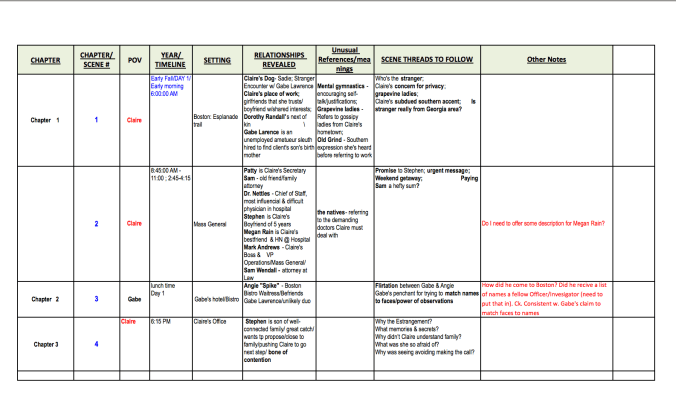
  • The Threads Map – Scene by scene, I  list the relationships revealed, useful repetitions, unusual phrases/words/references with meanings, threads I need to carry throughout the story, and any  notes on holes or things I need to follow up on during edits and rewrites. Helps me spot holes or unanswered questions, immediately.

Hope you will find these helpful and should you have suggestions for how you keep up with the details, please share it with us.


I’d love to hear your comments. Talk to me. Tell me your story. I’m all ears and look for me on Facebook at SheilaMGood,  PinterestBloglovinTwitter@sheilamgood, Contently, and Instagram. You can follow my reviews on Amazon and Goodreads.
Stories to Share

There is no shortage of talented writers out there, but if you’re like me, finding time to read all of the great stories that come across our screens can prove to be difficult. However,  I encourage you to make the time. Not only will you enjoy some great stories but also learn a bit about the craft of writing short fiction.

Reasons to Read Other’s Stories

Here are a few of things I’ve learned from reading the work of other writers.

1. With each story, I learn something new about the craft.

  • Story structure.
  • The use of a theme.
  • Character development.
  • The use of imagery
  • And, the lyrical language of prose.

2.  I also learn about the magazine, contest, or journal. The types of stories they like and publish most often. The more you read from a magazine, the better feel you have of what your story might need to achieve acceptance and publication. Of course, it goes without saying, read the guidelines before making any submission. 

3. I love to pass these stories on. As a writer, I know the work that goes into perfecting a story. It’s a labor of love and one we all like recognized.

It’s my honor to share these stories with you, and I hope you will pass them on. So, without further ado, happy reading:

Cadenza by Naira Kuzmich – carvezine.com/story/2018-winter-kuzmich

This Too Shall Pass by Shannon Stocker – WOW Essay Contest 1st Place Winner

Two Slices of Toast  by Dan Belmont – The Weekly Knob

As always, give the author a shoutout and let them know how much you enjoyed their work.

I’d love to hear your comments. Talk to me. Tell me your story. I’m all ears and look for me on Facebook at SheilaMGood,  PinterestBloglovinTwitter@sheilamgood, Contently, and Instagram. You can follow my reviews on Amazon and Goodreads.
 

What’s Your IP Address?

ipa
One thing is for sure, when you’re in the midst of a long-term recovery, you will get bored out of your mind. Top these circumstances with 2-3 days of snow and ice – someone is going to break the rules. Did I mention – me? To say I’ve been stretching the doctor’s instructions bit is an understatement.facebookhomescreenimage
Pardon my digression; the squirrels are playing havoc with my brain.

Back to the point of this post. Do you know your IP address IP (Internet protocol)? It is a unique number for your computer and links to all of your online activity.

It’s how a Macy’s ad, with the very thing you’re shopping for, just happens to show up on Facebook or other sites you might visit. It’s how Google and other search engines track what you like – through algorithms and your IP address. And, it’s how hackers find us – not that we’ve heard much about hacking lately?

More to the point, it’s why a suspect’s computer is confiscated and turned over for a forensics examination, following a crime.  “Your honor, may I present Exhibit C into evidence. This will show that the defendant completed a search on, how to choke someone, undetectable, poisons, how to break a person’s neck, and how to get away with murder, no less than 200 times.”

You get the idea, but why do you care? Well, knowing one’s IPA is also helpful when determining if your computer or the information within has been compromised. For example, in 2005 my identity was stolen online. The culprits were tracked through an IPA to Amsterdam – a mega site for stolen identities. And just today, I attempted to sign in to Facebook. A message appeared:

“Your account has been locked due to a suspicious login attempt.”  They provided the time, IPA, and location (Charlotte) of the incident. “Was this you? “They asked.

I wasn’t certain, but it prompted me to investigate. I got things straightened out, not that being locked out of Facebook was of concern – it wasn’t, but that’s a subject for another day.

If you want to find out more on the topic, as well as your own IP Address, check out these resources:

  1. IP 101: The Basics of IP Addresses
  2. What is my IP Address.com
  3. How a Hacker Might Exploit Your IP Address
  4. Computer Evidence Recovery
  5. Internet Defamation


I’d love to hear your thoughts on the subject. Join the conversation. Talk to me or tell me your story. I’m all ears.