 I ‘ve been asked, by a friend, to speak to her literary group about my newly released short story collection, Maybe Next Time.
I’ll admit I felt a bit of trepidation upon receiving the invite. I was excited about sharing my work, but a little nervous, but then decided, why not?
I will be speaking about my book, the inspiration for the stories, the Cow Pasture Chronicles and share one of the stories from my collection. It’s a small group and a good opportunity to get my feet wet in the realm of book signings. However, I knew little about being on this side of the table. So, I ask the experts.
How to Prepare for a Book Signing:
- Find out from the person/locale what they’re looking for from you. Do they want you to speak? Read an excerpt? Or, is it simply a platform they’re offering to promote your book?
- If speaking/reading, it’s important you understand how much time is available to you and prepare accordingly.
- Get a ballpark number of attendees, well in advance, to have enough books available.
- Have business cards available with your contact, social media pages, website information, and if desired info on your book.
- Although many people use electronic e-readers, not all do. Having bookmarks or other promotional items is a great and inexpensive way to get the word out, and as a thank you gift to offer guests.
- Use a good pen for signing and have more than one with you. The experts recommend a gel pen – they don’t bleed and don’t dry out if uncovered for a time.
- If the event is open to the public, promote the event – on social media, website, and tell your friends.
- Dress comfortably. You may be nervous, and the last thing you need is to feel like your clothes are choking you to death, or worse, you’re wearing a sauna.
- Take a bottle of water. Even if refreshments are being provided, you are the one speaking and reading – which becomes difficult when your lips are stuck to your teeth.
- Order your books and promotional items well in advance. Showing up empty handed is not cool nor appreciated.
Signing:
I was surprised how flummoxed I became recently when my sister asked me to her copy of the book. It was my sister for God sake, and I drew a blank. I didn’t know what to write! I’ll admit, I felt foolish, but it prompted me into action.
- You don’t have to be clever when signing a book (unless you want to).
- Most authors sign with a generic phrase or their name. Here are some typical phrases: All my best, Thanks, In gratitude, Much appreciation, Warm wishes, Your friend.
- Dating your signature is entirely up to you. The experts say dating adds value for those books likely to become collectibles in the future.
- Signing your full name is recommended, but some authors (not most) will sign just their first name.
- Some attendees will request a particular phrase with your signature. Have a notepad or post-its on the table and ask them to write exactly what they want you to say. This prevents errors.
- In addition, for those who want a personalized signature, a notepad is an excellent aid to ensure you get the spelling of their name correct. Do you realize how many ways you can spell Hailey?Hailee, Haleigh, Haley, Haylee, Hayleigh, Hayley, Haylie.
- Make sure your name is legible.
- Practice signing before you go. Decide how you want to sign and what you want to say (if anything) – practice makes perfect.
- Relax and have fun. Mingle if time allows and talk to the guests.
- Don’t forget to say “Thank you” to your host and the guest attending.
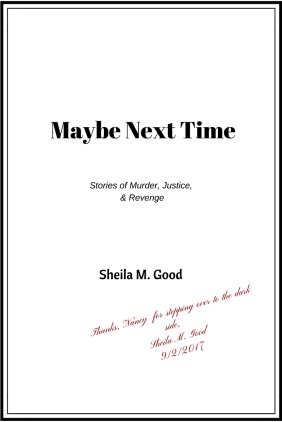 Granted, my book is not War and Peace, it’s a small collection of short stories, but it still represents my work.
I’m honored to have been asked, and I take the invitation seriously, as should you. No matter how large or small the opportunity, be prepared and make it count.
The Pen:
- The best pen should be fade proof, UV-resistant, water-resistant, and acid-free (archival or acid-free).
- Be fast-drying/smudge-proof.
- Show up well on colored or dark paper.
- Work on smooth or glossy paper.

So, what do you think? Have other suggestions or recommendations? Share it with us. I’d love to hear your thoughts on the subject. Join the conversation. Talk to me or tell me your story. I’m all ears.


 Thumb up and down buttons
  When I signed onto the Amazon author’s site, I saw this review for my second book,

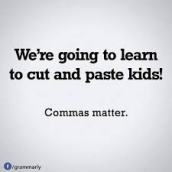




 Have you ever submitted a story or article only to discover later, mistakes you missed?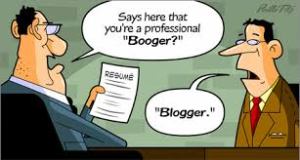

 COW PASTURE CHRONICLES