50 Shades of Red

Well, well, well. Seems the hottest topic in the universe these days is the movie/book, 50 Shades of Grey. Released in March of 2012, the book by EL James  amassed sales of 10 million copies within the first six weeks and surpassed the 100 million mark last week. The movie, released President’s Day weekend set box office records with $87.1 million dollars in a single weekend. And the world is seeing red.

The movie’s  success brought with it, torrid moralistic judgments and rantings from  every corner. Accusations of setting feminism back decades, glorifying the abuse of women, to rehashing the books inadequacy as a literary accomplishment, “The worst book ever written,” can be found on everywhere.

I admit, I haven’t read the book nor seen the movie. But, my curiosity is piqued. First, I’m curious why 68% of the audience belong to women. If it degrades and abuses women, or puts feminism back decades (a nice thought), what are women doing lining the theater seats? I have my theories, but that’s another post.

I surmise this movie, while making headlines now, will fade into the background and be forgotten, unlike feminism.  Society is still reeling and feeling that impact (another post for another time).

Secondly, I’m curious because this author, unknown before March 2012, has become a zillionaire in a matter of two and half years! What writer or aspiring writer doesn’t sit up and take notice of that little fact? I want to know, what made this book, it’s story so successful? And, no matter where you stand on the content, a success it is.

Larry Brooks at Storyfix.com had an excellent blog post on this subject and I believe it is well worth reading. He says it’s about story physics and I have to agree. In all the ruckus, we writer’s are forgetting what makes a good story.

Mr. Brooks explains what we’re missing in all of the hoopla, far better than I can here. Check it out: What you May be Missing about “50 Shades of Grey,” and let me know what you think.

Ten Things to Make Your Critique Group a Success

I apologize for being absent lately. Sometimes we have to make choices and prioritize to address more pressing matters.  Thank you for being patient.
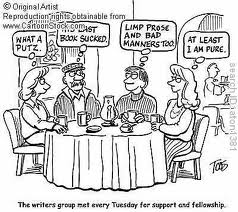
Two articles came to my attention this week on writing and critique groups. Guide to Literary Agents, Chuck Sambuchino, in his article, discusses The Top Ten Worst Types of Critique Partners.  Included among the attendees one might encounter were: The Snob, The Time Hog, The Retro, The Distractor, The Harsh Critic/The NiceyPiecey, The Debater, The Picker, The Sulker, The Boss, and The Sporadic.
images-8
Elmowrites describes in Critique and Critics, the attendees to her first group with slightly different names. The Fan, The Ogre, The Stuck Record, The Feeler, The Mechanic, and The Holy Grail. You get the gist.

Having belonged to a critique group for the last couple of years, the titles intrigued me. The “type casting” of members, however, left me wrinkling my brow. I won’t rehash the definitions here; you can read them for yourself. Whether it was one of the above personalities or group dynamics, the experience left a less than stellar impression on the authors. Still, in the end, both acknowledged the importance of feedback and encouraged writers to keep looking for a writing or critique group. Reading these articles made me wonder, was this the group experience of most people? It hasn’t been my mine.

I belong to a wonderful writer’s group, the South Carolina Writer’s Workshop (SCWW). We’re diverse in our experience, opinions, and genres. I imagine there are things in areas other than writing we might not see eye-to-eye on; I wouldn’t know and I don’t ask. We discuss writing. We focus on genuine critiques, helping each other improve, and get published. We promote each other’s blogs, author pages, websites, and publications.   We’re writers supporting writers.

So, here’s what I say: You can have a good group experience, but you have to participate. You can’t just be an observer. Here are my ten suggestions for a successful group experience.

  1. Find a group, or start one of your own. Growth comes faster with feedback.
  2. The group should have a designated leader who can moderate a meeting.
  3. Make the focus on writing, not people.
  4. Be prepared. Members are less disruptive if they’re prepared and know what to expect before the meeting. We find sending work in prior to the meeting an effective method.
  5. Don’t confuse social activities with the group meeting. The focus gets lost in the gossip.
  6. When difficult members do surface, let the leader or group moderator handle the situation one-on-one. 
  7. Don’t take it personally.  
  8. Be respectful of each other’s, work, time, and the group.
  9. Take time to familiarize yourself with group etiquette. If your group has guidelines, honor them.
  10. Know your own voice. It’s your story.

Ultimately, you are responsible for your writing and any experience you may or may not have. All critique groups are not the same, don’t give up the first time. It takes time to get to know people and the dynamics of a group. Instead, stick around, learn to listen, and speak up. You might just find yourself a group.

 Leave me a comment. Let me know about your group experience.

 Related articles

How To Critique A Novel Chapter by Chapter


CHAPTER  by CHAPTER 

Our writer‘s group raised the question recently, “How do other groups critique novels, chapter by chapter?” With several authors bringing novels in for critique, we wanted to know if we had the best  process in place.

So, I took the challenge and decided to do a little research of other critique groups. I found the process other groups used were as individual as the groups themselves, but the content and the components  required to  make a well written chapter, varied not at all.

My writing group has been invaluable. However, after my research I  realized  we’d  glossed over or failed to mention  a number of elements in our critiques.  Seems we’d gotten into a rut, mentioning the same glaring things from one critique to the other. It was time we started digging a little deeper into our critiques and being specific.

Let me explain.

How many times have you walked into a book store and picked up a book, opened it to the first page and began reading? If you bought the book after reading the first few paragraphs or page, you were hooked. If not, you put the book back on the shelf and picked up another one.

To keep the book from going back on the shelf is exactly what an opening line, sentence or paragraph is supposed to do. Did the opening line hook you? Did it make you want to turn the page or buy the book? Of all the chapters, chapter one is the most important chapter of a novel. I was reminded to pay more attention to the details and dig deeper when critiquing the first chapter, not only the opening line, but the introduction of the main characterthe setting, voice, and the POV. 

The main character deserves a closer evaluation than whether  we like  them or not. Are they believable? Readers want  to understand the conflicts, problems, and obstacles placed in the character’s way. They want to connect with, cheer on, fear for, and worry about the character. So, evaluate the character from a readers perspective.

The inciting event is “something” that happens which propels the character into action and the story forward. This is the one thing that turns the character’s world upside down and on which all other action or reactions are based. Is the inciting event clear? Did it work, and is there a clear transition into the next scene or chapter? In subsequent chapters or scenes, you should see the domino effect from the inciting event, leading to more complications. Does the event make sense based on what you know about the character so far? It reminds me of Newton’s Law: For every action there is a reaction. So, talk about this in your critiques.

Which leads me to stakes, conflict and tension; every scene should have one of these elements. In order to keep the story moving and the reader interested, the author must raise  stakes for the character  or increase the tensionWithout them, the reader will be bored to death. All of which is worth mentioning in a critique.

You don’t want the reader to lose hope for your character or have the sensation  they’re racing through the story; is it a fast or slow read? That’s why pacing is an essential aspect to good critique. A well written story will have some periods of narrative for down time.  Look for the action and active verbs and evaluate whether the backstory is done naturally and only as necessary. I had glossed over this aspect of the critique before, but understand now, how crucial pacing is to the novel as a whole.

Dialogue is rarely overlooked in a critique but, the tendency is to look at dialogue tags or the use of passive voice, but there is much more than tags to evaluate. Is the dialogue difficult to read, incongruent with the characters, too stiff or confusing? Does the dialogue move the scene forward? (When the dialogue doesn’t move the story forward, consider its merits and don’t be afraid to recommend the author cut unnecessary dialogue).

Voice is one of those hard to define things for many people and is often overlooked in critiques. However, voice is very important. Voice is the way the story is written. It creates the mood and tone of the story. The question to ask is, does the voice reflect the right mood and tone for the story? Is the voice cohesive and does it work? This is something rarely mentioned in critiques, but voice does matter. I recently had a short story rejected, and in the letter, the reason was, “…the tone of the story wasn’t what we were looking for….”

The end of the Chapter (break) cannot be ignored in the critique. Transitioning from one chapter to the next is critical in determining whether the reader will continue and turn the next page. One of the things to evaluate in a critique is whether the chapter break was placed strategically. Was the tension high? Did the reader receive new information? Did something happen leaving the reader in suspense? Did you want to keep reading?

A thorough critique can be a time consuming process. To  help improve our methodology I recreated a checklist for our group to utilize as a reference tool. We use it as a reminder to be specific when critiquing fellow writers. You or your group may use a different process, but feel free to utilize the checklist on the link below.

Please leave a comment and let me know what you think about the checklist. I’d love to hear from you.


Critique a Novel