Zemanta- The easy Way to Share Related Content

Day 2 6: #AtoZchallenge

Yeah, we made it. Today is the last post of the #AtoZchallenge. It has been a wonderful experience. For the letter – Z– I want to share Zemanta with you.

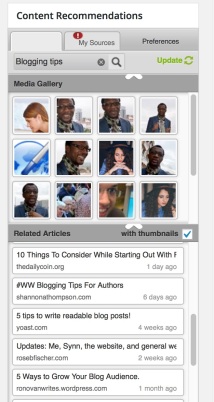
Zemanta is a browser extension that once installed provides recommended links and photos as related content (posts). It will load automatically as you write, allowing you to click on the specific content you wish to share. Proper credit for the articles and photos are provided by default. Below is an example of a post on Blogging Tips and the related content pulled up by Zemanta.

Zemanta 2

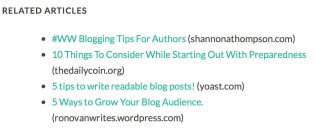
The content will show at the bottom of your post in either title  format:

Related


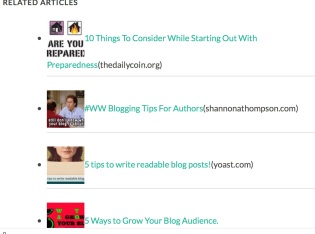
or thumbnail format based on your preferences in the settings.

Related2


This extension saves time and gives increases your authority, promotes, links to other writer’s content and increases networking.

To download the extension, click on this link.

I hope you will try it out and let me know what you think. Again, it has been my pleasure to participate in the #AtoZChallenge and to have met each one of you. I look forward to a long and engaging relationship in the Cow Pasture.

I’d love to hear your comments. Talk to me. Tell me your story and look for me on Facebook at SheilaMGood,  PinterestBloglovinTwitter@sheilamgood, and Contently.
A2Z-BADGE 2016-smaller_zpslstazvib


Word Counts

Day 23: #AtoZChallenge  

WORD COUNTSOne of the most frequent questions asked by writers is : “What is an acceptable word count for  _________” (fill in the blank). Most magazines, contests, or websites will define the type of fiction they’re looking for and the required word count or word limit. In my research, I found a number of sites with slightly different word counts, but all were generally within these limits.

Basic fiction classification and the associated word counts:

  1. Flash Fiction – under 500 but some accept up to 1000.
  2. Historical Fiction – 90,000-100,000.
  3. Literary –  80,000-120,000.
  4. Memoir – 80,000 – 90,000.
  5. Middle Grade Fiction – 25,000 -40,000.
  6. Mystery, Thrillers & Crime – 70,000 -90,000.
  7. Novella – 10,000 – 40,000.
  8. Novelette – 7,550 – 17,500.
  9. Picture Books – standard 32 pages (500-600 words).
  10. Romance Fiction– 50,000 – 100,000.
  11. Science fiction & Fantasy – 90,000 -120,000.
  12. Short Story – typically between 1,000 – 8,000.
  13. Women’s Fiction as low as 70,000. Standard is around 80,000.
  14. Young Adult Fiction – 50,000 -70,000.

Remember, it’s recommended not to rely on your software program for an accurate word count, especially when words are limited as in a contest.

Shortcut for determining word count: Change document to Courier with one-inch margins, count the number of pages, multiply by 250. This is the adjusted number of words in your manuscript.

Want more info on word Counts? Check out these resources:

I’d love to hear your comments. Talk to me. Tell me your story and look for me on Facebook at SheilaMGood,  PinterestBloglovinTwitter@sheilamgood, and Contently.

A2Z-BADGE 2016-smaller_zpslstazvib

Unusual Character Traits

Day 21:  #AtoZChallenge

The characters in our stories and novels are often very complex. We spend a lot of time getting to know them, asking questions, describing them and giving them a personality.

We want our readers to visualize our characters and recognize them every time they speak. But, what can we do, besides names, ages, or gender to make our characters memorable?

Give them unusual character traits or as John Yeoman from the Village Academy calls it, a signature. We all have our idiosyncrasies, so give your characters  a few; make them mimic real people. To get you started, here are a few suggestions.

30  Unusual character traits worth considering:

  1. Meaningful repetitions – for instance in my novel, one of the characters uses the term, “Dear” when speaking to others.
  2. Twirls hair when preoccupied or worried.
  3. Bites nails when nervious.
  4. Taps fingernails or pencils against a hard surface when nervous.
  5. Chain smokes.
  6. Always carries water, tea, or other beverage with them.
  7. A hugger or touchy-feely person or the reverse – can’t stand to be touched.
  8. Always chews gum – but only one flavor.
  9. Has a movie quote for every situation.
  10. A speech impediment – stutter, or lisp.
  11. A distinctive accent.
  12. Clumsy – in movements or socially.
  13. Intolerant and impatient.
  14. A peculiar dresser – loud colors or mismatched clothing.
  15. A jokester.
  16. Refuses to use slang – always correcting others.
  17. Superstitious – carries a rabbit’s foot or another talisman for luck.
  18. Whistles non-stop.
  19. Compulsively washes hands or straightens items on his desk.
  20. Colorblind.
  21. Carries a cigar and chews on it but never lights it.
  22. Draws squiggles in the border of every piece of paper or notepad in front of them.
  23. Photographic memory.
  24.  A facial tic.
  25. A crooked smile.
  26. Eyes that are a different color.
  27. Meticulous or expensive dresser.
  28. Calls every younger man “son.”
  29. Hates dirt.
  30. Only eats the “green” jelly beans or M & M’s.

Those listed above are a few among many unusual traits. People are a bit weir, sometimes. It’s our backgrounds, genetics, and life experiences that make us different. It’s also what gives us our uniqueness.Wheather your characters are lovable or detestable, make them real, unique and memorable.

Want to know More? Check out these recources:

Writers Helping Writers – Home to the The Emotion Thesaurus: A Writer’s Guide to Character Expression. 

What about your characters? Are they memorable? Do they have an unususal trait?

I’d love to hear your comments. Talk to me. Tell me your story and look for me on Facebook at SheilaMGood,  PinterestBloglovinTwitter@sheilamgood, and Contently.

A2Z-BADGE 2016-smaller_zpslstazvib

Tweet this

tweetthisDay 20: #AtoZChallenge

I’m sure you’re familiar with the, “Tweet This,”embedded quotes used on other blog sites. It’s a great way to get readers engaged in the content of your blog and to share it with others.

If you self host, you can use the Tweet This plugin, but these plugins only apply to self-hosted blogs and web sites that use the WordPress.org software.

For those of us on WordPress.com, there is a way around the plugins.

You can use HTML if you’re comfortable dealing with code (more about that here). Or, you could simply go to the website Click to Tweet.

Enter the quote you want shared into the box, click on “generate new link,” and the URL used for the anchor link to your quote will appear.

We’re heading into the last few posts for the #AtoZChallenge. It’s been an exciting and challenging month (no pun intended). When I signed up to do this challenge, I wasn’t certain I could post every day, but I’m a pretty determined woman. So for those of you who who been on this journey with me and see the light at the end of the tunnel, here’s a quote to keep your feet to the fire.

“The difference between the impossible and the possible lies in a person’s determination.” -Tommy Lasorda. Via @sheilamgood. Tweet This

What do you think? Like the idea of Click to Tweet?

I’d love to hear your comments. Talk to me. Tell me your story and look for me on Facebook at SheilaMGood,  PinterestBloglovinTwitter@sheilamgood, and Contently.
A2Z-BADGE 2016-smaller_zpslstazvib